Go-to-Market Strategy: A 5-Step Plan for Small Companies and New Products (with a One-Page Template)

Most new products don't fail because they are bad. They fail because the wrong people hear about them, or the right people don't understand why they should care. The founder spent six months building and six days on how to sell it.
This guide shows you how to build a go to market strategy for a small company or a new product, without a 40-page deck. You get a clear definition, the five decisions every launch has to make (target customer, positioning, pricing, channel, launch plan), a one-page template you can fill in this week, how Slack planned its own launch in a memo its founder later published, and the Claude prompts we use to run it.
The short version:
- A go-to-market strategy is five decisions: who you sell to first, how you describe the product, what you charge, where you reach buyers, and how you launch.
- Start with one narrow target customer. A launch aimed at everyone reaches no one.
- Position the result, not the features. People buy the change the product makes, not the list of things it does.
- Pick one main channel and get it working before you add a second one.
- Launch small and in batches, watch what real users do, fix, then open the doors wider.
What is a go-to-market strategy?
A go-to-market strategy is the plan for how a product reaches its first paying customers: who it is for, how it is described, what it costs, which channel carries it to buyers, and in what order you launch. It explains how one specific product gets from "built" to "bought".
For a small company it isn't a big document. It is a set of written decisions the whole team can repeat. If two people would describe the target customer differently, you don't have a go-to-market strategy yet.
The core: the five GTM decisions
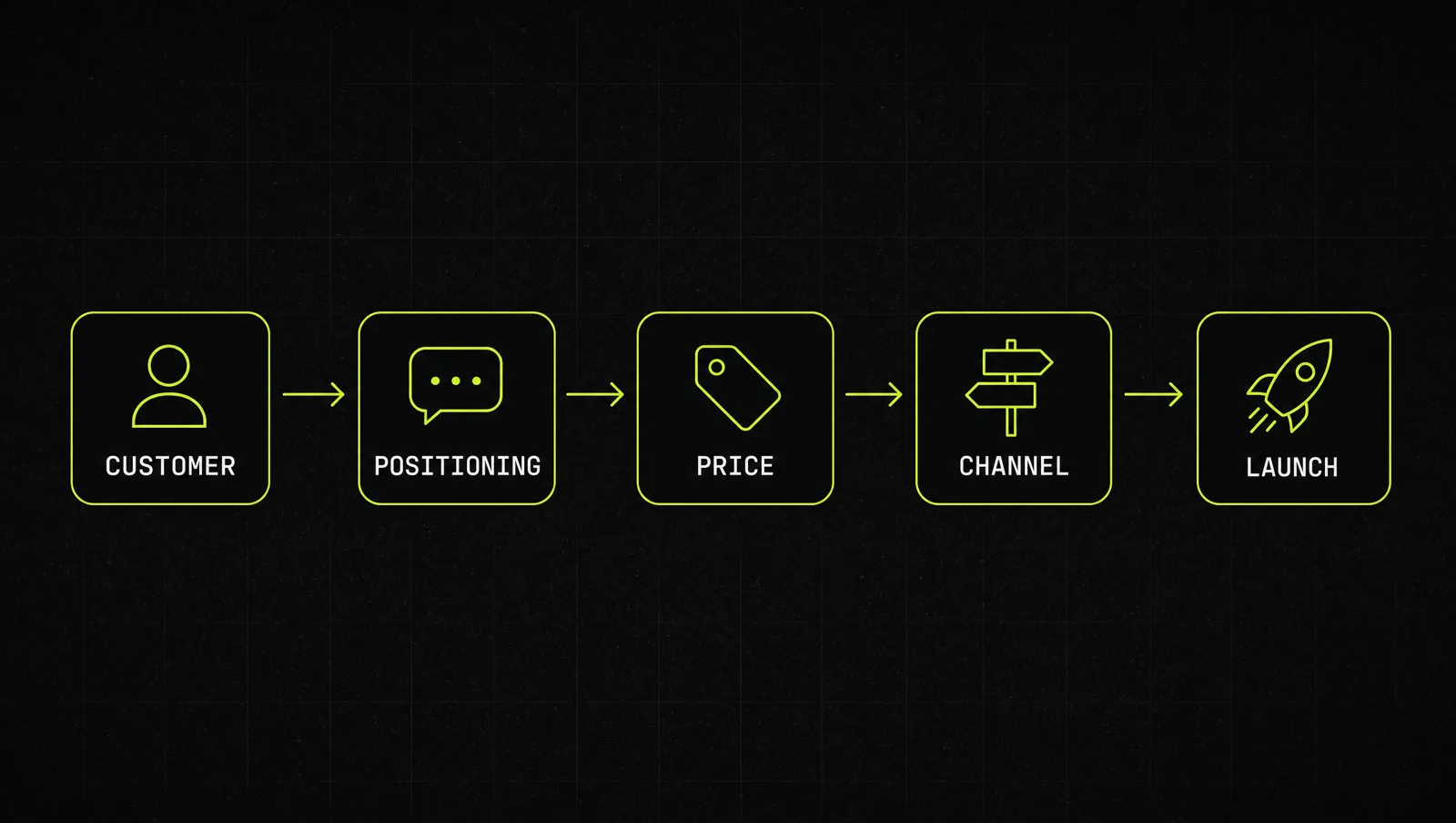
Every launch makes these five decisions, on purpose or by accident. The test question tells you whether you decided well.
| Decision | What it answers | Test question |
|---|---|---|
| Target customer | Who buys first, and what situation are they in | Can you name 20 real people or companies that fit? |
| Positioning | What you are, and why it beats the alternative | Can a stranger repeat it after hearing it once? |
| Pricing | What you charge and how (one-off, monthly, tiers) | Does the price match the value of the result, not your costs? |
| Channel | Where and how buyers find you | Can you reach your 20 names through it this month? |
| Launch plan | The order, the dates and what you measure | Do you know which number means "open the doors wider"? |
The order matters: positioning depends on the customer, price on the positioning, and the channel on where that customer already spends time. Pick the channel first and you bend the product to the channel instead of the buyer.
How to build your go-to-market strategy in 5 steps
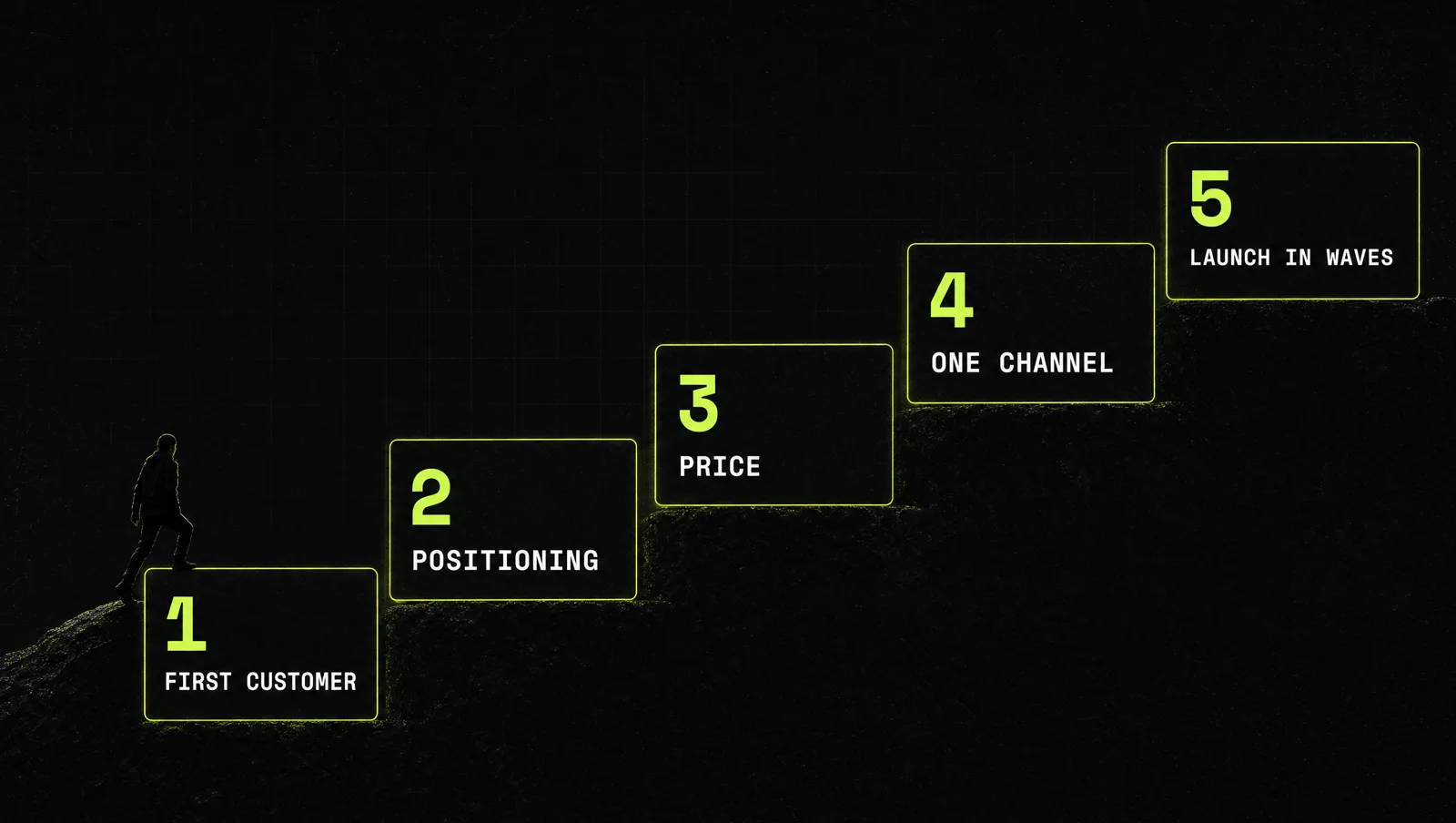
Step 1: Pick your first customer
Don't define a market. Define a person in a situation. "Small businesses" is not a target customer. "Owners of 3 to 10 person agencies who lose client requests in email threads" is. The narrower the first customer, the easier every other decision gets.
Look at the job they are trying to get done, not their demographics: what do they "hire" today, and what frustrates them about it? The Jobs to Be Done framework is built for this question. Then write down 20 real names that fit.
Step 2: Write the positioning
Positioning answers two things: what category the buyer puts you in, and why you beat what they use today. Buyers don't shop for features, they shop for a result.
Write it in one sentence with this shape: "For [first customer] who [problem], [product] is a [category] that [result]. Unlike [current alternative], it [key difference]." Test it on five people from your list. If they can't repeat it back, rewrite it.
Step 3: Set the price
Price is part of the positioning: a low price says "small tool", a higher one says "serious result". Anchor the price to the value of the outcome for the customer, then choose the model: one-off, monthly, per seat or tiers.
For a new product, keep it simple: one main plan, maybe a free way to start, and a clear reason to upgrade. The details of picking the number are in our guide to pricing strategy.
Step 4: Choose one channel
A channel is how the buyer finds you: outreach, content, ads, partners, referrals or an existing audience. Small companies often try four channels at once, each with a quarter of the effort.
Pick the one channel where your 20 names already are and where you can reach them this month. For most new B2B products that is direct outreach: cheap, fast and full of real feedback. For more options and how to run each one, see how to get more leads.
Step 5: Launch in batches
A launch is not a single day. It is a sequence: a handful of friendly users, then a small wave, then the public. Each wave shows you what breaks before more people see it.
Before you start, set the date of each wave and the one number that says a wave worked, for example "half of new users still active after two weeks". If the number is not there, fix the product or the message before you invite more people.
The one-page GTM template
Fill this in. If a line needs more than two sentences, the decision isn't made yet.
Make it yours · 0/22 filled
ONE-PAGE GO-TO-MARKET PLAN: [PRODUCT NAME]

1. First customer: [ROLE / COMPANY TYPE] in [SITUATION]
   The job they are trying to get done: [JOB]
   What they use today: [CURRENT ALTERNATIVE]
   20 real names: [LINK TO LIST]

2. Positioning: For [FIRST CUSTOMER] who [PROBLEM], [PRODUCT]
   is a [CATEGORY] that [RESULT]. Unlike [ALTERNATIVE], it [DIFFERENCE].

3. Price: [PRICE] per [UNIT], model: [ONE-OFF / MONTHLY / TIERS]
   Why this price: [VALUE OF THE RESULT TO THE CUSTOMER]

4. Main channel: [CHANNEL]
   Weekly activity: [E.G. 50 MESSAGES, 2 POSTS]

5. Launch plan:
   Wave 1 (friendly users): [DATE], [NUMBER] users
   Wave 2 (small public wave): [DATE], [NUMBER] users
   Public launch: [DATE]
   Success number to move on: [METRIC AND TARGET]
A real case: how Slack planned its go-to-market

Slack is a rare launch where the founder published the internal thinking behind it. On July 31, 2013, Stewart Butterfield sent his team at Tiny Speck, the company behind Slack, a memo two weeks before the preview release. He later published it on Medium as "We Don't Sell Saddles Here".
What the memo says, in short:
- Butterfield wrote that almost no teams knew they wanted Slack, because they had never heard of it. The job was to understand what people think they want and translate Slack's value into their terms (memo).
- He argued that there were not enough people shopping for a group chat tool, so the positioning had to be the result. In his words: "what we're selling is organizational transformation." He listed results like less information overload and searchable team archives.
- His analogy: a saddle company can compete on leather and price, or it can sell horseback riding, grow the whole market and become its leader. Slack chose to define a new market instead of fighting inside an existing one.
- He was explicit about the stage: Slack was still before product-market fit, so the work was testing and iterating, from both the product end and the market end.
The execution matched the plan. In an interview with First Round Review, Butterfield described how the team first convinced roughly six to ten friendly companies to try Slack and give feedback. The preview release then opened on August 14, 2013, and according to the memo's closing note, Slack officially launched on February 12, 2014 (memo). First Round reports that 8,000 people requested an invite on the first day of the preview and 15,000 within two weeks. Slack invited teams in batches, watched what happened, changed things and repeated (First Round Review).
Look at it through the system:
- Target customer: teams that ran their communication through email, starting with friendly companies the founders could talk to directly.
- Positioning: not "group chat" but a result: less overload, knowledge that is searchable.
- Channel: a press push around the preview, built on the founding team's existing relationships, plus direct asks to friendly companies.
- Launch plan: friendly users, then a preview in batches, then a public launch about six months later.
The lesson: Slack didn't launch a product on one big day. It decided who it was for, sold the result instead of the category, and opened the doors in waves, fixing things between each one.
Three use cases
The examples below are illustrative, not real clients. They show how the one-page plan looks for very different launches.
Use case 1: Agency launching a new service
Before: "We now also offer AI automation!" posted on LinkedIn. Three likes, no calls.
After: the first customers are existing real estate clients who already trust the agency. The positioning is a result ("every new lead gets a reply within 5 minutes"), priced as a setup fee plus a monthly add-on. The channel is personal messages to 20 clients, and the launch is 3 pilot clients first, then a case study, then new clients.
Use case 2: Coach launching a first digital product
Before: a $49 course recorded over three months, launched to an audience that mostly follows for free tips.
After: the first customers are the people who already asked the same question in DMs. The positioning is one specific result in a set time, priced higher with a live component. The launch is a paid pilot cohort of 10, built live, then recorded and opened to everyone.
Use case 3: SaaS founder launching version one
Before: one big launch day, a spike of sign-ups, then silence and no paying users.
After: the first customer is one role in one industry, such as bookkeepers at small accounting firms. The positioning uses their own words from interviews, with one plan and a free trial. The channel is direct outreach to 200 matching firms, and the launch is 10 firms onboarded by hand, then weekly batches.
How we run this with Claude
Inside CopyPasteCEO we run the plan as a sequence of Claude prompts, in one chat so Claude keeps the context. Here are the first two. Fill in the brackets.
Prompt 1: find and sharpen the first customer
Make it yours · 0/4 filled
You are a go-to-market advisor for small companies. My product: [WHAT IT DOES], price idea: [PRICE]. The people I think it is for: [YOUR CURRENT DESCRIPTION]. What they use today instead: [ALTERNATIVES]. Propose 3 narrower first-customer segments, each described as a role in a specific situation. For each, tell me the job they are trying to get done, why they would switch now, and where I can find 20 of them this week. Then recommend ONE segment and explain why.Prompt 2: build the one-page GTM plan
Make it yours · 0/3 filled
My first customer is: [SEGMENT]. Their current alternative is: [ALTERNATIVE]. Here are real quotes from customer conversations: [QUOTES]. Fill in a one-page go-to-market plan with five parts: target customer, a one-sentence positioning statement in the format "For [customer] who [problem], [product] is a [category] that [result]. Unlike [alternative], it [difference]", a price and pricing model with reasoning, one main channel with a weekly activity target, and a launch plan in three waves with dates and one success metric per wave. Flag every assumption I should test first.These two prompts give you a first draft of the whole plan. Choosing one segment, holding the price and waiting for the numbers before opening the doors are where most people get stuck, because judgment matters more there than templates.
Where most people get stuck
Writing the plan takes an afternoon. Sticking to it through the quiet first weeks is the hard part:
- They target everyone. The positioning gets vague, the channel gets expensive, and nobody feels the product was made for them.
- They launch once, loudly. One big day burns the best leads before the product and the message have been tested on a small wave.
- They switch channels too early. Two slow weeks of outreach and they jump to ads, so no channel ever gets good.
That is exactly the gap the Inner Circle is built for: the playbooks to plan and run your launch, a new playbook every week, and founders who are taking their own products to market next to you.