Positioning Statement: Template, Examples and 5 Steps to Write One That Sharpens Your Marketing

Most founders don't have a marketing problem. They have a positioning problem. The website says "all-in-one platform", the ads say "save time", the sales call says "we're different", and buyers still can't tell what the product is, who it is for or why it beats what they already do. So every channel underperforms and nobody knows why.
This guide shows you how to write a positioning statement that fixes the root cause instead of the copy. You get the classic fill-in-the-blank template from Geoffrey Moore, examples, the five-step method we use (built on April Dunford's approach), a real repositioning case with documented results, and the two Claude prompts we run it with.
The short version:
- A positioning statement is an internal sentence that says who your product is for, what it replaces, what makes it different and why that matters.
- The classic template comes from Geoffrey Moore's Crossing the Chasm, where it works as an "elevator test" for your strategy.
- A template is only as good as the thinking behind it. Filling in blanks without research produces a pretty sentence and no strategy.
- Start with the competitive alternatives, not with your features: differentiation only exists compared to what buyers would do without you.
- Good positioning is written for your best-fit customers, the people who care most about what only you do.
What is a positioning statement?
A positioning statement is a short internal description of where your product fits in the buyer's mind: the target customer, the need, the category you compete in, the key benefit, and the alternative you beat. It is not a tagline and it is not meant for your homepage. It is the brief your homepage, ads, sales deck and pricing are written from.
Why it matters: buyers make sense of a new product by comparing it to something they already know. If you don't choose that comparison, they choose it for you. A positioning statement makes that choice on purpose, so the whole team tells the same story.
The core: the positioning statement template
The best-known template comes from Geoffrey Moore's Crossing the Chasm, first published in 1991 (Wikipedia). Moore calls it the elevator test: if you can't state your position in the time of an elevator ride, you don't have one yet. The formula, as quoted in Unusual Ventures' write-up of Moore's framework, reads:
For [target customers] who are dissatisfied with [the current market alternative], our product is a [product category] that provides [compelling reason to buy]. Unlike [the product alternative], we have assembled [key whole product features for your specific application].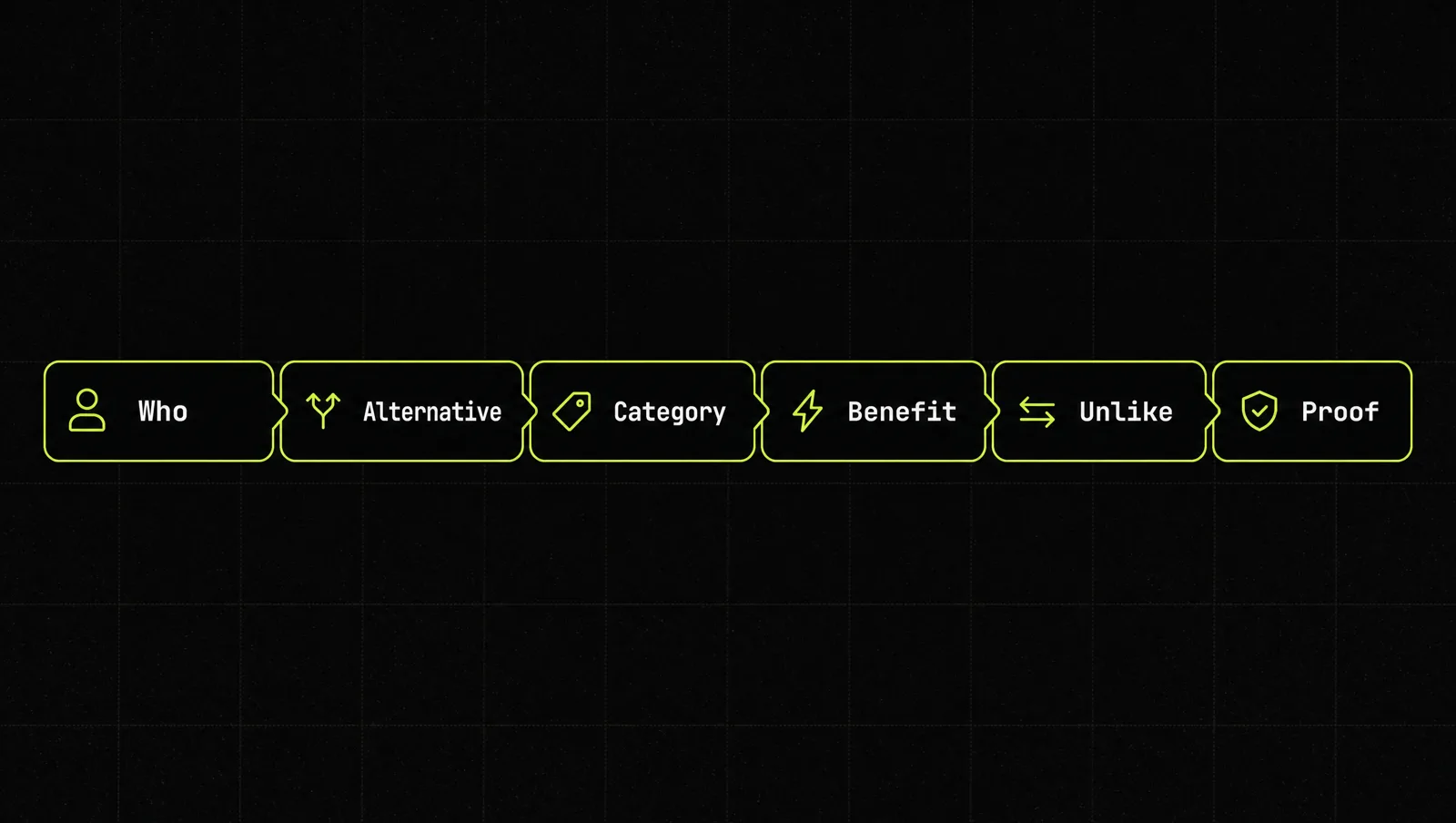
| Blank | What it asks | Weak answer | Strong answer |
|---|---|---|---|
| Target customers | Who exactly is this for? | "Small businesses" | "Independent physio practices with 2 to 10 therapists" |
| Current alternative | What do they use today and dislike? | "Other tools" | "Paper calendars and phone tag with the front desk" |
| Product category | What should they compare you to? | "Platform" | "Online booking system for physio practices" |
| Reason to buy | What result do they get? | "Saves time" | "Fills cancelled slots automatically from a waitlist" |
| Product alternative | Which option do you beat? | "The competition" | "Generic booking apps built for hair salons" |
| Whole product | What makes it work for this use case? | "Great features" | "Insurance fields, treatment series and recall reminders built in" |
Every strong answer is narrow and specific. The template rewards focus: win a small segment first, then expand.
One warning from the other side of the debate. April Dunford, author of Obviously Awesome, calls the fill-in-the-blank positioning statement "not only pointless but potentially dangerous" when it is done as a quick exercise (aprildunford.com). Her argument: the blanks assume there is only one right answer per line, when a product can usually be positioned several ways. So the template is the output. The work is choosing between positions, which is what the next five steps are for.
How to write a positioning statement in 5 steps
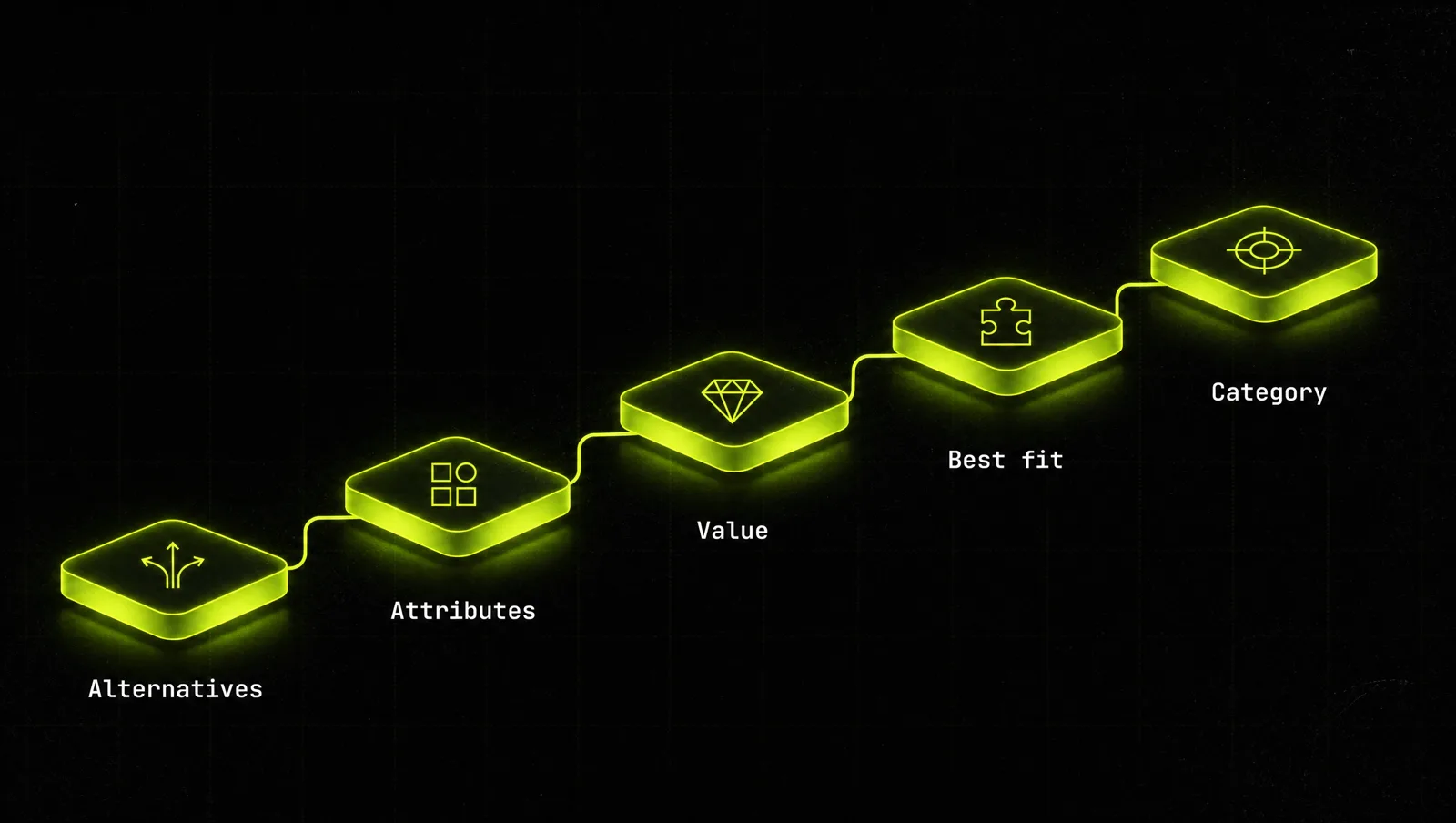
The five steps below follow the components Dunford lays out in her quickstart guide: competitive alternatives, unique attributes, value, best-fit customers and market category. Only at the end do you pour the result into Moore's template.
Step 1: List the competitive alternatives
Ask the question Dunford starts with: what would your customers do if your product didn't exist? The answer is rarely just "a competitor". It is often a spreadsheet, an intern, an agency, or doing nothing. Ask your best customers what they used before they bought. That list is your real competition.
Step 2: Find your unique attributes
Now compare yourself to that list. What do you have or do that the alternatives don't? Features, a delivery model, a specific expertise, a guarantee, an integration. Dunford is clear that an attribute only counts as differentiated in relation to the alternatives from step 1. "Easy to use" is not unique if the alternative is a notebook.
Step 3: Translate attributes into value
For every unique attribute, ask "so what?" until you reach a result a buyer cares about: more revenue, less risk, time saved, a job done that couldn't be done before. If you want a structured way to find that job, the Jobs to Be Done framework is built for exactly this translation. Keep only the value you can prove with a customer story or a number.
Step 4: Pick your best-fit customers
Now look at who cares most about that value: the customers who buy fast, stay long and tell others. What do they share: industry, size, a trigger event, a specific pain? Your positioning is written for them. Everyone else can still buy.
Step 5: Choose the market category, then write the statement
The market category is the frame that makes your value obvious. Dunford describes it as the context in which your target customers immediately understand why you are good. You can position inside an existing category, as a focused subsegment of one, or create a new one. A narrower frame often wins, which is also the core idea behind Blue Ocean Strategy: stop fighting in the crowded space everyone compares.
Only now fill in the template. Each blank should come straight from your research: the target from step 4, the current alternative from step 1, the category from step 5, the reason to buy from step 3, the differentiation from step 2. Then test it: read it to three best-fit customers and ask if it describes why they bought.
Positioning statement examples
The examples below are illustrative, not real companies. They show the template filled in for three common business models.
Coach: For first-time managers in tech companies who were promoted without training, this program is a 60-day management bootcamp that gets them through their first reviews and hard conversations. Unlike leadership books and courses, it includes weekly role-play with a coach on the situations they face that week.
SaaS: For online stores with more than 1,000 orders a month who handle returns manually in their inbox, our product is a returns portal that turns refunds into exchanges. Unlike helpdesk software, it connects to the store's inventory and suggests an exchange before a refund is issued.
A real case: how Janna Systems went from "another CRM" to "CRM for investment banks"

Dunford describes this case on her own website, from her time running marketing at the company (aprildunford.com).
- The starting position: Janna was positioned as an enterprise CRM and competed head to head with Siebel Systems. By Dunford's account, Janna had a couple dozen employees, under $2M in revenue and 6 customers. Siebel had around 8,000 employees, about $2B in revenue and 400 customers.
- The unique attribute: Janna's software modeled relationships between people differently from other CRMs.
- The discovery: working with an investment bank customer, the team saw that this attribute gave sales teams insight into interpersonal relationships they could use to open new sales conversations. In investment banking, that is exactly how deals start.
- The repositioning: from "enterprise CRM" to "CRM for investment banks".
- The result: Dunford describes sales taking off once Janna sold to investment banks. Her revenue figures and the press reports from that time don't match, so we only rely on what is on public record:
- The exit: in September 2000, Siebel announced it would buy Toronto-based Janna for $975 million in stock. Computerworld listed Merrill Lynch, Lehman Brothers, First Union Securities and Allstate among Janna's customers (Computerworld).
Look at it through the system:
- Competitive alternatives: as a general CRM, the alternative was Siebel, a fight Janna could not win. For investment banks, the alternative was a CRM that didn't understand how bankers actually find deals.
- Unique attributes: relationship modeling. Same software before and after. Only its context changed.
- Value: better insight into who knows whom, turned into new deal conversations.
- Best-fit customers: investment banks, where relationships are the pipeline.
- Market category: a focused subsegment ("CRM for investment banks") where Janna was the obvious leader instead of a tiny challenger.
The lesson: Janna didn't build a new product to win. It changed the comparison. The same features that looked minor next to Siebel looked essential to an investment bank.
Three use cases
The examples below are illustrative, not real clients. They show what the five steps change in practice.
Use case 1: Marketing agency
Before: "Full-service digital marketing for growing businesses." The competitive alternative is every other agency, so the buyer compares on price.
After: the five steps show that its three best clients are dental practices that stayed for years. New position: a patient acquisition agency for dental practices that also writes the front desk call script. Sales calls get shorter because the buyer no longer needs convincing.
Use case 2: Coach or creator
Before: "Business coaching for entrepreneurs." The real alternative, figuring it out alone with YouTube, is never named.
After: a 90-day accountability program for solo consultants who earn well but have no system. The value is no longer "advice" but finished weekly milestones, which free content can't give.
Use case 3: SaaS or digital product
Before: "The smart project management tool." Compared feature by feature with the market leaders, and losing.
After: interviews show the most loyal users are architecture firms tracking permit deadlines. New position: project tracking for architecture firms, with permit timelines built in. Same code, a comparison the team can win.
How we run this system with Claude
Inside CopyPasteCEO we run positioning as a sequence of Claude prompts, in one chat so Claude keeps the context. Here are the first two, copy-paste ready. Fill in the brackets.
Prompt 1: map alternatives, attributes and value
Make it yours · 0/3 filled
You are a positioning strategist trained on April Dunford's approach (competitive alternatives, unique attributes, value, best-fit customers, market category). My business: [WHAT YOU SELL], at [PRICE]. My three happiest customers are: [CUSTOMER 1, 2, 3 WITH ONE LINE EACH ON WHY THEY BOUGHT]. What they used before us: [PREVIOUS SOLUTIONS]. First, list the realistic competitive alternatives, including doing nothing. Then list the attributes I have that those alternatives lack. For each attribute, ask "so what?" until you reach a business result, and mark which results I can back with proof and which I can't.Prompt 2: generate and test positioning statements
Make it yours · 0/7 filled
Based on the analysis above, write 3 different positioning statements in Geoffrey Moore's format: For [TARGET CUSTOMERS] who are dissatisfied with [CURRENT ALTERNATIVE], our product is a [CATEGORY] that provides [REASON TO BUY]. Unlike [PRODUCT ALTERNATIVE], we have [KEY DIFFERENTIATION]. Each version must use a different market category or best-fit customer. For each, tell me who it wins, what it gives up, and the one question I should ask [NUMBER] best-fit customers to test it. Then recommend one and explain why.These two prompts get you from a blank page to three testable positions. Choosing between them, and staying disciplined once the new position feels "too narrow", is where most people get stuck, because that is where judgment matters more than templates.
Where most people get stuck
Writing a positioning statement takes an afternoon. Committing to it is the hard part. The usual reasons it fails:
- They fill in blanks without research. The statement sounds good, but it describes the founder's hopes, not why customers actually buy.
- They refuse to pick a segment. "For everyone" feels safer, and it keeps them compared to the biggest competitor in the market.
- They never roll it out. The statement sits in a doc while the website, ads and sales deck keep telling the old story.
That is exactly the gap the Inner Circle is built for: the playbooks to find and roll out your position, a new playbook every week, and founders sharpening their own positioning next to you.