Jobs to Be Done Framework: How to Find What Customers Really Buy
Most founders know their customers by numbers: age, industry, company size, job title. They build a product for that profile, ask a survey what features people want, ship the features, and sales barely move. The profile told them who buys. It never told them why.
Clayton Christensen's Jobs to Be Done theory is the best-known answer to that gap. This guide shows you how to use the Jobs to Be Done framework in your own business. It isn't a theory summary. It turns the core ideas into a system you can run: what the system is, how to find the job behind a purchase in five steps, the famous milkshake case, three worked use cases and the Claude prompts we use. For the full depth, read Christensen's own work. It's worth it.
The short version:
- Customers don't buy products. They hire them to make progress in a specific situation.
- Every job has three sides: functional, social and emotional. Miss one and a "better" product still loses.
- Your real competition is everything else the customer could hire for the same job, often outside your category.
- Find the job in five steps: pick a moment, interview recent buyers, map the circumstance, list the real competitors, rewrite the offer.
- Then build, price and market around the job, not around the customer profile.
The problem the system solves
Most product and marketing decisions are built on correlation. Buyers of this product tend to be 35, urban and in tech, so we target people who are 35, urban and in tech. That tells you who shows up in the data. It doesn't tell you what caused the purchase.
The cost of guessing is high. In their Harvard Business Review article, Christensen and his co-authors cite a McKinsey poll in which 84% of global executives called innovation extremely important to growth, while 94% were unhappy with their own innovation performance (Harvard Business Review, 2016). HBS Working Knowledge notes that around 30,000 new consumer products launch every year and many of them fail (HBS Working Knowledge).
Jobs to Be Done flips the question. Instead of "who is our customer?", you ask "what progress was this person trying to make when they pulled our product into their life?" Once you know that, the features, the price, the message and the real competitors all become obvious.
The core: the job, its three sides and the hire
The Christensen Institute defines a job as the progress a person is trying to make toward a goal, within a particular circumstance (Christensen Institute). People "hire" a product when it helps them make that progress and "fire" it when something else does the job better (Christensen Institute blog).
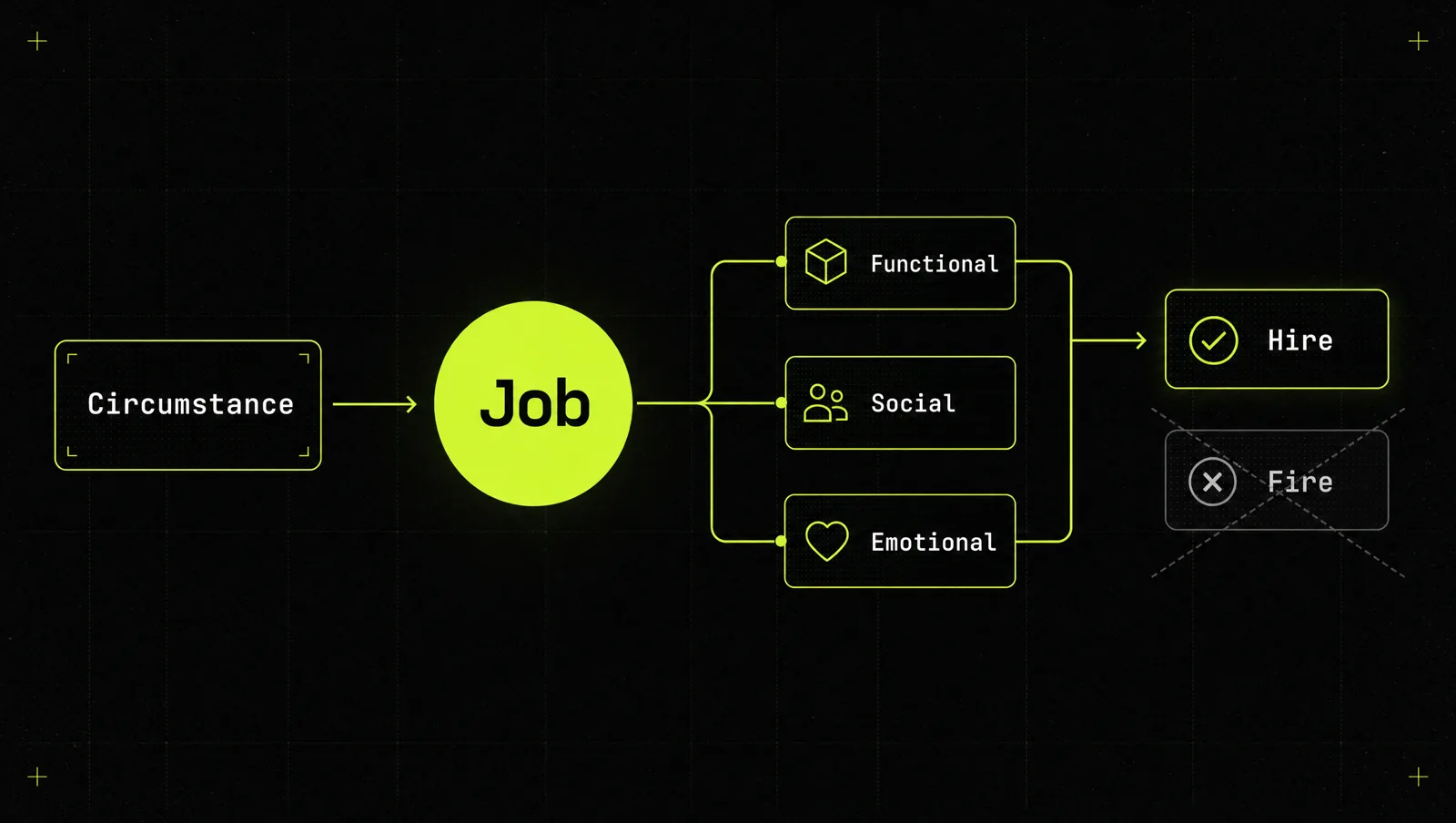
According to the Christensen Institute, every job has functional, social and emotional forces behind it:
| Element | What it means | Your question |
|---|---|---|
| Circumstance | The situation the person is in when the need shows up | When, where, with whom, under what pressure? |
| Functional side | The practical task that has to get done | What has to work for them? |
| Social side | How others see them using it | Who is watching, and what do they need to think? |
| Emotional side | How it makes them feel | What do they want to feel, or stop feeling? |
| Hire and fire | What they pick for the job, and what they drop | What did they use before, and why did they switch? |
The circumstance is the part most people skip. The same person can have completely different jobs at 8 a.m. and at 4 p.m. If you describe your customer without the circumstance, you describe nobody.
How to use the Jobs to Be Done framework in 5 steps
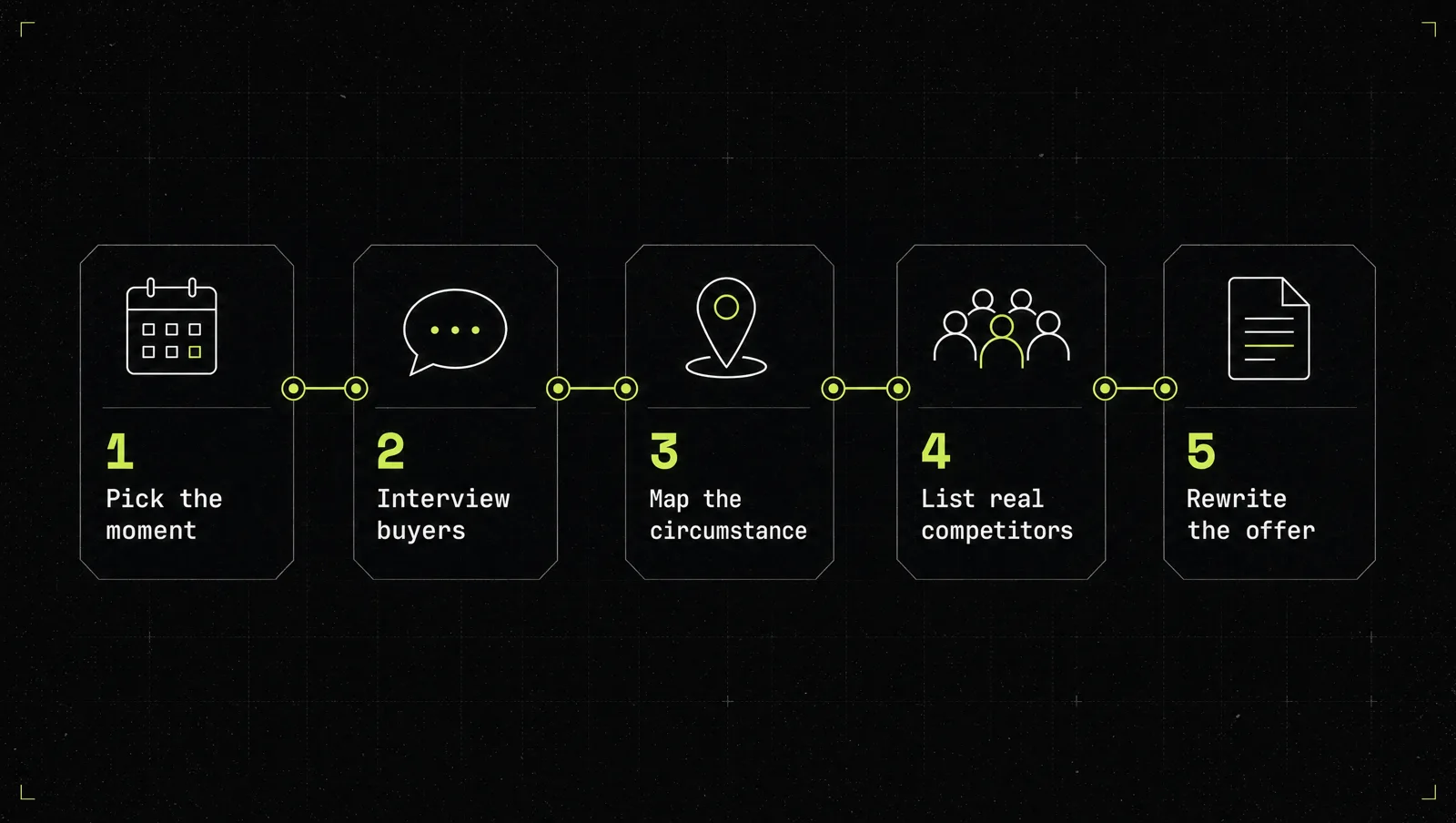
Step 1: Pick one purchase moment
Don't try to understand "the customer". Pick one concrete moment: the day someone signed up, booked the first call, or paid for the first time. A job always lives in a moment, so start from one.
Step 2: Talk to people who just hired you
Interview five to ten recent buyers, ideally within weeks of the purchase, while they still remember. Don't ask what features they want. Ask what was going on in their life or business when they started looking, what they tried before, and what almost stopped them. Also talk to people who fired you: churned customers tell you what job you failed at.
Step 3: Map the circumstance and the three sides
Write down the circumstance in plain words: time, place, pressure, who else was involved. Then write one line each for the functional, social and emotional side. "Get my books done before the tax deadline" is functional. "Not look disorganised in front of my accountant" is social. "Stop the Sunday night dread" is emotional.
Step 4: List everything else they could hire
Now ask: in that exact circumstance, what else could they have used? Include the odd ones: a spreadsheet, an intern, a friend, doing nothing. These are your real competitors. Very often the biggest one isn't in your category at all.
Step 5: Rewrite the offer around the job
Turn the job into one sentence: "When [circumstance], I want to [progress], so I can [outcome]." Then check every part of your offer against it. Keep what helps the job, cut what doesn't, and change your message so it speaks to the circumstance, not the demographic. If you want to go one step further and stack the offer, use the job as the dream outcome in a Grand Slam Offer.
Making it stick: one job per offer
When you find two different jobs, don't try to serve both with one product and one message. Build one version per job. The milkshake case below shows exactly why: one product was hired for two opposite jobs, and a single "improved" milkshake could never win both.
A real case: the milkshake that was hired for a commute
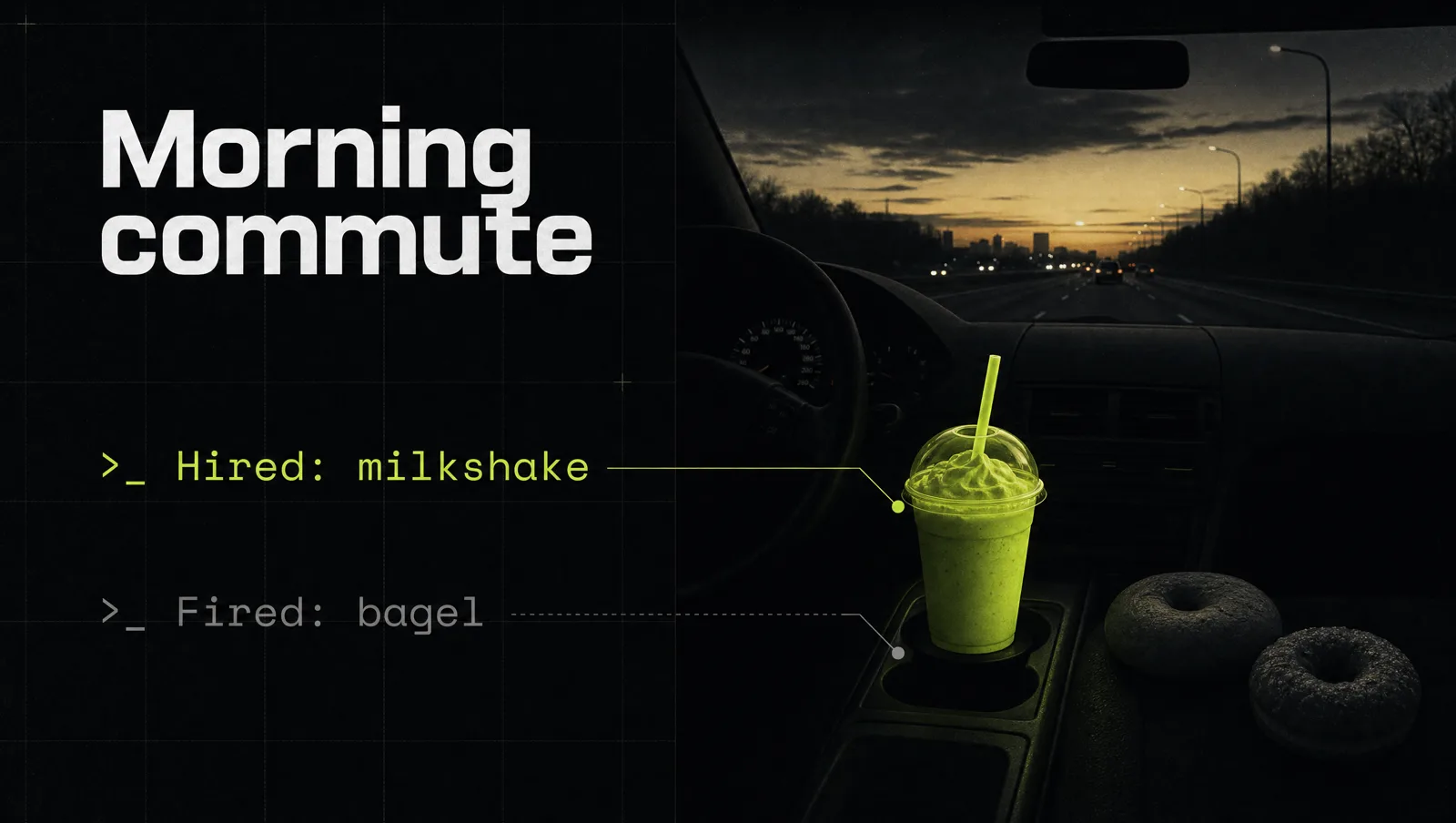
The most famous Jobs to Be Done story comes from Christensen's own research, and it's documented by Harvard Business School.
A fast food chain wanted to sell more milkshakes (HBS Working Knowledge). It first did what most companies do: it segmented the market by product and by customer demographics, then asked people who fit the profile what the ideal milkshake would look like, for example thicker, a different flavour, a different texture. It made changes based on that feedback. Sales didn't improve.
Then one of Christensen's fellow researchers took a different route. According to HBS Working Knowledge:
- The researcher spent a whole day in one of the restaurants, documenting the milkshake purchases.
- About 40% of the milkshakes were bought first thing in the morning, by commuters who ordered them to go.
- The next morning the researcher came back and interviewed those buyers about the job they had hired the milkshake to do.
- They faced a long, boring drive and wanted something to keep one hand busy. They weren't hungry yet, but knew they would be by 10 a.m. They were in a hurry, wearing work clothes, and had one free hand.
- They picked the milkshake over a bagel or a doughnut because it was tidy and kept hunger away.
- Later in the day, the same product did a different job: parents bought it as a treat for young children.
The Christensen Institute sums up the competitive insight: the morning shake wasn't competing with other chains' milkshakes, but with "bananas and bagels" (Christensen Institute). The recommended responses followed directly from the jobs: a thicker morning shake that lasts the whole commute, maybe with chunks of fruit to keep it interesting, and a different, thinner version for kids, so parents don't wait forever while a child works through a straw. The source describes what the chain could do. It doesn't report a sales figure afterwards.
Look at it through the system:
- Circumstance: early morning, alone in the car, in a hurry, one hand free.
- Functional side: stay full until mid morning, without crumbs or mess.
- Emotional side: make a boring drive a little more interesting.
- Real competitors: bagels, doughnuts, bananas, not the milkshake down the road.
- Why the survey failed: it asked "the milkshake customer" what they wanted, but there were at least two customers with two opposite jobs.
The lesson: the product didn't need to be better in general. It needed to be better at one specific job, in one specific moment. Once you see the job, the right changes are obvious.
Three more use cases
The examples below are illustrative, not real clients. They show how the same system changes very different businesses.
Use case 1: Bookkeeping service
Before: "Affordable bookkeeping for small businesses, $300 a month." Compared with every other bookkeeper and with software on price.
After interviews: most new clients signed up in the six weeks before a tax deadline, after a stressful call from their accountant.
- Job: "When my accountant chases me for documents, I want everything sorted in one go, so I can stop feeling behind."
- Social side: look organised in front of the accountant. Emotional side: end the dread.
- Real competitor: a shoebox of receipts and a weekend of panic, not other bookkeepers.
- New offer: "Accountant-ready in 14 days", with direct handover to the client's accountant.
Use case 2: Online fitness coach
Before: "Custom workout plans and weekly check-ins." Marketed to "people who want to get fit".
After interviews: a big group of buyers were new parents who had quit the gym because they couldn't leave the house.
- Circumstance: at home, 20 minutes during nap time, no equipment.
- Real competitors: free YouTube workouts and doing nothing.
- Emotional side: feel like themselves again, not "get shredded".
- New offer: 20-minute home sessions, built around nap schedules, with a group chat of other new parents.
Use case 3: B2B SaaS reporting tool
Before: a dashboard product, sold on number of integrations and chart types.
After interviews: the champion was usually a marketing manager who had to present results to the CEO every Monday.
- Job: "When I present on Monday, I want numbers I can defend, so I look in control."
- Real competitor: a spreadsheet built every Sunday night.
- Social side matters most: the CEO is the audience.
- New feature and message: a one-click Monday report, sold as "never build the Sunday spreadsheet again".
How we run this system with Claude
Inside CopyPasteCEO we run this as a sequence of Claude prompts, in one chat so Claude keeps the context. Here are the first two, copy-paste ready. Fill in the brackets.
Prompt 1: prepare your job interviews
Make it yours · 0/4 filled
You are a Jobs to Be Done researcher trained on Clayton Christensen's theory (circumstance, functional, social and emotional sides, hire and fire). My business: [WHAT YOU SELL], to [WHO], at [PRICE]. Write me a 30-minute interview guide for people who bought in the last [NUMBER] weeks. Cover: what was happening when they started looking, what they used before, what almost stopped them, and what they would use if we disappeared. No questions about features. Then list 5 follow-up questions for customers who cancelled.Prompt 2: turn interview notes into job statements
Make it yours · 0/2 filled
Here are my notes from [NUMBER] customer interviews: [PASTE NOTES]. Group the buyers by circumstance, not by demographics. For each group, write the job as "When [circumstance], I want to [progress], so I can [outcome]", then one line each for the functional, social and emotional side, and a list of everything else they could hire for that job. Finally, tell me which ONE job my current offer serves worst and what I should change first.These two prompts get you from guesswork to written job statements. Running the interviews well, and turning a job into a new offer, price and message, is where most people get stuck, because that is where judgment matters more than the template.
Where most people get stuck
Understanding Jobs to Be Done takes an afternoon. Using it takes real conversations, and most founders never have them. The usual reasons:
- They ask about features. "What would you like us to add?" gets polite wish lists, not the job. Ask about the moment they started looking.
- They stay with demographics. Customers get sorted by industry or age again, and the circumstance disappears from the analysis.
- They find the job and change nothing. The insight ends up in a slide, while the offer, the price and the ads stay exactly the same.
That is exactly the gap the Inner Circle is built for: the playbooks to run customer interviews and rebuild your offer, a new playbook every week, and founders who are digging into their own customers' jobs next to you.