How to Make a Grand Slam Offer ($100M Offers, Step by Step)

Most businesses don't have a traffic problem. They have an offer problem. They pour money into ads, content and cold outreach, and the numbers stay flat because the thing they are selling looks like everything else on the market.
Alex Hormozi's book $100M Offers is the best-known fix for this. This guide shows you how to make a Grand Slam Offer yourself. It isn't a chapter-by-chapter summary. It turns the core ideas into a system you can run: what the system is, how to build an offer with it step by step, what it looks like in three real business models, and the exact Claude prompts we use to run it. If you want the full depth and all the stories, read the book. It's worth it.
The short version:
- Stop competing on price. Build an offer nobody can compare you to.
- Value comes from four levers. The two most founders ignore (time and effort) are usually the fastest wins.
- Build the offer in five steps: outcome, problems, solutions, delivery, trim and stack.
- Then add five enhancers: scarcity, urgency, bonuses, guarantees, naming.
The problem the system solves
A normal offer forces the buyer to compare you. Same deliverables, same format, same price range as the next five providers. Once a buyer can compare, the cheapest option wins, and you end up in a price war you can't win.
The goal of a Grand Slam Offer is the opposite: an offer so obviously valuable that the buyer can't compare it to anything. Hormozi calls this becoming a "category of one". When there is nothing to compare you to, price stops being the main question.
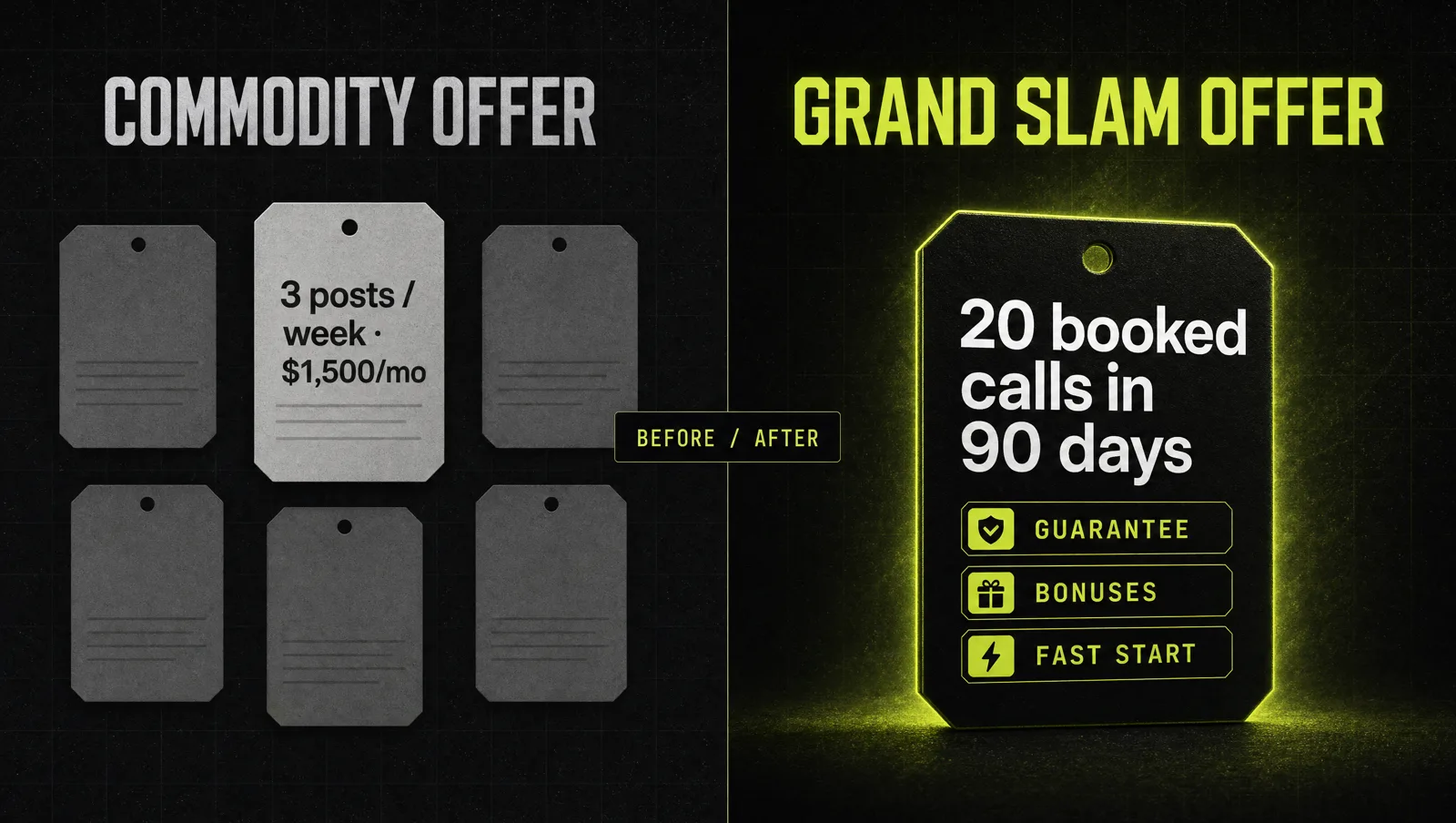
Left: an offer the buyer can compare line by line. Right: an offer with nothing to compare it to.
Three things have to be true before any offer works:
- A starving crowd. Pick a market that is in real pain, can pay, is easy to reach and is growing. A great offer to the wrong market still fails.
- A premium price. Charging more lets you deliver more, which makes the result better, which justifies the price. Cheap offers starve the delivery.
- Value that is obviously bigger than the price. That is what the rest of the system builds.
The core: the Value Equation
Everything in the system comes back to one idea. How valuable an offer feels depends on four levers:
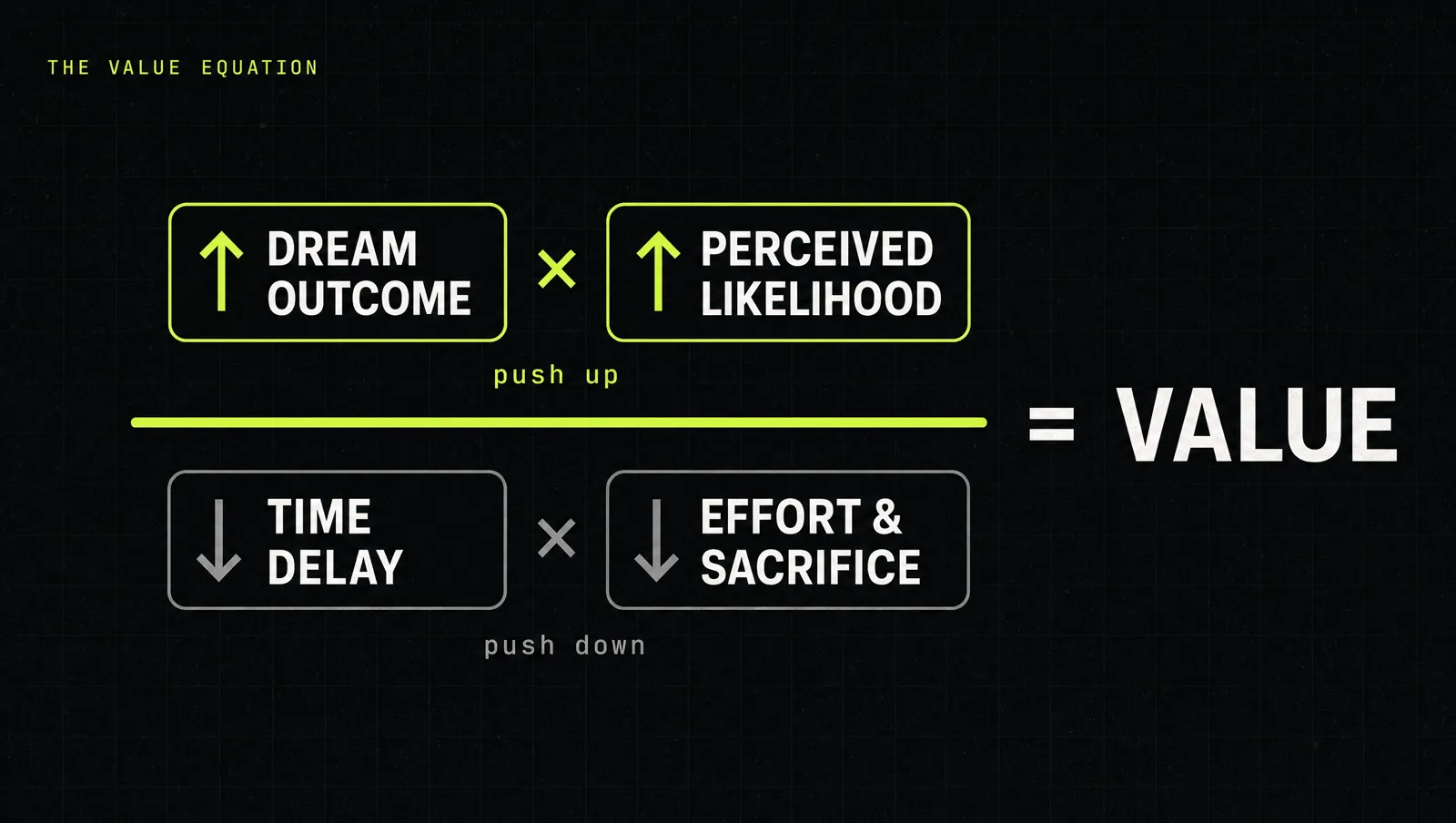
| Lever | What it means | Your job |
|---|---|---|
| Dream outcome | The result the buyer actually wants | Make it bigger and more specific |
| Perceived likelihood | How sure they are it will work for them | Raise it with proof, guarantees, a clear plan |
| Time delay | How long until they see the result | Shorten it, add fast first wins |
| Effort and sacrifice | What they have to do or give up | Do more of the work for them |
Value goes up with the first two and down with the last two. Most founders only work on the dream outcome ("make more money!"). The fastest gains usually come from the bottom two: cut the time until the first win, cut the effort, and the same promise suddenly feels worth twice as much.
How to make a Grand Slam Offer in 5 steps
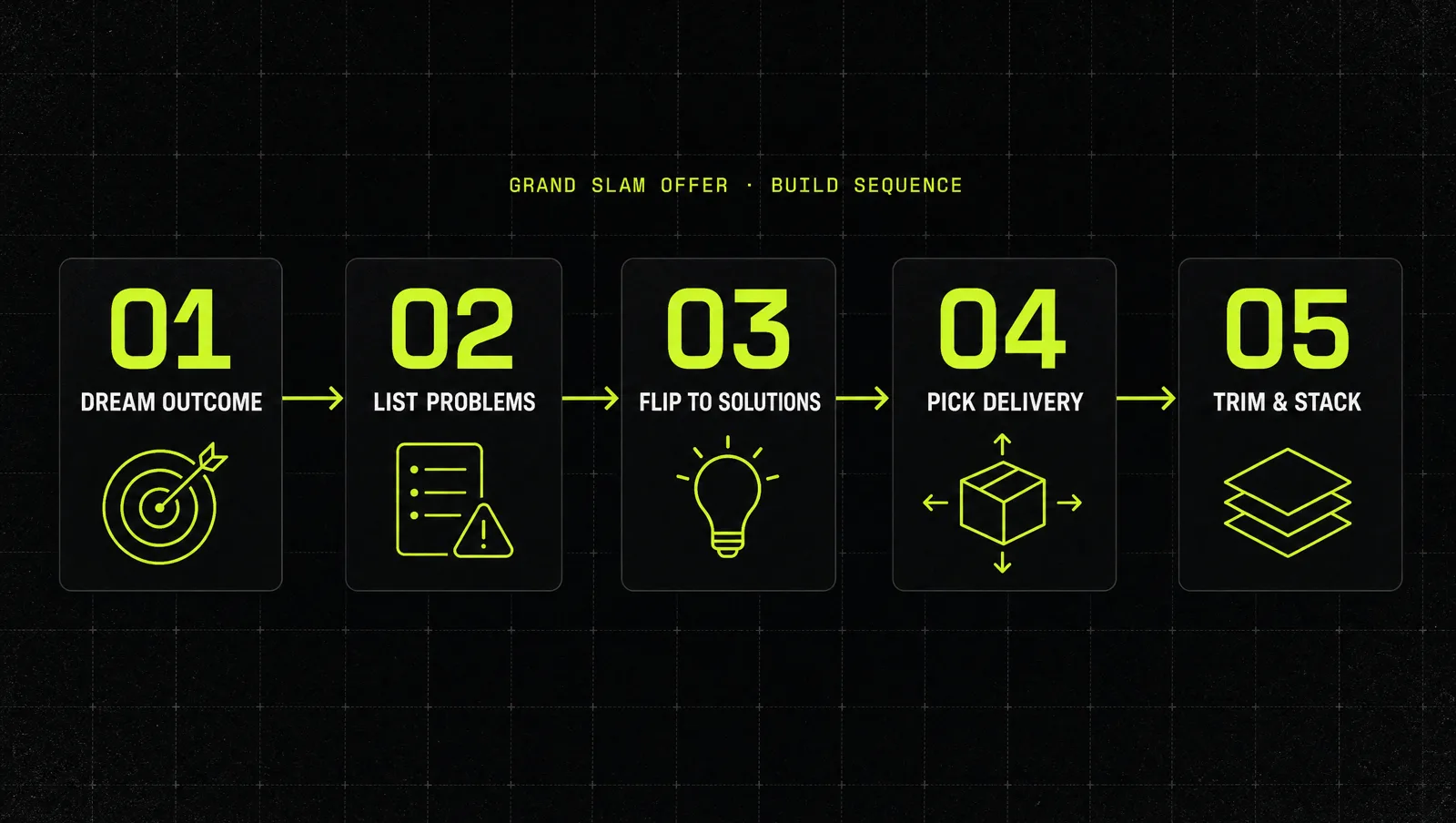
Step 1: Define the dream outcome
Write down the result in the buyer's words, not yours. "Get 20 new booked calls a month without cold calling" beats "lead generation services". Be specific about the outcome and about who it is for.
Step 2: List every problem between them and that outcome
Think through the whole journey: before they buy, while they work with you, after. For every step, ask what could stop them, slow them down, cost them effort or make them doubt it will work. Aim for 20 or more. Each problem is a value lever you haven't pulled yet.
Step 3: Turn every problem into a solution
Flip each problem into a "how to" statement. "I don't have time to write content" becomes "How to have a month of content without writing it yourself". You now have a long list of things your offer could solve.
Step 4: Decide how you deliver each solution
For every solution, brainstorm delivery options: done-for-you, done-with-you, templates, a group call, a 1:1 session, software, a checklist. Then think about what costs you little to deliver but feels very valuable to the buyer. Templates, recordings and systems scale. Your personal time doesn't.
Step 5: Trim and stack
Cut everything that costs you a lot but adds little value. Keep what is high value and cheap to deliver. Then stack what is left into one offer, where every component solves a named problem. This is what makes the offer impossible to compare: nobody else has solved exactly this set of problems in exactly this way.
Making it stronger: the five enhancers
Once the core is built, five enhancers raise demand without changing what you deliver:
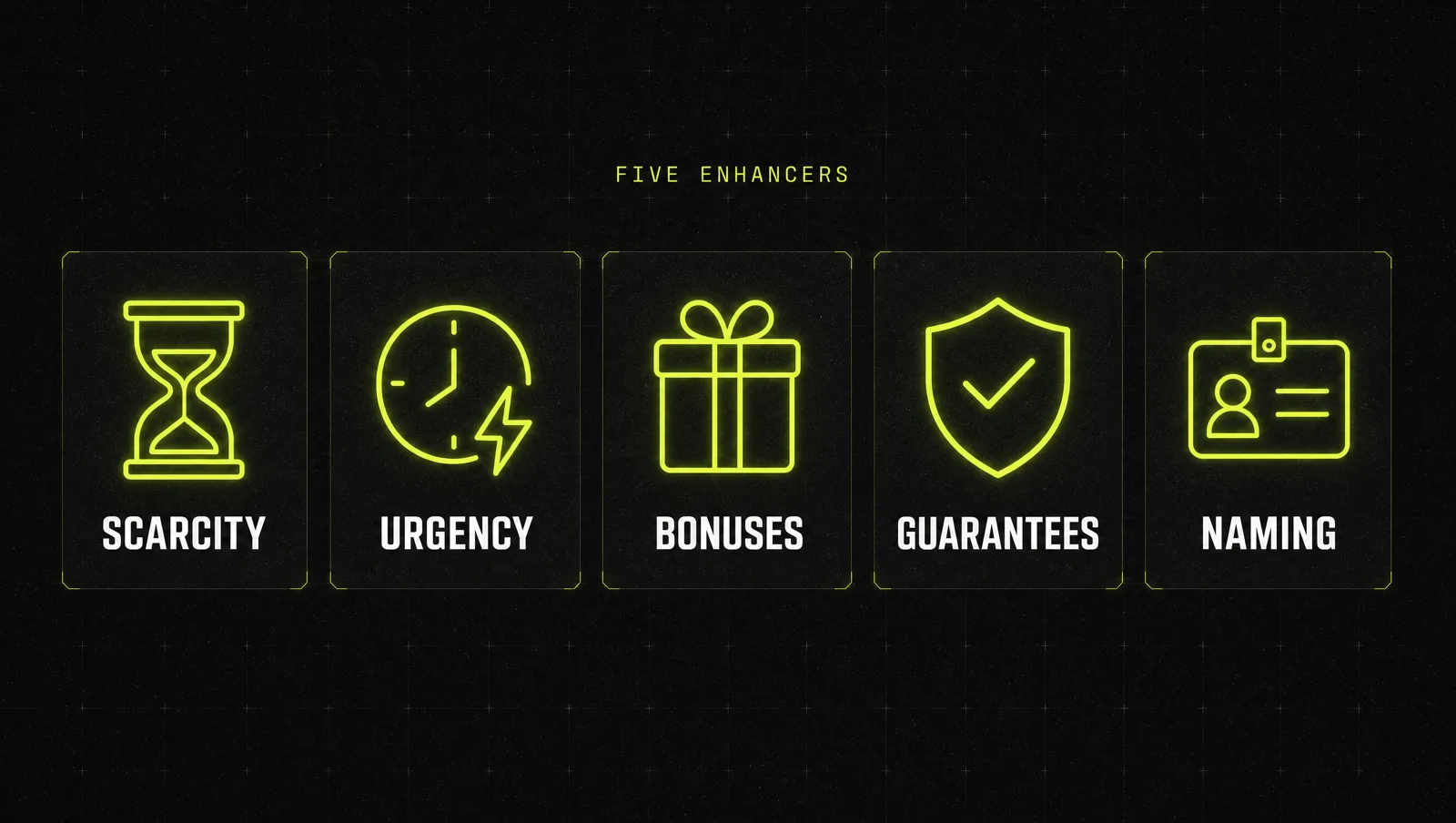
- Scarcity: a real limit on supply, like spots per month or seats per cohort.
- Urgency: a real reason to act now, like a start date or a price that goes up after a deadline. Never fake timers.
- Bonuses: extra components, each one killing one specific objection. Give each bonus its own name and value.
- Guarantees: take risk away from the buyer. Unconditional, conditional (if you do X and don't get Y) or performance-based.
- Naming: a name that makes the offer instantly clear, for example who it is for, the result, and the time frame.
A real case: how Hormozi ran this system on gyms
The system in the book wasn't invented on a whiteboard. It came out of the gym business.

Before the books, Hormozi owned gyms. In 2016 he and Leila Hormozi founded Gym Launch, a company that sold gym owners coaching programs and business training to grow revenue and profit (Capstone Partners). What they sold was not a new type of fitness knowledge. Gyms were a crowded, commodity market. The offer is what made it stand out.
Look at it through the Value Equation:
- Dream outcome: gym owners don't want "marketing". They want a full gym. Gym Launch sold exactly that: members, revenue, a gym that pays its owner.
- Perceived likelihood: a playbook that had already been run in other gyms, not a new experiment the owner had to trust blindly.
- Time delay: the system was built around a launch campaign, so owners could see new members come in fast instead of waiting months for "brand awareness".
- Effort and sacrifice: the ads, the sales scripts and the retention process were handed over. The owner didn't have to invent any of it.
The same logic ran one level down, in the offers gyms made to their own members. Hormozi has often described a short transformation challenge that members paid for up front and could earn back by hitting their goal. That combines a specific dream outcome, a short time frame and a guarantee in one offer.
The result: in December 2021, private equity firm American Pacific Group bought into Gym Launch and its sister company Prestige Labs, a supplement brand (Jones Day, American Pacific Group). The thinking behind the offers became $100M Offers.
The lesson: the product was never unique. Plenty of people knew how to run a gym. The offer was unique, and that is something you can build in any business.
Three more use cases
The examples below are illustrative, not real clients. They show how the same system changes very different businesses.
Use case 1: Marketing agency
Before: "Social media management, 3 posts a week, $1,500/month." Directly comparable with hundreds of freelancers, so the buyer negotiates on price.
After: "The 90-Day Booked Calls System for local dental practices."
- Dream outcome: 20 booked new-patient calls a month, specific to one niche.
- Likelihood: case studies from the same niche plus a conditional guarantee: if you don't get 10 booked calls by day 60, we keep working for free until you do.
- Time delay: first campaign live in 7 days instead of "after onboarding".
- Effort: done-for-you content, and the practice only answers the phone.
- Bonuses: a call script for the front desk (objection: "we won't convert the calls"), a review-request template (objection: "we don't have enough reviews").
Same team, same skills. The price can go up because nobody else offers this exact package.
Use case 2: Coach or creator
Before: "1:1 coaching, 4 calls a month, $400." Time for money, hard to scale, easy to compare.
After: "Launch in 30: your first paid digital product live in 30 days."
- Delivery shifts from 1:1 calls to a step-by-step program, templates and weekly group calls. The coach's time per client drops, the result gets more predictable.
- Time delay is cut with a milestone plan: offer written in week 1, sales page in week 2, first sale by day 30.
- Likelihood goes up with a public progress board: buyers see others hit each milestone.
- Scarcity is real: one cohort a month, 15 spots.
Use case 3: SaaS or digital product
Before: "Scheduling tool, $29/month, 14-day free trial." Compared feature by feature against five competitors.
After: the same software, packaged as an outcome: "Fully booked calendar in 14 days, or your next 3 months are free."
- Effort drops with done-for-you setup: the team imports the contacts and builds the first booking page.
- Time delay drops with a first-win moment: the first booking is in within 48 hours.
- Bonuses kill churn objections: templates for reminder messages, a migration service from the old tool.
The product didn't change. The offer around it did.
How we run this system with Claude
Inside CopyPasteCEO we don't run this on a whiteboard. We run it as a sequence of Claude prompts, in one chat so Claude keeps the context. Here are the first two, copy-paste ready. Fill in the brackets.
Prompt 1: score your offer on the Value Equation
Make it yours · 0/3 filled
You are an offer strategist trained on the Value Equation (dream outcome, perceived likelihood, time delay, effort and sacrifice). Here is my offer: [WHAT YOU SELL], for [WHO], at [PRICE]. Score each of the four levers from 1 to 10 and explain each score in one sentence. Then tell me the ONE lever that is hurting my conversion most and why.Prompt 2: list the problems and flip them into solutions
Make it yours · 0/1 filled
My buyer's dream outcome is: [DREAM OUTCOME]. List at least 20 problems that stand between them and that outcome: before they buy, while they work with me, and after. For each problem, write the matching solution as a "How to ..." statement. Then mark the 5 solutions that would feel most valuable to the buyer and cost me the least to deliver.These two prompts cover steps 1 to 3. Steps 4 and 5, the enhancers, pricing and the naming are where most people get stuck, because that is where judgment matters more than the template.
Where most people get stuck
Understanding a Grand Slam Offer takes an evening. Building one takes a few focused rounds of work, and most founders stop after the first round. The usual reasons:
- They build the offer alone. Nobody pushes back on a weak guarantee or a bonus that doesn't remove a real objection.
- They stop at the idea. The offer never gets a sales page, a script or a price test, so they never find out if it works.
- They go back to comparing. The first "that's too expensive" makes them strip the offer back down to what everyone else sells.
That is exactly the gap the Inner Circle is built for: the systems to run it, a new playbook every week, and founders who are building their own offers next to you.