How to Make More Money Per Customer: Hormozi's Money Model (Step by Step)
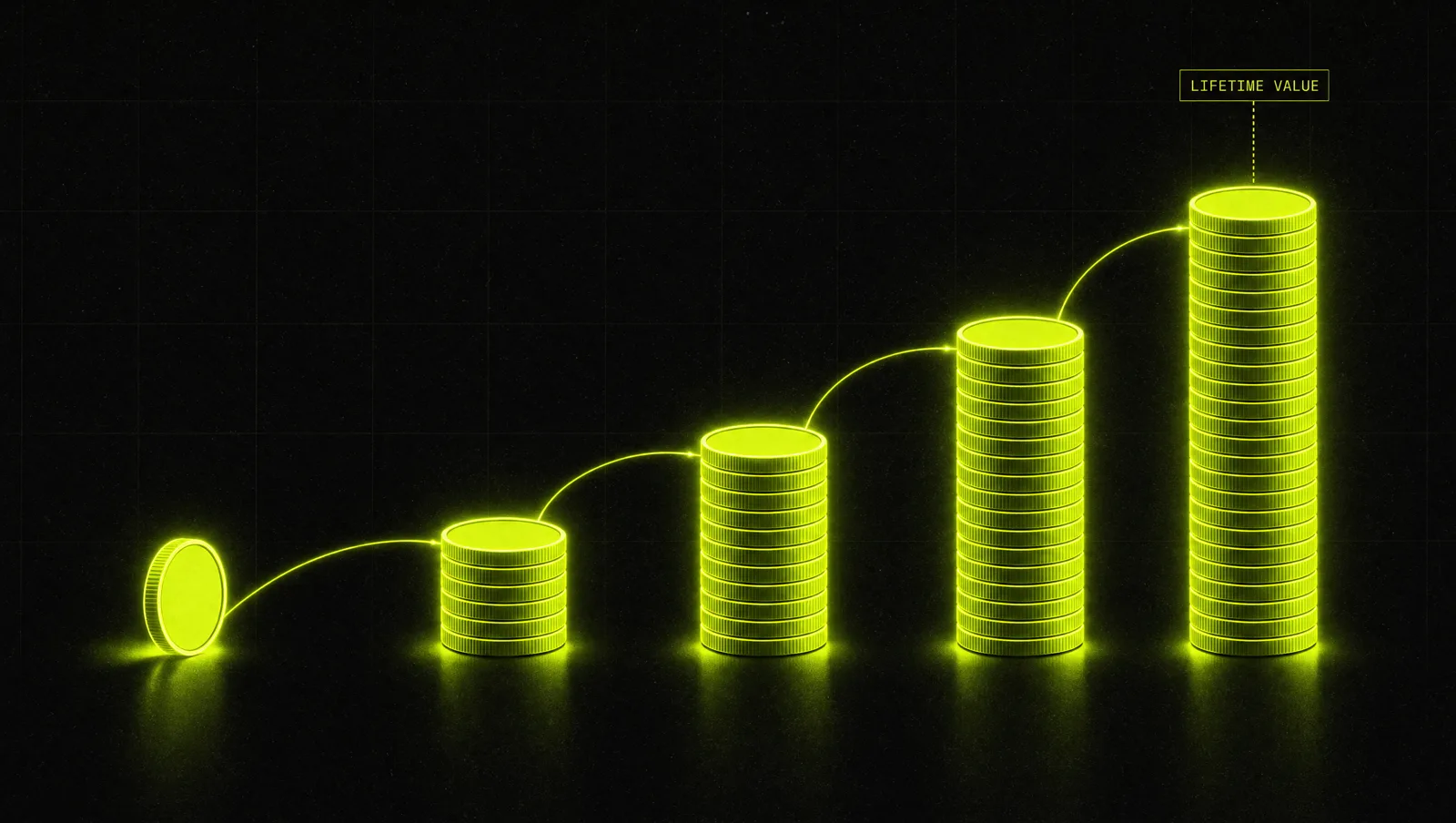
You fixed your offer. You have a steady flow of leads. And still, growth feels expensive: every new customer costs money to win, pays once, and then you start from zero again.
Alex Hormozi's book $100M Money Models is the third part of the series and fixes exactly that. This guide shows you how to make more money per customer with it. It isn't a chapter-by-chapter summary. It turns the core ideas into a system you can run: the four offers every money model is built from, the five steps to build yours, how Costco turned a membership card into roughly half of its operating income, our own money model at CopyPasteCEO, and the Claude prompts we use. For all the depth and examples, read the book.
The short version:
- One offer is not a business model. A sequence of offers is.
- Every money model is built from four offers: attraction, upsell, downsell and continuity.
- The goal: a customer's first 30 days pay back what it cost to win and serve them.
- Then growth stops being a cash problem, because customers fund the next customers.
The problem the system solves
Most businesses sell one thing, once. They pay for ads or spend hours on outreach to win a customer, make one sale, and then need a new customer to make the next sale. The more they grow, the more cash they need up front.
Hormozi's answer is to design what happens after the first yes. The benchmark is simple: within the first 30 days, the profit from a new customer should cover what it cost to get and serve them. When that is true, every customer pays for the next one and growth is no longer limited by how much cash is in the bank.
The core: four offers in a sequence
A money model is not one offer. It is four types of offers, each with one job.
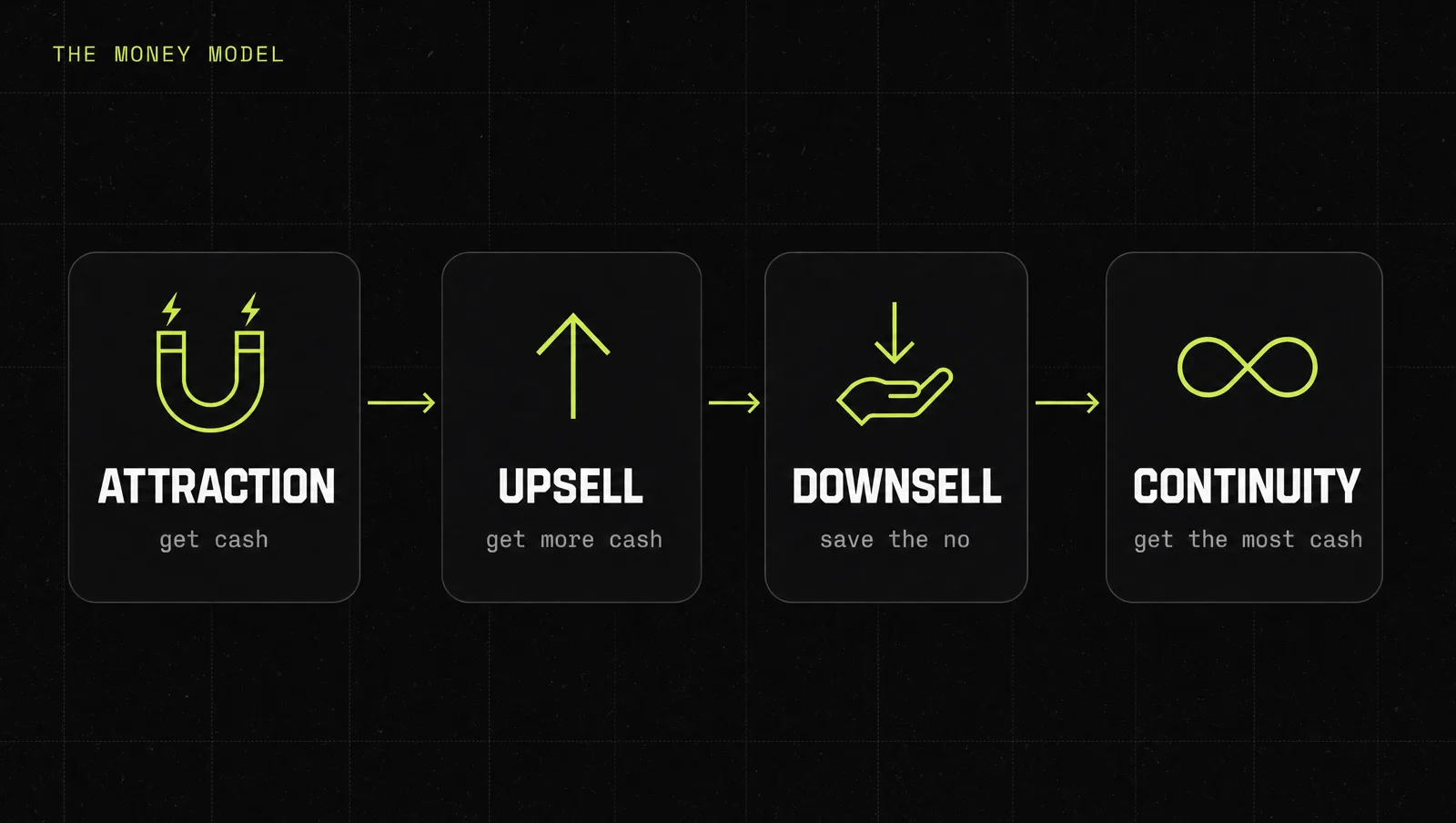
| Offer | Job | Typical form |
|---|---|---|
| Attraction | Turn strangers into customers and get cash in | Low-risk entry offer, trial, sample, "win your money back" |
| Upsell | Get more cash from people who just said yes | The next thing they need, more of the same, done-for-you |
| Downsell | Save the "no" with a different deal, not a cheaper version of the same thing | Payment plan, trial, lighter scope |
| Continuity | Get the most cash over time | Membership, subscription, retainer |
The order matters. Attraction offers only need to break even. Upsells and downsells make the first 30 days profitable. Continuity is where the long-term profit comes from.
How to build your money model in 5 steps
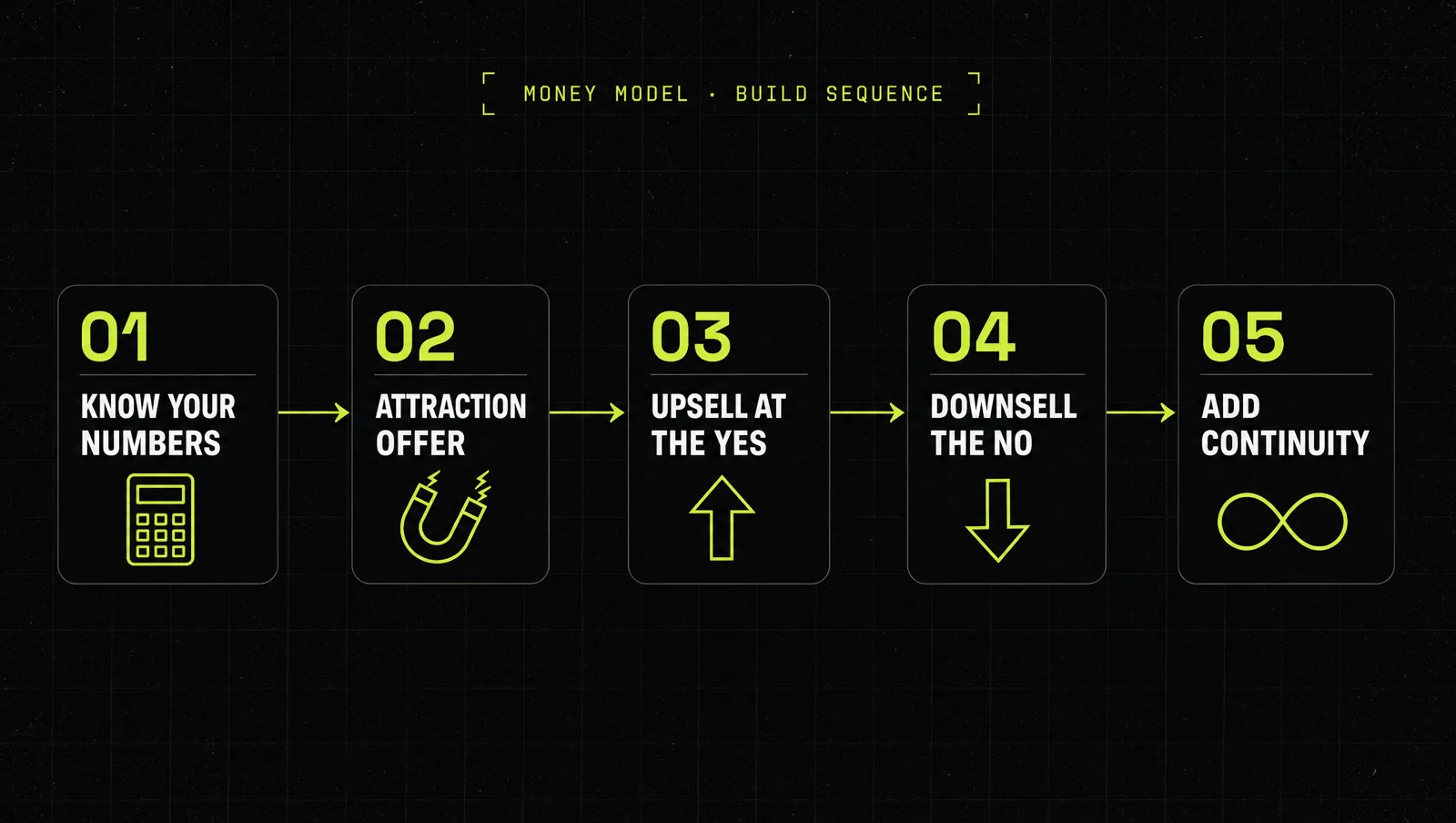
Step 1: Know your numbers
You need two numbers: what it costs to win one customer (your ads, outreach time or commissions per sale) and what it costs to serve them in the first month. Add them up. That is the amount your first 30 days need to beat.
Step 2: Build an attraction offer
The attraction offer gets people to buy for the first time. Its job is not to make you rich, it is to get a customer in at break-even or better. Good attraction offers remove risk: a low entry price, a trial, a guarantee, or a challenge where people can earn their money back by reaching a goal.
Step 3: Upsell at the moment of yes
The best moment to offer more is right after someone buys, because that is when their trust and excitement are highest. The upsell should be the obvious next step: the problem they will have next, more of what they just bought, or you doing it for them.
Step 4: Downsell the no
A "no" to your main offer is often a "no" to the terms, not to the result. Instead of dropping the price of the same thing, change the deal: split it into payments, start with a trial, or offer a smaller scope. That way the full offer keeps its value and more people still say yes.
Step 5: Add continuity
Continuity turns a one-time buyer into recurring revenue: a membership, a subscription, a monthly retainer or a community. This is the part that keeps paying after the first 30 days, and it is where most of the profit in a good money model ends up.
A real case: how Costco makes its money from a card, not from groceries

Costco is the cleanest public example of a money model, because it reports the numbers every year. From its fiscal 2024 annual report (Form 10-K, income statement):
- Costco sold $249.6 billion of goods, but merchandise costs were $222.4 billion. That leaves a gross margin on products of only about 11%.
- Membership fees brought in $4.8 billion, less than 2% of total revenue.
- Costco's operating income was $9.3 billion. Membership fees alone were equal to about half of it.
The rest of the 10-K shows why the model is so stable: 76.2 million paid members and a renewal rate of 92.9% in the U.S. and Canada (Form 10-K 2024). Costco itself calls the membership format "an integral part of our business and profitability" and names getting more members onto the higher Executive membership as one of its levers.
Look at it through the money model:
- Attraction: prices so low that people drive across town for them. Costco barely profits on the goods.
- Continuity: the annual membership fee, renewed by more than nine out of ten members.
- Upsell: the Executive membership, which costs more and gives more back.
The lesson: the thing that brings customers in does not have to be the thing that makes the money. It has to bring them into a sequence that does.
Our own money model at CopyPasteCEO
We run the same system on ourselves, and all of it is public on this website:
- Attraction: free playbooks, and a $1 trial that unlocks everything for 7 days.
- Continuity: the Inner Circle membership at a founding price of $47/month (normally $97).
- Downsell: people who don't want a subscription can buy all 24 Claude playbooks once for $24.
Every piece has one job: the free playbooks and the $1 trial get people in with no risk, the membership is where the value and the revenue compound, and the one-time vault saves the "no" from people who dislike subscriptions.
Three use cases
The examples below are illustrative, not real clients.
Use case 1: Coach or fitness studio
- Attraction: a 6-week challenge with a clear goal and an entry fee members can earn back.
- Upsell: nutrition plan or 1:1 check-ins for challenge members.
- Downsell: the same challenge in a group format for people who said no to 1:1.
- Continuity: monthly membership after the challenge.
Use case 2: Marketing agency
- Attraction: a fixed-price audit that pays for itself with one quick win.
- Upsell: implementation of the audit findings.
- Downsell: a done-with-you version with templates and two calls.
- Continuity: monthly retainer for ongoing campaigns.
Use case 3: SaaS or digital product
- Attraction: a low-priced first month or a free plan with a clear limit.
- Upsell: annual plan or a setup service at checkout.
- Downsell: a smaller plan instead of a cancellation.
- Continuity: the subscription itself, protected by onboarding that gets users to their first win fast.
How we run this system with Claude
Inside CopyPasteCEO we run this as a set of Claude prompts in one chat. Here are the first two, copy-paste ready. Fill in the brackets.
Prompt 1: audit your money model
Make it yours · 0/5 filled
You are a business model strategist trained on money models (attraction, upsell, downsell, continuity). My business: [WHAT YOU SELL], main offer [OFFER] at [PRICE]. It costs me about [COST TO WIN ONE CUSTOMER] to win a customer and [COST TO SERVE] to serve them in the first month. List what I currently have for each of the four offer types (or "missing"). Calculate whether my first 30 days pay back the cost to win and serve a customer. Then tell me the ONE offer I should add first and why.Prompt 2: design an upsell and a downsell
Make it yours · 0/2 filled
My customers buy [MAIN OFFER] to get [RESULT]. Right after they buy, what is the next problem they will face? Give me 3 upsell ideas that solve it, each with a name, what they get and a price range. Then give me 3 downsell ideas for people who say no to [MAIN OFFER], changing the terms or scope (payment plan, trial, smaller version) instead of just lowering the price. Recommend one upsell and one downsell to test first.These two prompts show you where the money is leaking. Pricing, the exact wording of each offer and when to show it are where most people get stuck, because that is where testing matters more than templates.
Where most people get stuck
Understanding a money model takes an afternoon. Building one that works takes a few rounds of testing. The usual reasons people stop:
- They try to make the attraction offer profitable. Its job is to get customers in. The profit comes later in the sequence.
- They discount instead of downselling. Dropping the price of the same thing teaches customers to wait for the discount.
- They never add continuity. Without it, every month starts at zero.
That is exactly what the Inner Circle is built for: the playbooks for offers, pricing and follow-up, a new playbook every week, and founders who are building their own money models next to you.