Customer Lifetime Value (LTV): Formula, Example, LTV:CAC Ratio and 5 Ways to Increase It

Most founders know what a new customer costs. Few know what a customer is worth. So they judge every channel on the first sale, cut ad spend that was actually profitable, and chase new buyers while existing ones quietly leave.
Customer lifetime value fixes that blind spot. This guide shows you how to increase customer lifetime value with a system you can run. You get a plain definition, two simple formulas with a worked example, the LTV:CAC ratio and what a healthy number looks like, five steps to raise LTV, how Salesforce reports the one number that drives its lifetime value, three illustrative use cases and the two Claude prompts we use.
The short version:
- Customer lifetime value (LTV or CLV) is the total gross profit a business earns from one customer over the whole relationship.
- The simplest formula for a subscription business is: average monthly revenue per customer times gross margin, divided by monthly churn rate.
- The LTV:CAC ratio compares what a customer is worth with what it cost to win them. Harvard Business School Online calls three or higher attractive.
- LTV has only four levers: order value, purchase frequency, gross margin and how long customers stay. Retention is usually the cheapest one to pull.
- Higher LTV lets you outspend competitors on acquisition, which is how LTV turns into growth.
What is customer lifetime value?
Customer lifetime value is the total profit you can expect from one customer from their first purchase until they stop buying. It tells you how much a new customer is really worth, and therefore how much you can afford to spend to get one. Harvard Business School Online defines it as the value a customer delivers to a company over the long term.
You will see it written as LTV, CLV or CLTV. What matters is that you measure it in gross profit, not revenue. A customer who pays you $2,000 but costs you $1,500 to serve is worth $500, not $2,000. Revenue LTV flatters you and leads to overspending on acquisition.
The core: the customer lifetime value formula
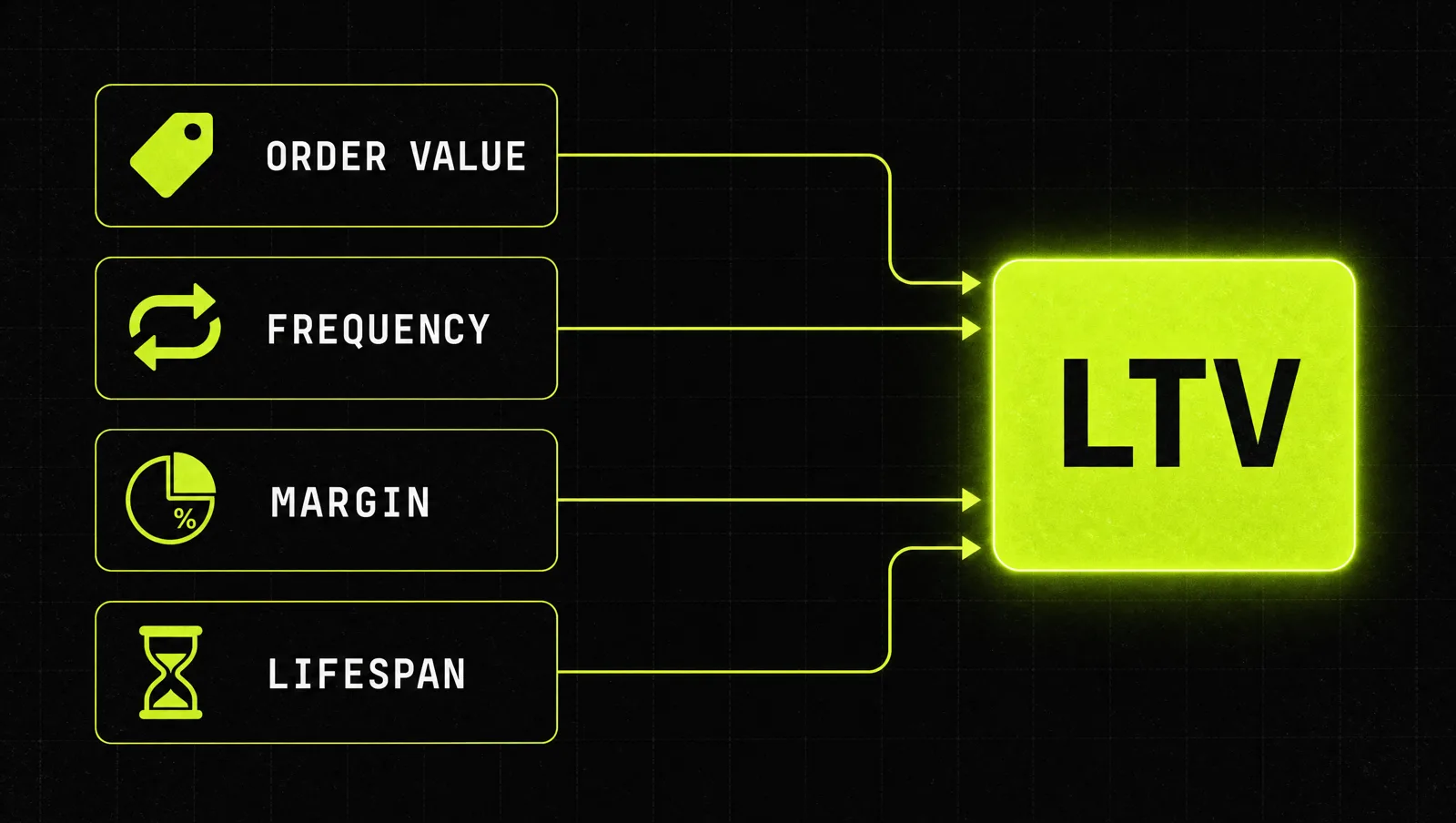
Every LTV formula combines four levers: spend, frequency, margin and time.
| Lever | What it measures | How you raise it |
|---|---|---|
| Order value | What a customer spends per purchase or per month | Upsells, bundles, higher tiers, better pricing |
| Purchase frequency | How often they buy | Consumables, reminders, subscriptions, a reason to come back |
| Gross margin | The share of revenue you keep after delivery costs | Productize delivery, cut service cost, stop discounting |
| Lifespan | How long they stay a customer | Faster first result, onboarding, success check ins, win backs |
Formula 1, for one-off purchases (shops, services, agencies):
LTV = average order value x purchases per year x years as a customer x gross margin
Formula 2, for subscriptions and retainers:
LTV = average monthly revenue per customer x gross margin / monthly churn rate
The second one works because 1 divided by your monthly churn rate gives you the average customer lifetime in months. If 5% of customers cancel each month, the average customer stays about 20 months.
A worked example
Say you run a subscription business:
- Average revenue per customer: $100 per month
- Gross margin: 70%, so you keep $70 a month
- Monthly churn: 5%, so the average customer stays 1 / 0.05 = 20 months
LTV = $70 x 20 = $1,400 in gross profit per customer.
Now cut churn from 5% to 4%. The average lifetime goes from 20 to 25 months, and LTV rises to $70 x 25 = $1,750. One percentage point of churn added 25% to the value of every customer, without a single new sale. That is why retention work pays off so fast, and why Bain's Frederick Reichheld found that raising retention by 5% can lift profits by 25% to 95%.
The LTV:CAC ratio
LTV on its own tells you little. It becomes useful when you compare it with customer acquisition cost (CAC): everything you spend on marketing and sales, divided by the number of new customers it brought in.
LTV:CAC = LTV / CAC
In the example, if a new customer costs $400 to acquire, the ratio is $1,400 / $400 = 3.5 to 1. Each dollar spent on acquisition returns $3.50 of gross profit over the customer's life.
How to read it, based on Harvard Business School Online:
- Below 1: you lose money on every customer you win. More marketing makes it worse.
- Around 3 or higher: HBS Professor Christina Wallace calls three or higher an attractive rule of thumb.
- Below 3: the article suggests revisiting the value proposition, go to market or pricing.
A very high ratio can also mean you are underinvesting in growth.
How to increase customer lifetime value in 5 steps
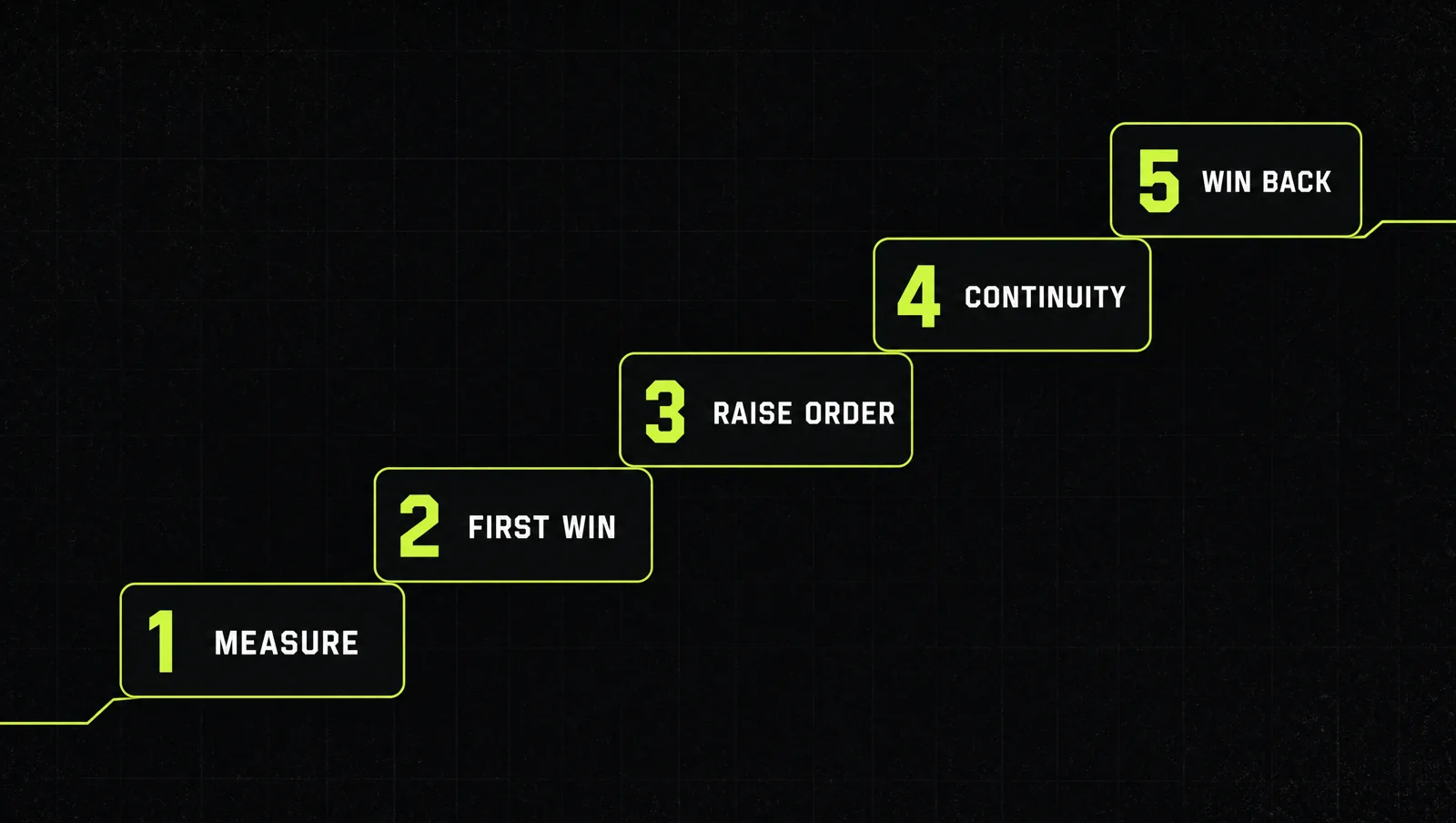
Step 1: Measure your real numbers by cohort
Group the last 12 months of customers by the month they joined. For each group, track revenue, gross margin and how many still buy after 1, 3, 6 and 12 months. One average hides the truth; cohorts show whether your changes make newer customers stay longer.
Step 2: Fix the first 30 days
Most churn is decided early. Customers who get a clear result in the first weeks stay; confused, waiting ones leave. Map the path from payment to first result and remove every delay: a welcome call, a done for you setup, a checklist, one quick win you can deliver in days. This is the same logic as cutting time delay and effort in a Grand Slam Offer.
Step 3: Raise order value at the moment of yes
The easiest time to sell more is right after someone buys. Offer a natural next step at checkout or on the kickoff call: a higher tier, a bundle, a faster version, a done for you add on. Then offer a smaller option to people who say no. We break this sequence down in how to make more money per customer.
Step 4: Add continuity
If customers only pay you once, give them a reason to keep paying: a membership, a maintenance plan, a retainer, a refill subscription, a monthly review. Recurring revenue turns one sale into a sale times months. Annual prepaid plans help too: a customer who paid for a year has a full year to get results.
Step 5: Win back and expand
Treat every cancellation as data: ask why they left, fix the top reason, and build a simple win back offer. Then look at your best customers and ask what else they buy elsewhere that you could deliver. More users, locations or services is how the best subscription businesses grow.
A real case: how Salesforce keeps customers worth more every year

Salesforce is a useful case because it reports the number that drives its lifetime value in its annual report. From its Form 10-K for the fiscal year ended January 31, 2025:
- Total revenue was $37.9 billion, and subscription and support revenue was $35.7 billion, about 94% of the total. Almost all of the business is recurring.
- Salesforce defines attrition as the reduction or loss of the annualized value of its customer contracts, measured on a trailing twelve month basis. As of January 31, 2025, its attrition rate, excluding Slack self service, was approximately 8%, consistent with the prior year.
- Subscription contracts typically run 12 to 36 months, and customers have no obligation to renew.
- The growth in subscription and support revenue came mainly from new business, which the company says includes new customers, upgrades and additional subscriptions from existing customers. Pricing was not a significant driver.
- One of its stated priorities is to deepen existing customer relationships through cross selling and upselling.
- Sales and marketing cost $13.3 billion, about 35% of revenue. Winning customers is expensive.
A quick back of the envelope, which is our math and not a Salesforce figure: if roughly 8% of contract value is lost per year, an average dollar of contract value stays for around 12 years (1 / 0.08) before counting any upsells.
Look at it through the system:
- Lifespan: low attrition means each customer pays for many years, which is what justifies spending over a third of revenue on sales and marketing.
- Order value: growth comes from existing customers buying more products and more subscriptions, not from raising prices.
- Continuity: 94% recurring revenue and multi year contracts turn each sale into a stream.
- Measurement: attrition is tracked monthly and reported yearly.
The lesson: a high acquisition cost is not the problem if customers stay for years and keep buying more. Fix lifespan and expansion first, and you earn the right to spend more on growth.
Three use cases
The examples below are illustrative, not real clients. They show how the same five steps change very different businesses.
Use case 1: Marketing agency
Before: $3,000 a month retainers, 60% gross margin, clients leave after about 6 months. LTV = $1,800 x 6 = $10,800. A new client costs $4,000 in sales time and ads, so LTV:CAC is 2.7.
After: a 14 day launch plan so the first campaign goes live in week two, a monthly results review, and a reporting add on. Average stay rises to 10 months and LTV to $18,000. Same CAC, ratio 4.5.
Use case 2: Coach or course creator
Before: a one time $1,000 program, 80% margin, no follow up. LTV = $800. Ads cost $350 per buyer, ratio 2.3.
After: a $97 a month community for graduates, joined by 40% of buyers who stay 8 months on average, at an 80% margin. That adds about $250 of margin per buyer on average and lifts LTV to around $1,050, a ratio of 3.
Use case 3: SaaS or digital product
Before: $49 a month, 85% margin, 6% monthly churn. Lifetime is about 17 months, LTV about $700.
After: guided setup that delivers the first result on day one, an annual plan with two months free, and a team tier. Churn drops to 4%, lifetime to 25 months, and LTV passes $1,000 before any upgrade revenue.
How we run this with Claude
Inside CopyPasteCEO we run this as a short sequence of Claude prompts, in one chat so Claude keeps the context. Here are the first two, copy paste ready. Fill in the brackets.
Prompt 1: calculate your LTV and LTV:CAC
Make it yours · 0/5 filled
You are a unit economics advisor. My business: [WHAT YOU SELL] to [WHO]. Here are my numbers: average order value or monthly price [AMOUNT], purchases per year [NUMBER], gross margin [PERCENT], monthly churn or average customer lifespan [NUMBER], total marketing and sales spend last quarter [AMOUNT], new customers last quarter [NUMBER]. Calculate my customer lifetime value in gross profit, my CAC and my LTV:CAC ratio. Show every step of the math. Then tell me which of the four levers (order value, frequency, margin, lifespan) is weakest and what a one point improvement in it would add to LTV.Prompt 2: build a 30 day LTV plan
Make it yours · 0/3 filled
My weakest LTV lever is [LEVER]. Here is how a new customer experiences my business from payment to first result: [DESCRIBE THE STEPS]. Here are the top three reasons customers leave or stop buying: [REASONS]. Give me five concrete changes that would improve this lever within 30 days, ranked by impact and effort. For each one, tell me which number to track and what result would prove it works.These two prompts give you your real numbers and a first plan. Choosing the lever, pricing the upsell and designing a continuity offer people keep paying for is where judgment matters more than a formula.
Where most people get stuck
Calculating LTV takes an hour. Raising it takes months. The usual reasons founders stop:
- They measure revenue instead of profit. LTV looks great on paper, so they overspend on ads and wonder why cash is always tight.
- They only chase new customers. Every hour goes into acquisition while churn quietly erases the growth.
- They change everything at once. Without cohorts they can't tell which change worked, so they never double down on it.
That is exactly the gap the Inner Circle is built for: the playbooks to raise the value of every customer, a new playbook every week, and founders who are building their own businesses next to you.