How to Get More Leads: Hormozi's Core Four (Step by Step)

Once your offer is strong, a new problem shows up: not enough people know it exists. You post when you have time, send a few messages when things are quiet, try ads for a week, and nothing adds up to a steady flow of people who want to talk to you.
Alex Hormozi's book $100M Leads is the follow-up to $100M Offers and solves exactly this. This guide shows you how to get more leads with it. It isn't a chapter-by-chapter summary. It turns the core ideas into a system you can run: what the system is, the five steps to run it, the real case of how Dropbox made one part of it work while its ads failed, three worked use cases and the Claude prompts we use. For all the depth and stories, read the book.
The short version:
- Stop doing random acts of marketing. Pick one of four channels and run it every day.
- The four channels are warm outreach, content, cold outreach and paid ads. Everything else is a variation.
- Give people a reason to raise their hand: a lead magnet that solves one narrow problem completely.
- Do 100 actions a day on your channel, count engaged leads, fix the weakest step.
- Then let others bring leads for you: customers, employees, agencies and affiliates.
The problem the system solves
Most founders don't lack leads because their market is too small. They lack leads because their lead generation is a mood. A good week of posting, then nothing. Ten messages, then a month of silence.
Hormozi separates two things that most people mix up:
- A lead is simply someone you can contact.
- An engaged lead is someone who has shown interest: they replied, booked, downloaded or asked a question.
Your business runs on engaged leads. So that is the number the whole system is built to increase, and the only number you track at first.
The core: the Core Four
There are only four ways to let people know about you. They come from two simple questions: do you reach one person at a time or many at once, and do these people already know you or not?
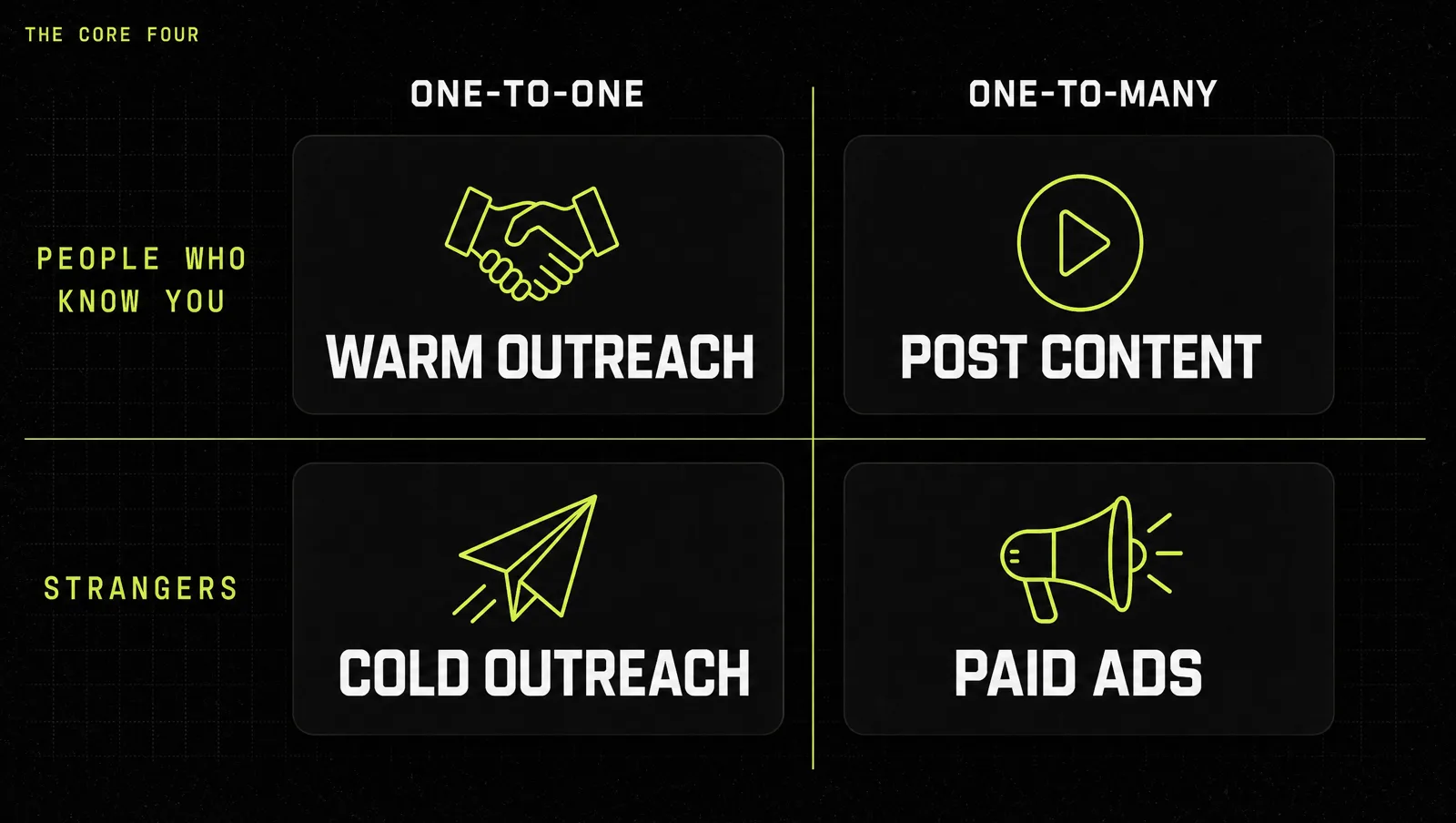
| Channel | Who | How | Best for |
|---|---|---|---|
| Warm outreach | People who know you | One-to-one | Your first customers, fast, for free |
| Post content | People who follow you | One-to-many | Compounding reach and trust over time |
| Cold outreach | Strangers | One-to-one | Predictable pipeline once you have a script |
| Paid ads | Strangers | One-to-many | Scaling what already converts |
Warm outreach costs nothing but a little courage and almost always gets the first customers fastest. Content is slow at first and then compounds. Cold outreach and paid ads bring in strangers, which is where real scale comes from, but they punish a weak offer and a weak message fastest.
How to get more leads in 5 steps
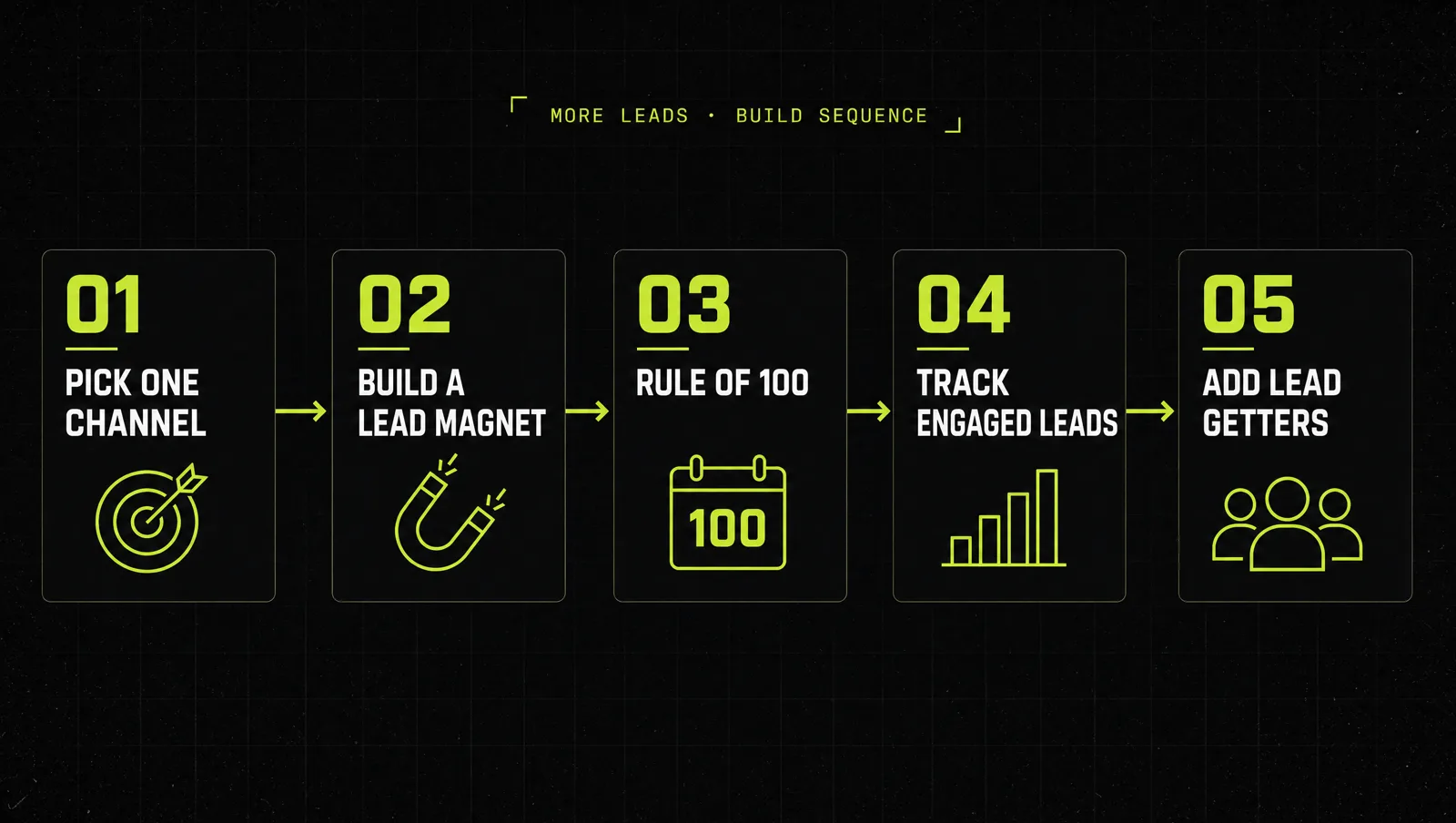
Step 1: Pick one channel you can start today
Not four. One. For most early businesses that is warm outreach: go through your contacts and start real conversations. Don't pitch in the first message. Reconnect, show genuine interest in what they are doing, and only then ask whether they know anyone who has the problem you solve.
Step 2: Build a lead magnet
A lead magnet is a small, free offer that gets the right people to raise their hand. The best ones solve one narrow problem completely, so the person thinks: "If the free thing is this good, the paid thing must be great." There are three reliable types:
- Reveal a problem they didn't know they had, for example an audit, a scorecard or a quiz.
- A sample or trial of the real thing.
- One step of a multi-step process, done completely.
Give away the secrets, sell the implementation.
Step 3: Do the Rule of 100
This is the part that separates people who get leads from people who talk about it. Every single day, do 100 primary actions on your channel: 100 outreach messages, or 100 minutes of making content, or $100 in ads. Do it for 100 days before you judge the channel. Volume beats cleverness at the start.
Step 4: Track engaged leads and fix the weakest step
Count, every day, how many engaged leads each action produced. When the number is low, it is almost always one of three things: people don't stop (weak hook), people don't care (weak lead magnet), or people don't act (weak call to action). Fix one at a time.
Step 5: Add Lead Getters
Once you have one channel working, let other people bring leads for you. Hormozi names four kinds of lead getters: customers who refer, employees who run the Core Four for you, agencies that run it for a fee, and affiliates who promote you for a cut. This is where lead flow stops depending on your personal time.
Making it scale: More, Better, New
When something works, the order matters. First do more of it (more messages, more posts, more budget). Then make it better (a stronger hook, a sharper lead magnet). Only when both are maxed out, add something new: a second channel or a lead getter. Most people do it the other way round and end up with five half-working channels.
A real case: how Dropbox turned users into its best lead source
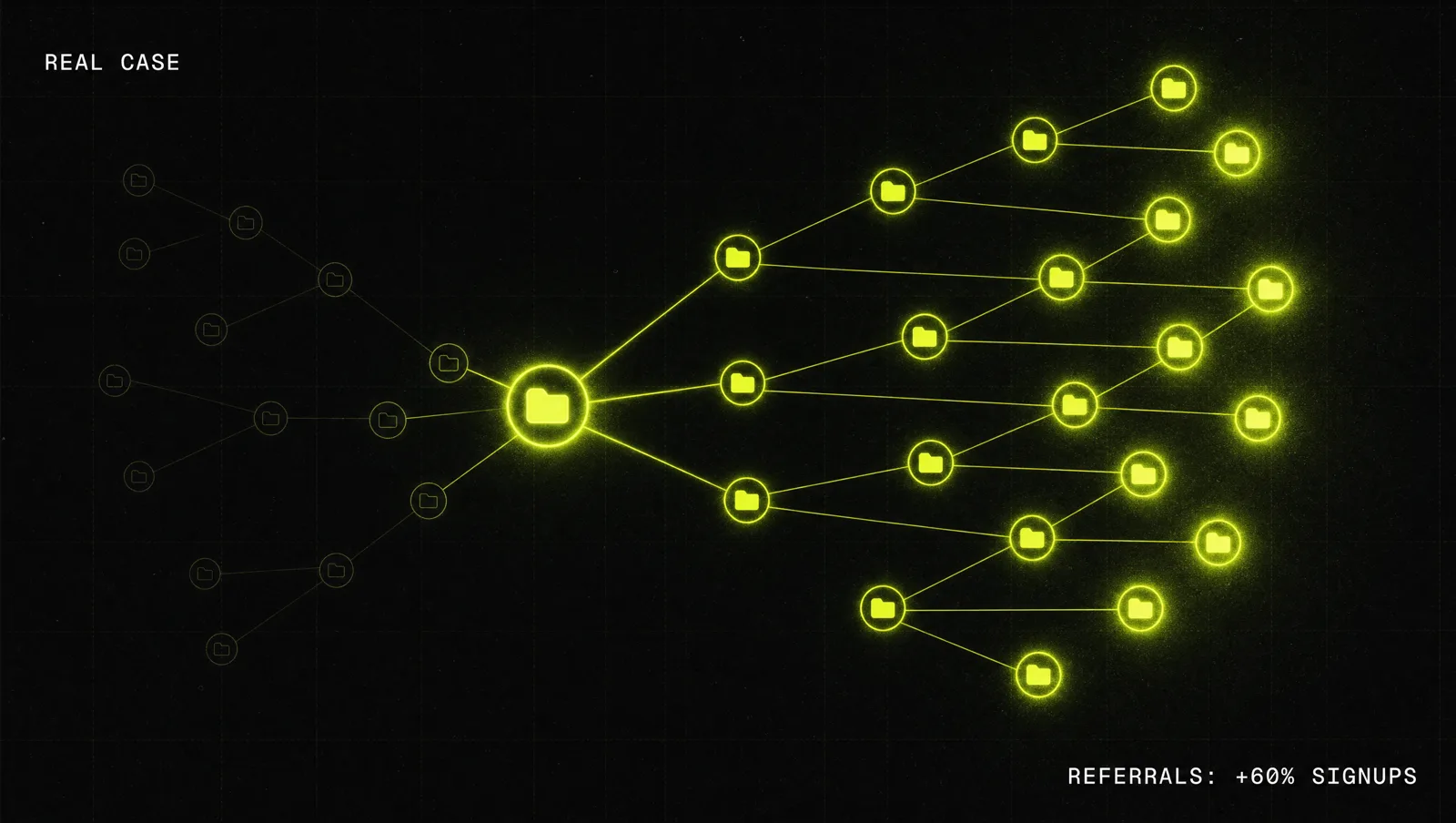
Dropbox is one of the clearest public examples of this system, because its founder published the numbers.
In 2010, Dropbox co-founder Drew Houston showed how the company had tried the classic route first: paid search ads. It didn't work. Acquiring one customer through search ads cost between $233 and $388, for a product that cost $99 (Drew Houston, Startup Lessons Learned 2010). A paid channel can't work when every customer costs more than they pay.
So Dropbox built a lead getter instead: a referral program where both the person inviting and the new user got extra free space. According to Houston's slides:
- The referral program permanently increased signups by 60%.
- 35% of daily signups came through referrals.
- In April 2010 alone, users sent 2.8 million referral invites.
- Dropbox grew from 100,000 registered users in September 2008 to 4 million in January 2010.
Look at it through the system. Paid ads (one of the Core Four) failed on the numbers. Customers as lead getters (step 5) worked because the incentive rewarded both sides and the product was good enough that people wanted to share it.
The lesson: you don't have to win on every channel. You have to find the one where your numbers work, and then get others to bring leads for you.
Three more use cases
The examples below are illustrative, not real clients. They show how the same system looks in very different businesses.
Use case 1: Local service business
Before: a cleaning company posts on Facebook "whenever there's time" and waits for the phone to ring.
After:
- Channel: warm outreach first. Every past customer gets a personal message and a small thank-you offer for a referral.
- Lead magnet: "Free 10-minute home check: the 5 spots that are never cleaned properly."
- Rule of 100: 100 messages a day to past customers, neighbours and local businesses for the first month.
- Lead getter: happy customers get a free cleaning for every new client they send.
Use case 2: B2B consultant
Before: relies on "word of mouth" and one conference a year.
After:
- Channel: cold outreach to a tightly defined list, for example operations leads at logistics companies with 50 to 200 employees.
- Lead magnet: a free cost-leak audit with a one-page report.
- Rule of 100: 100 personalized messages a day, tracked in a simple sheet: sent, replied, booked.
- Better: after 30 days, rewrite the first line of the message that gets the lowest reply rate.
Use case 3: Creator or info product
Before: posts every day, grows followers, but nobody buys.
After:
- Channel: content, with every post ending in one clear next step.
- Lead magnet: a free checklist or template that solves one problem the paid product solves in depth.
- Rule of 100: 100 minutes of content work every day, measured by lead magnet downloads, not likes.
- Lead getter: affiliates from the audience who earn a share of every sale.
How we run this system with Claude
Inside CopyPasteCEO we run this as a set of Claude prompts, one chat so Claude keeps the context. Here are the first two, copy-paste ready. Fill in the brackets.
Prompt 1: pick your channel with the Core Four
Make it yours · 0/3 filled
You are a lead generation strategist trained on the Core Four (warm outreach, content, cold outreach, paid ads). My business: [WHAT YOU SELL], to [WHO], at [PRICE]. My situation: [CONTACTS IN YOUR NETWORK, AUDIENCE SIZE, AD BUDGET PER MONTH, HOURS PER DAY]. Score each of the four channels from 1 to 10 for my situation and explain each score in one sentence. Pick the ONE channel I should run for the next 100 days and write my daily Rule of 100 plan for it.Prompt 2: build a lead magnet that gets hands raised
Make it yours · 0/3 filled
My ideal customer is [WHO] and their most painful problem is [PROBLEM]. My paid offer solves [WHAT YOUR OFFER SOLVES]. Give me 5 lead magnet ideas, at least one of each type: reveal a problem, sample or trial, one step of the process. For each: the name, what exactly they get, why it makes them want the paid offer, and the one-line call to action at the end. Then tell me which one to build first and why.These two prompts get you a channel and a reason for people to raise their hand. Scripts for outreach, content hooks and follow-ups are where most people get stuck, because that is where practice matters more than templates.
Where most people get stuck
Knowing the Core Four takes ten minutes. Running it for 100 days is the hard part. The usual reasons people stop:
- They switch channels too early. Two weeks of content, then ads, then cold email. None of them gets enough volume to work.
- They skip the lead magnet. "Book a call" is a big ask from a stranger. A small, useful free step converts far better.
- They don't count. Without a daily number for engaged leads, there is no way to tell what to fix.
That is exactly what the Inner Circle is built for: the outreach, content and lead magnet playbooks, a new playbook every week, and founders who are running their own 100 days next to you.