Blue Ocean Strategy: How to Find Uncontested Market Space (Step by Step)
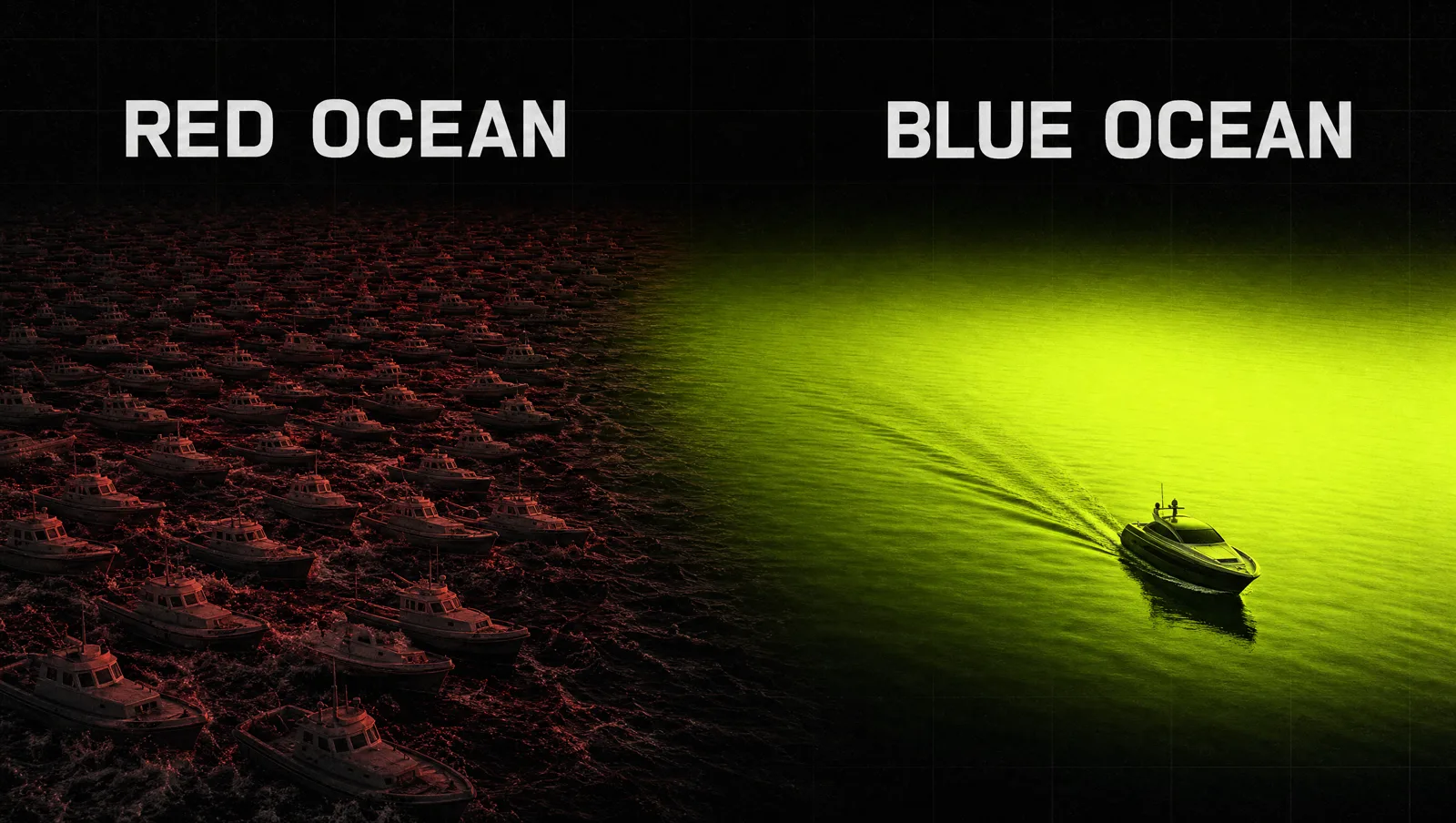
Most founders compete in a market that was crowded before they arrived. Same features, same channels, same price range as everyone else. Every month the ads get more expensive, the margins get thinner, and the only lever left seems to be a discount.
W. Chan Kim and Renée Mauborgne, professors at INSEAD, gave this situation a name: a red ocean. Their answer, Blue Ocean Strategy, first appeared as an article in Harvard Business Review in October 2004 and later became a bestselling book. This guide shows you how to find a blue ocean for your own business. It isn't a chapter-by-chapter summary. It turns the core ideas into a system you can run: what the system is, the five steps to run it, the real case of Cirque du Soleil, three worked use cases and the Claude prompts we use. For the full research and all the cases, read the book.
The short version:
- Red oceans are existing markets where you fight rivals for the same demand. Blue oceans are market spaces nobody competes in yet.
- You rarely find a blue ocean far away. Most are built from inside a red ocean by redrawing its boundaries.
- The goal is value innovation: more value for the buyer and lower cost for you, at the same time.
- The main tool is the Four Actions Framework: eliminate, reduce, raise, create.
- You draw it on a strategy canvas, so you can see whether your offer actually looks different from the market.
The problem the system solves
In a red ocean, everyone benchmarks everyone else. When a competitor adds a feature, you add it too. When they cut the price, you follow. Kim and Mauborgne describe how, as a space gets more crowded, products turn into commodities and the fight for share gets so intense that the water, in their picture, turns red (HBR, 2004).
The classic advice says you have to choose: be the premium option with higher costs, or be the cheap option with less value. Blue ocean strategy rejects that choice. According to the authors, the companies that created new market space pursued differentiation and low cost simultaneously. They call this value innovation (blueoceanstrategy.com).
| Red ocean strategy | Blue ocean strategy | |
|---|---|---|
| Where | Compete in existing market space | Create uncontested market space |
| Goal | Beat the competition | Make the competition irrelevant |
| Demand | Fight over existing demand | Create and capture new demand |
| Trade-off | Choose value or low cost | Break the value and cost trade-off |
Based on the red ocean versus blue ocean comparison in the HBR article.
The core: the Four Actions Framework
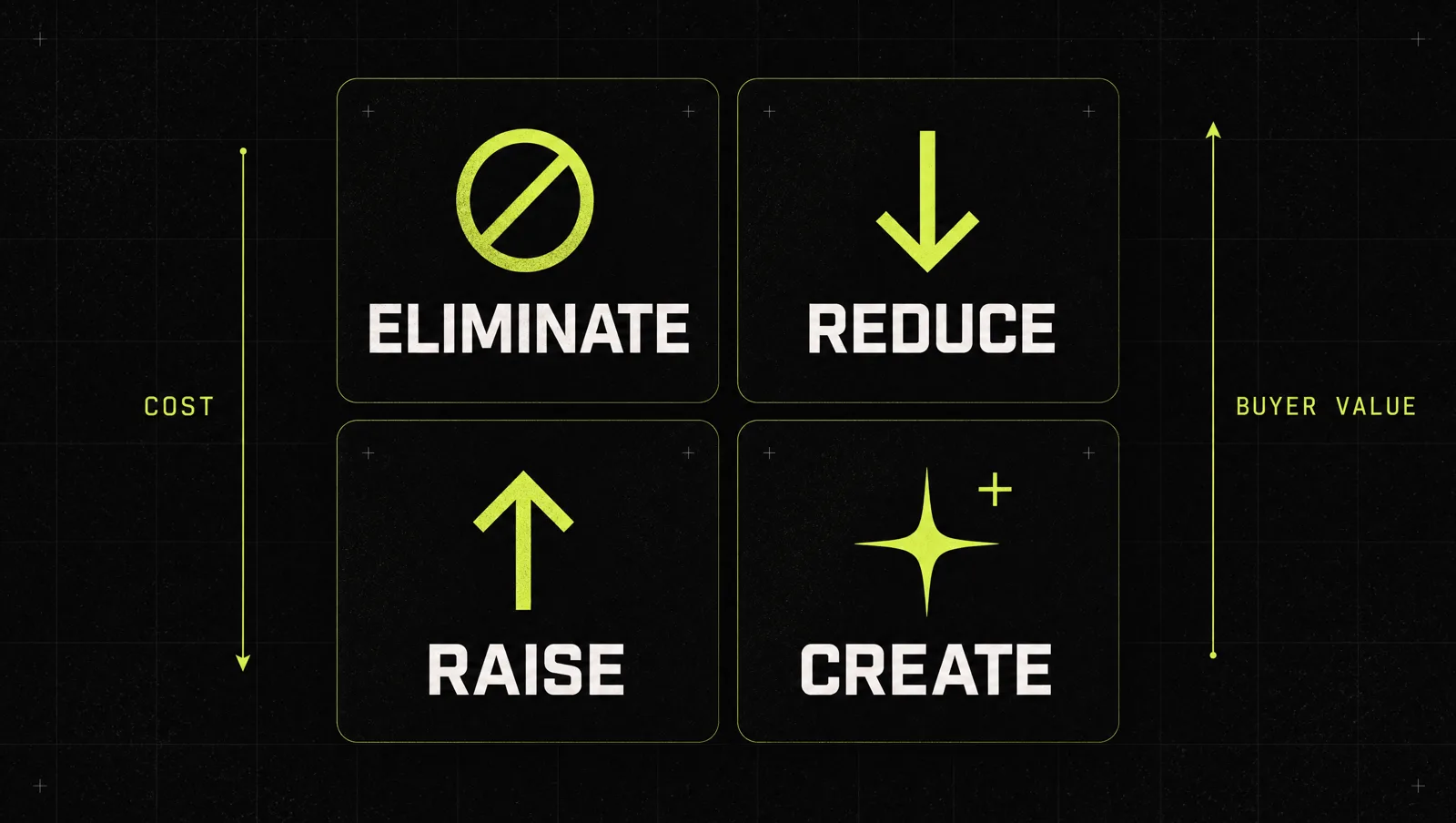
If you want more value and lower cost at once, you can't just add things. You also have to remove things. The Four Actions Framework forces both, by asking four questions about the factors your industry competes on (blueoceanstrategy.com):
| Action | The question | What it does |
|---|---|---|
| Eliminate | Which factors that the industry takes for granted should go completely? | Cuts cost |
| Reduce | Which factors should be reduced well below the industry standard? | Cuts cost |
| Raise | Which factors should be raised well above the industry standard? | Lifts buyer value |
| Create | Which factors has the industry never offered that you should create? | Lifts buyer value |
The first two actions lower your cost structure. The last two raise the value buyers get. When you write all four answers into one table, it is called the ERRC grid (eliminate, reduce, raise, create), and the authors stress that you act on all four, not just one (blueoceanstrategy.com).
This is the same destination as a Grand Slam Offer: a category of one, where the buyer has nothing to compare you to. The Grand Slam Offer gets there by stacking value into the offer. Blue ocean strategy gets there by redrawing what the whole market competes on.
How to find your blue ocean in 5 steps
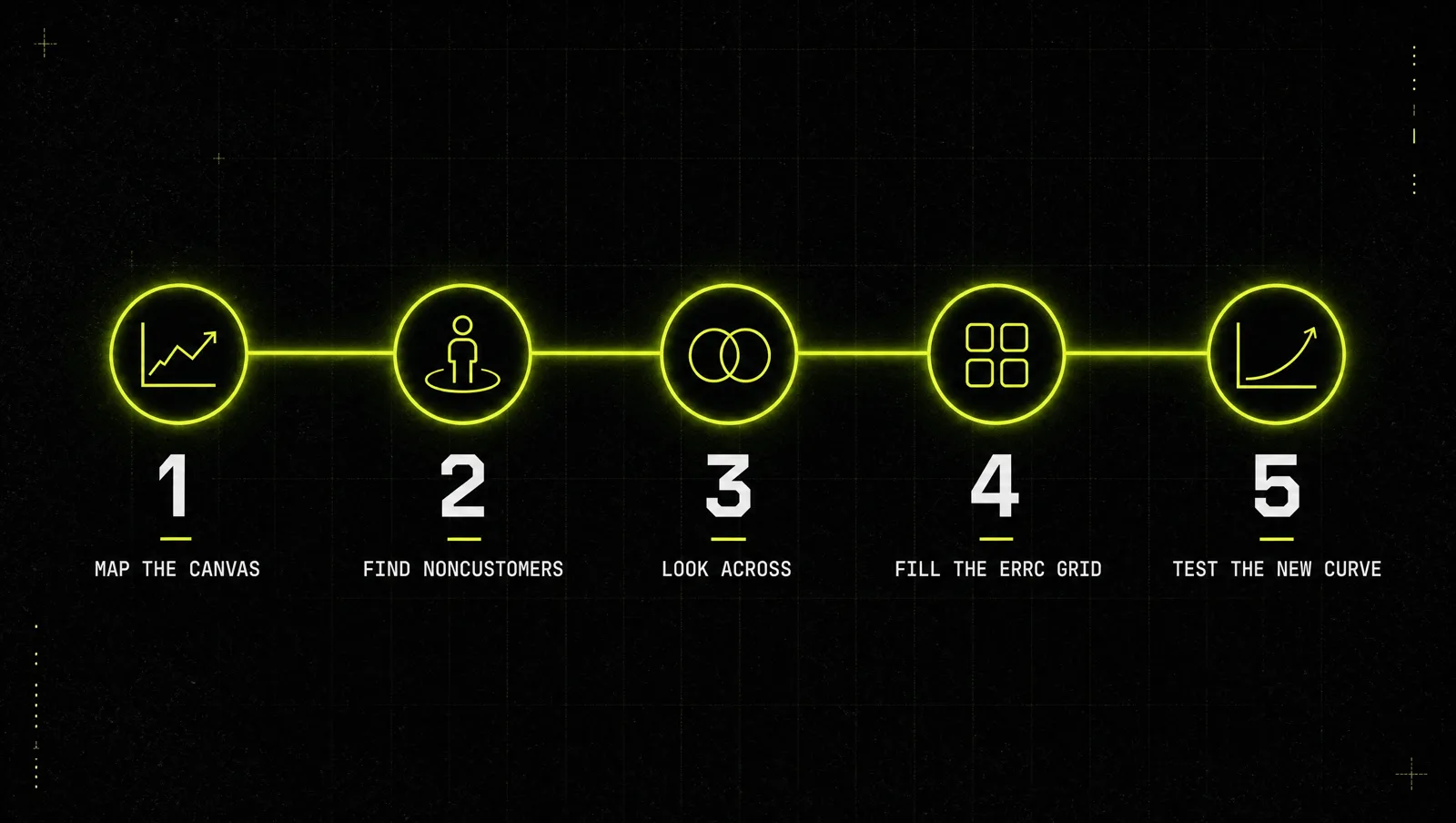
Step 1: Draw the strategy canvas of your market
The strategy canvas is a simple chart. On the horizontal axis you list the factors your industry competes on: price, features, support, speed, brand, whatever buyers compare. On the vertical axis you mark how much of each factor a player offers. Connect the dots and you get a line, which the authors call the value curve (blueoceanstrategy.com).
Draw the curve for your three biggest competitors and for yourself. If the lines look almost the same, you are in a red ocean, and you now have proof.
Step 2: Look at the noncustomers
Your competitors all fight over the same current buyers. The bigger opportunity is often the people who don't buy from anyone in your market at all. Ask: who could use what we do but chooses something else, or nothing? Why? Every reason is a factor you might eliminate, reduce, raise or create.
Step 3: Look across alternatives
Buyers solving the same job often choose between very different industries. A night out can be a circus, a theater show or a concert. Look at why people pick the alternative industry, and which of its strengths you could borrow. This is how most blue oceans are made: from inside an existing market, by breaking the boundary to a neighbouring one (HBR, 2004).
Step 4: Fill the ERRC grid
Now take every factor on your canvas and put it into one of the four boxes. Be honest about the eliminate and reduce boxes. Most founders only add. Ask for each factor: do buyers really value this, or does the industry only offer it because everyone else does? Then pick one or two factors to raise well above the market, and at least one new factor nobody offers.
Step 5: Draw your new value curve and test it
Draw your new line on the same canvas. A good blue ocean curve looks clearly different from the rest: low where they are high, high where they are low, and with at least one point nobody else has. If you can't describe the difference in one short sentence, it isn't clear enough yet. Then test it with real buyers, especially the noncustomers from step 2, before you rebuild the business around it.
Why most "differentiation" isn't a blue ocean
Adding a premium tier, a new feature or a nicer brand is not a blue ocean. It raises your cost and keeps you on the same canvas as everyone else. The test is simple: did your cost go down while buyer value went up? If you only did one of the two, you are still competing, just a little differently.
A real case: how Cirque du Soleil reinvented the circus

Cirque du Soleil is the opening case of the original HBR article, and the authors still call it perhaps the best-known example of blue ocean strategy (blueoceanstrategy.com).
According to Kim and Mauborgne in HBR, Cirque was founded in 1984 by a group of street performers. The circus industry at the time was in long-term decline. Children, the core audience, were turning to video games. Animal rights groups were pushing against animal acts. Star performers could dictate their terms. Audiences shrank while costs rose, and Ringling Bros. and Barnum & Bailey had set the standard for most of the century.
Cirque did not try to beat Ringling. The tagline of one of its first productions says it all: "We reinvent the circus." The HBR article reports that Cirque grew revenue 22-fold over the ten years before 2004, that its shows had been seen by some 40 million people in 90 cities, and that in 20 years it reached revenues that took Ringling more than a century. Today, blueoceanstrategy.com puts the audience at more than 150 million spectators in more than 300 cities.
Look at it through the system, using what the HBR article describes:
- Eliminate: animal acts, which were expensive to buy, train, house, insure and transport. Promoting performers as stars. Aisle concession sales, whose high prices annoyed parents.
- Reduce: the three-ring format, which confused spectators and required more performers. The acrobats stayed, but with smaller roles and more artistic flair.
- Raise: the tent. Many circuses had moved to rented venues. Cirque made the tent a glamorous symbol, with a much higher level of audience comfort.
- Create: elements borrowed from theater: a theme and story line for each show, an original musical score, abstract and spiritual dance, and multiple productions, so people had a reason to come back more often.
The buyer changed too. Instead of children, Cirque pulled in adults and corporate clients who had been noncustomers of the circus and were used to theater, opera or ballet. They were prepared to pay several times the price of a conventional circus ticket (HBR, 2004). And because the most expensive circus elements were gone, the cost structure dropped at the same time.
The lesson: Cirque didn't win the circus market. It left it. It removed what the industry took for granted, borrowed what a neighbouring industry did best, and sold it to people who had never been circus customers.
Three more use cases
The examples below are illustrative, not real clients. They show how the same system changes very different businesses.
Use case 1: Marketing agency
Before: a full-service agency with 40-page reports, monthly strategy meetings and every channel on offer. Its value curve looks like every other agency's.
After:
- Eliminate: the long monthly reports and the long-term contracts.
- Reduce: the channels, down to one channel the agency is the best at.
- Raise: speed. First campaign live in 7 days instead of 6 weeks.
- Create: a live dashboard the client checks any time, plus a fixed price per booked call.
Noncustomers who never trusted agencies (small practices burned by retainers) suddenly become buyers.
Use case 2: Fitness or coaching business
Before: a gym competing on equipment, opening hours and monthly price with three other gyms on the same street.
After:
- Eliminate: the huge equipment floor and the long contract.
- Reduce: opening hours, down to fixed class times.
- Raise: personal accountability, with a coach who knows every member by name.
- Create: a 6-week program for people who have never been to a gym, borrowed from the structure of a course, not a membership.
The target is no longer gym-goers. It is people who hate gyms.
Use case 3: SaaS or digital product
Before: a project management tool racing competitors on the number of features and integrations.
After:
- Eliminate: most custom settings and the enterprise feature list.
- Reduce: onboarding from weeks to one setup call.
- Raise: templates built for one niche, for example construction firms.
- Create: done-for-you setup and a weekly summary sent by email, so the boss never has to log in.
The product gets cheaper to build and support, and it now wins buyers who never used project software at all.
How we run this system with Claude
Inside CopyPasteCEO we run this as a set of Claude prompts, in one chat so Claude keeps the context. Here are the first two, copy-paste ready. Fill in the brackets.
Prompt 1: draw your strategy canvas
Make it yours · 0/6 filled
You are a strategist trained on Blue Ocean Strategy by W. Chan Kim and Renée Mauborgne. My business: [WHAT YOU SELL], to [WHO], at [PRICE]. My three main competitors: [COMPETITOR 1], [COMPETITOR 2], [COMPETITOR 3]. List the 8 to 12 factors buyers in this market compare on. Score me and each competitor from 1 to 10 on every factor as a table, so it works as a strategy canvas. Then tell me honestly where my value curve looks the same as everyone else's.Prompt 2: fill the ERRC grid
Make it yours · 0/2 filled
Using the strategy canvas above, build an ERRC grid (eliminate, reduce, raise, create) for my business. My noncustomers are [WHO COULD BUY BUT DOESN'T] and the alternative they choose instead is [WHAT THEY DO INSTEAD]. For every factor, say which box it goes in and why, and what it does to my cost and to buyer value. Add at least two factors nobody in my market offers today. Finish with my new value curve and a one-sentence description of it.These two prompts give you a canvas and a first ERRC grid. Choosing which move to actually make, pricing it and testing it with real noncustomers is where most people get stuck, because that is where judgment matters more than templates.
Where most people get stuck
Understanding blue ocean strategy takes an evening. Actually leaving your red ocean is much harder. The usual reasons people stop:
- They only add, never cut. Without the eliminate and reduce boxes, a "blue ocean" is just a more expensive version of the same offer.
- They ask current customers only. The biggest insights sit with noncustomers, and nobody talks to them.
- They never test the new curve. The ERRC grid stays a slide instead of becoming an offer, a sales page and a price test.
That is exactly the gap the Inner Circle is built for: the playbooks to run it, a new playbook every week, and founders building their own category next to you.