Pricing Strategy for Founders: Value Based Pricing, Price Anchoring and Good/Better/Best (Step by Step)
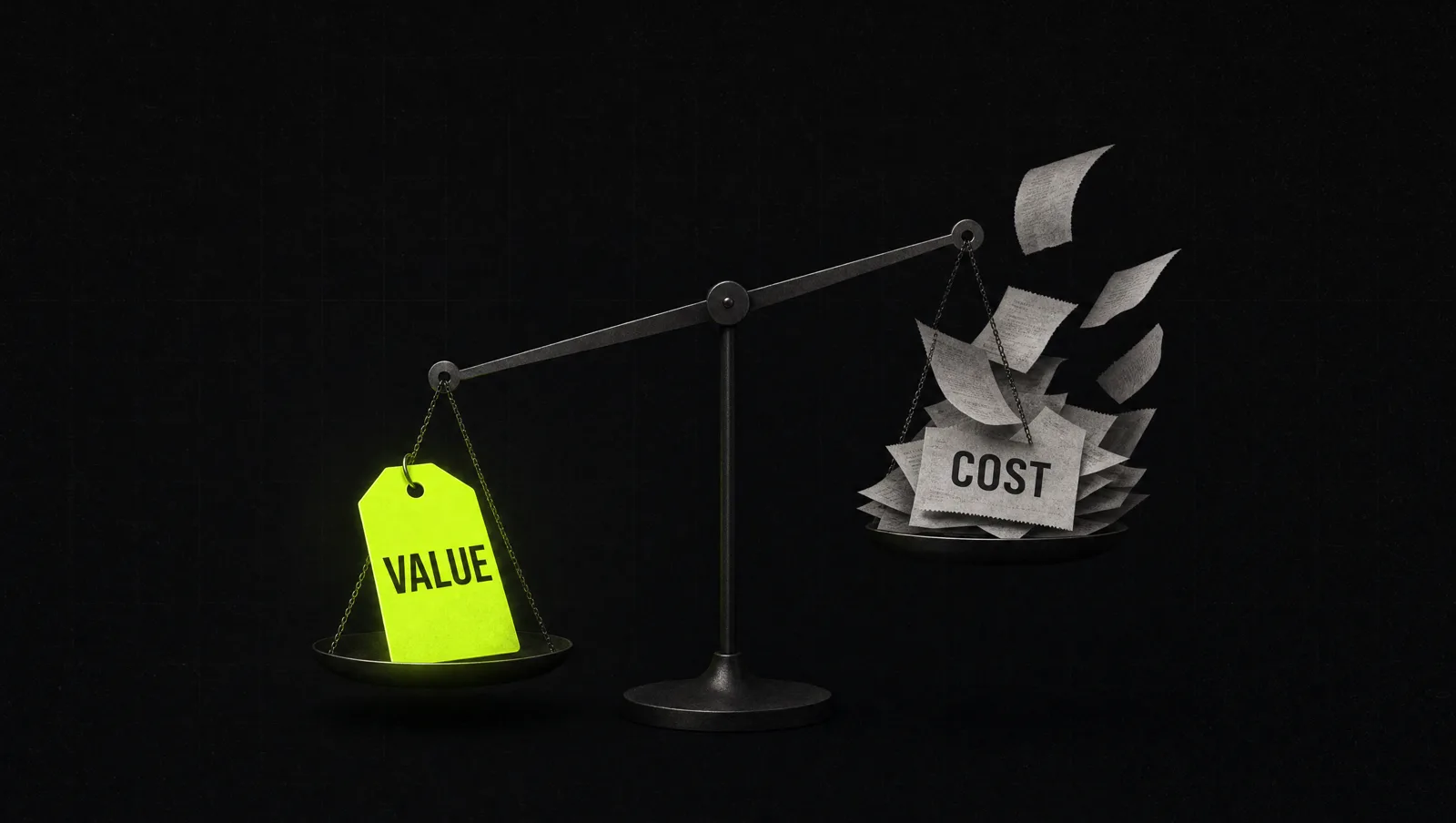
Most founders set their price once, in an afternoon, and never touch it again. They add up costs, glance at two competitors, pick a number that feels safe and move on. Then they spend two years trying to fix with more leads what a better price would have fixed in a week.
Price is the fastest lever in your business, because every change goes straight to profit. This guide shows you how to build a pricing strategy around value instead of costs, as a system you can run: the three ways to set a price, how price anchoring and good/better/best packaging shape what people buy, a 5-step method to set and test your price, a real anchoring experiment, and the Claude prompts we use.
The short version:
- Cost-plus asks what you spent, competitor-based asks what others charge, value based pricing asks what the result is worth to the buyer. Only the last has no built-in ceiling.
- Buyers rarely judge a price on its own. They judge it against the options next to it, which is why price anchoring works.
- Good/better/best packaging turns "yes or no" into "which one", and gives you room to charge more for the buyers who want more.
- A price is a hypothesis. Set it from value, then test it with real buyers and real money.
- Anchoring and decoys work best on simple, number-based choices, so always test on your own market.
What is a value based pricing strategy?
Value based pricing means you set your price from the value the customer gets, not from what the product costs you or what competitors charge. You estimate what the result is worth to the buyer in money, time or risk avoided, and you charge a share of that value. Your costs only set the floor, and competitors only tell you what the buyer's next best alternative is.
Value pricing is the same idea under a shorter name. You stop asking "what does this cost me?" and start asking "what is this worth to them?" A pricing strategy is the full plan around that number: the model, the packaging, how the options are presented, and how you test and change the price.
The core: three ways to set a price
Every price is set with one of three logics, or a mix. Knowing which one you use is the first step to fixing it.
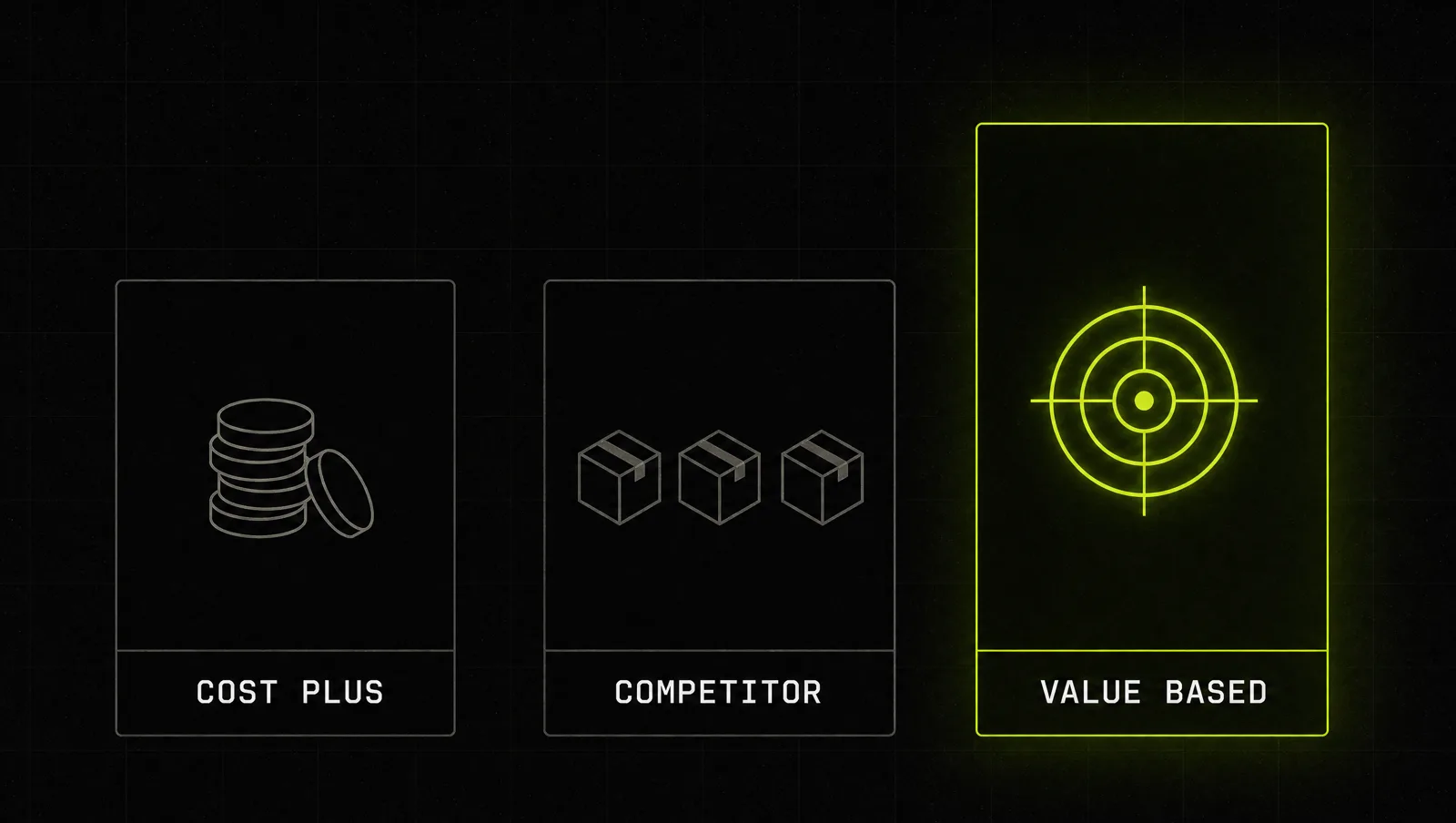
| Cost-plus | Competitor-based | Value based | |
|---|---|---|---|
| Starts from | Your costs plus a margin | What similar offers charge | What the result is worth to the buyer |
| Question it answers | "Do I make a profit?" | "Will I look normal?" | "What would they gladly pay for this outcome?" |
| Ceiling | Your own costs | The market average | The value you create |
| Main risk | Leaving most of the value on the table | A race to the bottom | Overestimating value you can't prove |
| Best used for | Setting your floor | Understanding the buyer's alternatives | Setting your actual price |
Cost-plus feels safe because the math is easy, but the buyer doesn't care how many hours a project takes you. Competitor-based pricing feels safe because nobody questions a normal price, but it quietly tells the buyer you are interchangeable, which is exactly the problem a Grand Slam Offer solves. Value based pricing keeps both in their place: costs set the floor, competitors show the alternatives, and value sets the number.
Price anchoring and good/better/best packaging
Once you know the value, two tools decide how that price is perceived.
Price anchoring means the first or most visible number a buyer sees becomes the reference point for every number after it. A $2,000 package looks expensive on its own. Next to a $6,000 package it looks reasonable. You aren't hiding anything, you are giving the buyer something to compare against.
Good/better/best packaging builds that comparison into your offer. Instead of one price, you offer three versions:
- Good: the core result, stripped down, for price-sensitive buyers.
- Better: the package you want most people to buy, priced from value.
- Best: more speed, service and certainty. A few buyers take it, and it anchors the middle.
The tiers should differ in value, not just quantity: speed, less effort and a stronger guarantee are what people pay for. If you want the upsell side of this, it connects directly to how to make more money per customer.
How to set your price in 5 steps
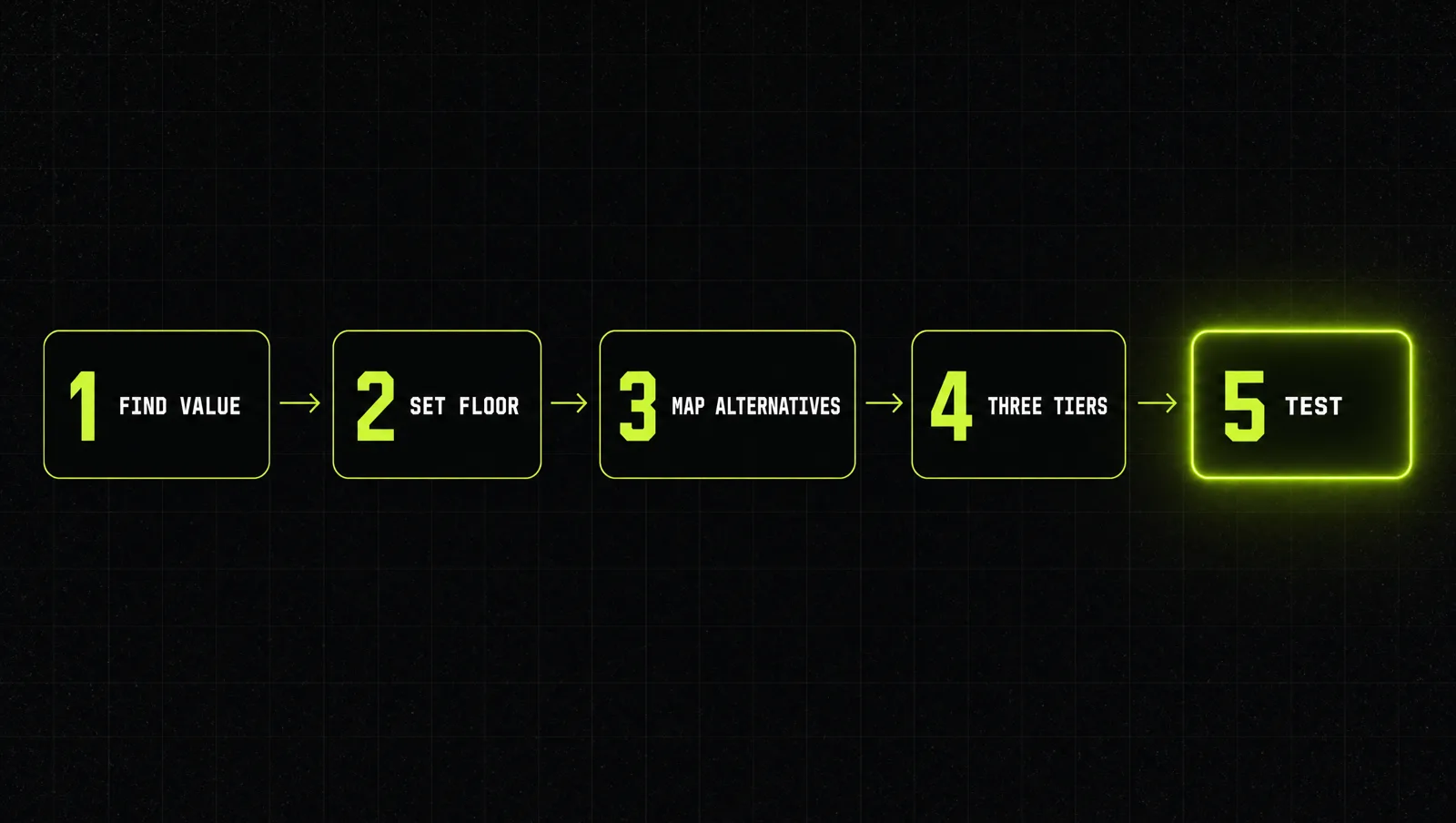
Step 1: Put a number on the value
Write down the result your buyer gets and translate it into money: more revenue, hours saved times their hourly value, a hire they don't need, a mistake they avoid. Use the buyer's numbers and be conservative. If you can't name the value, ask five customers what they used before, what it cost them, and what changed after.
Step 2: Set your floor with costs
Now do the cost-plus math, but only to find the line you can't go below. Include your time, tools, delivery and the cost of getting the customer. Anything below this floor loses money no matter how well it sells. Anything above it is a pricing decision, not an accounting one.
Step 3: Map the buyer's alternatives
List what the buyer would do if you didn't exist: a competitor, a freelancer, a hire, a tool plus their own time, or nothing. Put a real cost on each. That is the honest use of competitor pricing: understanding what you are compared against, not copying it. Your price sits between the best alternative and the value from Step 1.
Step 4: Package three tiers
Build good, better and best around the same core result. Price the middle tier from value, make the top tier a real step up in speed or certainty, and make the bottom tier clearly smaller. Show the top tier first or most prominently so it acts as the anchor. Write one line per tier that says who it is for.
Step 5: Test with real buyers and real money
A price is a hypothesis until someone pays it. Test on new customers only: quote the new price on the next ten sales calls, or show new tiers to new visitors. Track close rate, tier mix and revenue per customer. If nearly everyone says yes without a pause, your price is probably too low. If the close rate drops but revenue per customer rises more, the new price wins.
A real case: The Economist's subscription page
The best-known demonstration of price anchoring comes from behavioral economist Dan Ariely, and it started with a real ad.
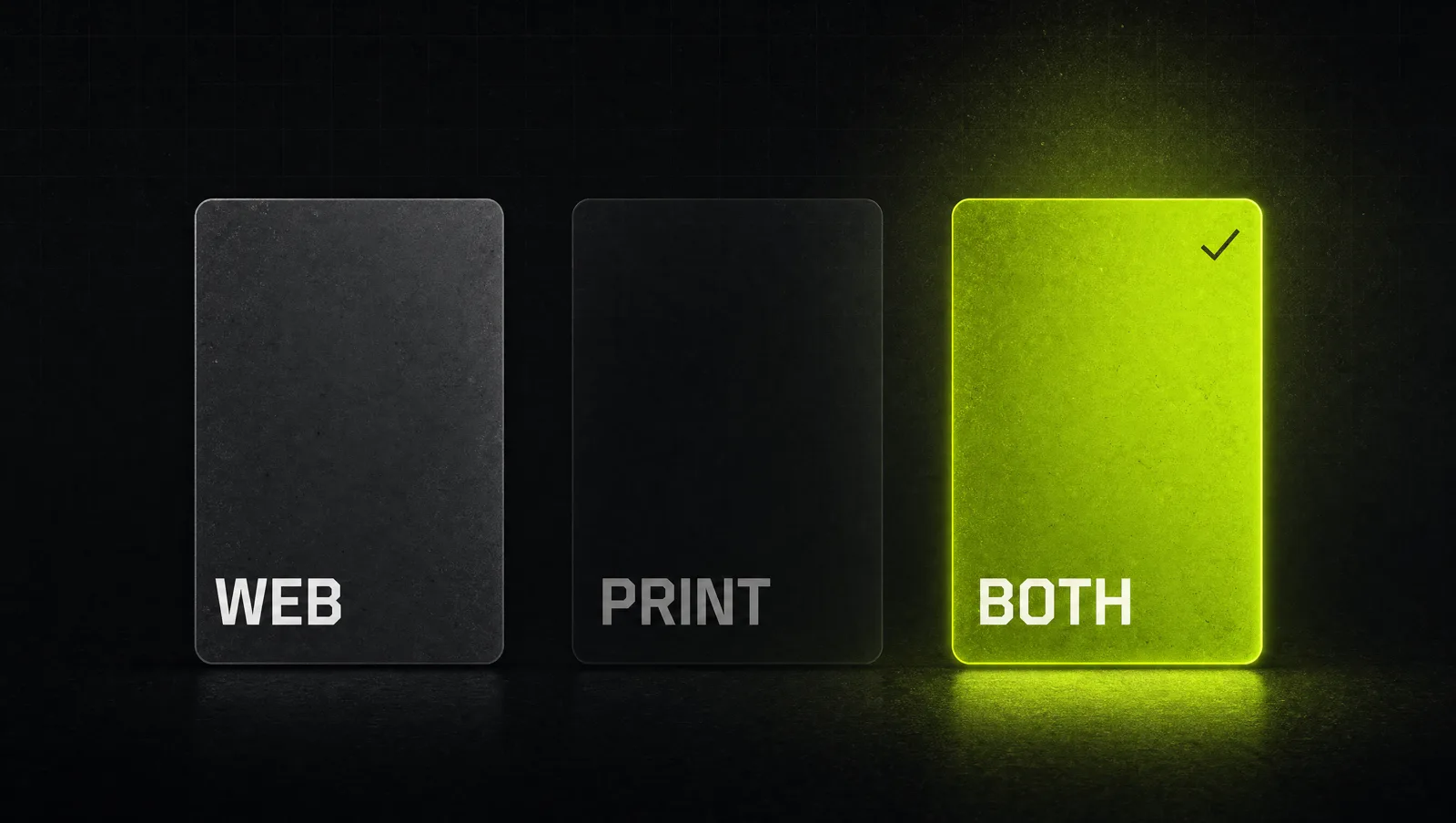
In his TED talk, Ariely describes an ad from The Economist that offered three choices: an online subscription for $59, a print subscription for $125, or both print and online for $125 (TED transcript). The middle option made no sense. Nobody should pay the same price for less.
So he ran the experiment he wished the publisher had run. He gave the offer to 100 MIT students. Most chose the combined deal, and nobody chose print only. Then he removed the useless middle option and gave the new version to another 100 students. The result flipped: the most popular option became the least popular, and the least popular became the most popular (TED transcript, NPR TED Radio Hour). The option nobody bought still changed what everybody bought, because next to "print only for $125", the combined deal looked like a bargain.
Researchers call this the decoy or attraction effect. It was first described in 1982 by Huber, Payne and Puto, who showed that adding an option that is clearly worse than one alternative can raise the share of the alternative that beats it (Journal of Consumer Research).
There is an honest limit, too. A 2014 paper in the Journal of Marketing Research by Frederick, Lee and Baskin found the effect mostly shows up when every attribute is shown as a number, and often disappears when people experience the product or see it in a more realistic way (Journal of Marketing Research).
Look at it through the system:
- Value: the combined subscription was the real product. The decoy made existing value easy to see.
- Anchoring: against the $125 print-only price, "both for $125" felt like getting online access for free.
- Packaging: three options turned a yes/no decision into a comparison, where anchors do their work.
- Testing: Ariely showed two versions to two groups and compared the choices, which is Step 5 in miniature.
The lesson: how you present your options can move buyers as much as the price itself. But the effect is strongest on simple, number-based choices like a pricing page, and it can fade in messier real buying. Use anchoring on top of real value, and always test it on your own buyers.
Three use cases
The examples below are illustrative, not real clients. They show how the same pricing system changes three different business models.
Use case 1: Bookkeeping service
Before: "$40 per hour". The owner competes with every freelancer on hourly rate, and getting faster means earning less.
After: three fixed monthly packages built around "books closed by the 5th, no surprises at tax time". Good covers reconciliation, Better adds a cash report and a quarterly call, Best adds payroll and same-day answers. Faster work now means more margin, not less revenue.
Use case 2: Online course creator
Before: one course at $97, priced "like the others in the niche".
After: the course stays as Good. Better adds live group Q&A and templates, Best adds a 1:1 review of the student's work. Best is shown first as the anchor, the new page is tested on new traffic only, and the entry price stays the same while the average order can grow.
Use case 3: B2B software tool
Before: $29 per user per month, set by looking at the three nearest competitors.
After: ten customer interviews show the tool saves each account hours of reporting per week. Tiers are rebuilt around outcomes: Starter, Growth with automated reports as the default, Scale with onboarding and priority support. New prices go to new signups only, tracked for a month before anything else changes.
How we run this system with Claude
Inside CopyPasteCEO we run pricing as a sequence of Claude prompts in one chat, so Claude keeps the context. Here are the first two, copy-paste ready. Fill in the brackets.
Prompt 1: put a number on the value
Make it yours · 0/6 filled
You are a pricing strategist who uses value based pricing. I sell [WHAT YOU SELL] to [WHO]. The result they get is [RESULT]. Their best alternative today is [ALTERNATIVE] which costs them about [COST OF ALTERNATIVE]. My delivery cost per customer is [YOUR COST]. Estimate the value of the result to the buyer in money, show your math and assumptions, and flag which assumptions I must confirm with real customers. Then suggest a price range between my cost floor and the value, and explain where in that range I should start and why.Prompt 2: build good/better/best tiers with an anchor
Make it yours · 0/2 filled
Here is my core offer: [OFFER] at a value based price of about [PRICE]. Build three tiers: good, better and best. The middle tier must be the one most buyers choose. For each tier, list what is included, who it is for in one line, and a price. Make the differences about speed, effort and certainty, not just quantity. Then tell me which tier to show first as the anchor, and write a simple test plan for new customers only: what to measure, for how long, and what result would make me keep or change the prices.These two prompts cover steps 1 to 4 and set up the test in step 5. Reading the test results and deciding what to change is where most people get stuck, because that is where judgment matters more than a template.
Where most people get stuck
Understanding value based pricing takes an evening. Raising your price and holding it takes a system. The usual reasons founders stop halfway:
- They never put a number on the value. Without it, every objection feels true and the price drifts back down to the competitor average.
- They test on the wrong people. They change prices for existing customers, get pushback, and give up before a single new buyer sees the offer.
- They copy the tactic, not the system. They add a decoy tier to a weak offer and wonder why nothing changes. Anchoring amplifies value. It can't replace it.
That is exactly the gap the Inner Circle is built for: playbooks to run your pricing system, a new playbook every week, and founders who are setting and testing their own prices next to you.