How to Build a Referral Program for Your Small Business or Startup (in 5 Steps)

Your happiest customers already talk about you. They answer "who do you use for that?" in group chats. But at that moment there is no link to send, no reason to send it today and no way for you to know it happened. So your best lead source runs on luck.
This guide shows you how to build a referral program that turns that luck into a system. You get the difference between one-sided and two-sided rewards, when to ask, the mechanics that make sharing easy, how to track it, a five-step build, reward ideas you can copy, and the real case of how Airbnb relaunched its referral program and measured every step.
The short version:
- A referral program pays existing customers, or their friends, for bringing in new customers, so word of mouth becomes a channel you can measure and improve.
- Two-sided rewards give something to both the referrer and the new customer; one-sided rewards only pay the referrer.
- Pay the reward when the referred customer does the thing you actually earn money on, like a first purchase, not when they merely sign up.
- Ask for referrals right after a moment of success, like a completed order or a positive review, not at a random time.
- Decide your success metrics and tracking before you launch, or you will never know whether the program works.
What is a referral program?
A referral program is a structured offer that rewards customers for introducing new customers to your business. Each referrer gets a unique link or code, the business tracks who came in through it, and a reward is paid once the new customer meets a clear condition, such as a first purchase. Referral marketing is the broader practice of growing through these personal recommendations.
Why bother? Because referred customers tend to be better customers. A study in the Journal of Marketing tracked around 10,000 customers of a German bank for almost three years and found that the average referred customer was at least 16% more valuable than a comparable nonreferred customer, with higher retention that persisted over time (Schmitt, Skiera and Van den Bulte, 2011). The bank's program was simple: every customer who brought in a new customer got a 25 euro voucher, and the total cost of acquiring a referred customer was about 20 euros lower than acquiring one through mailings (full paper, PDF).
The core: one-sided versus two-sided rewards
The first design decision is who gets rewarded. It shapes the message, the cost and who feels comfortable sharing.
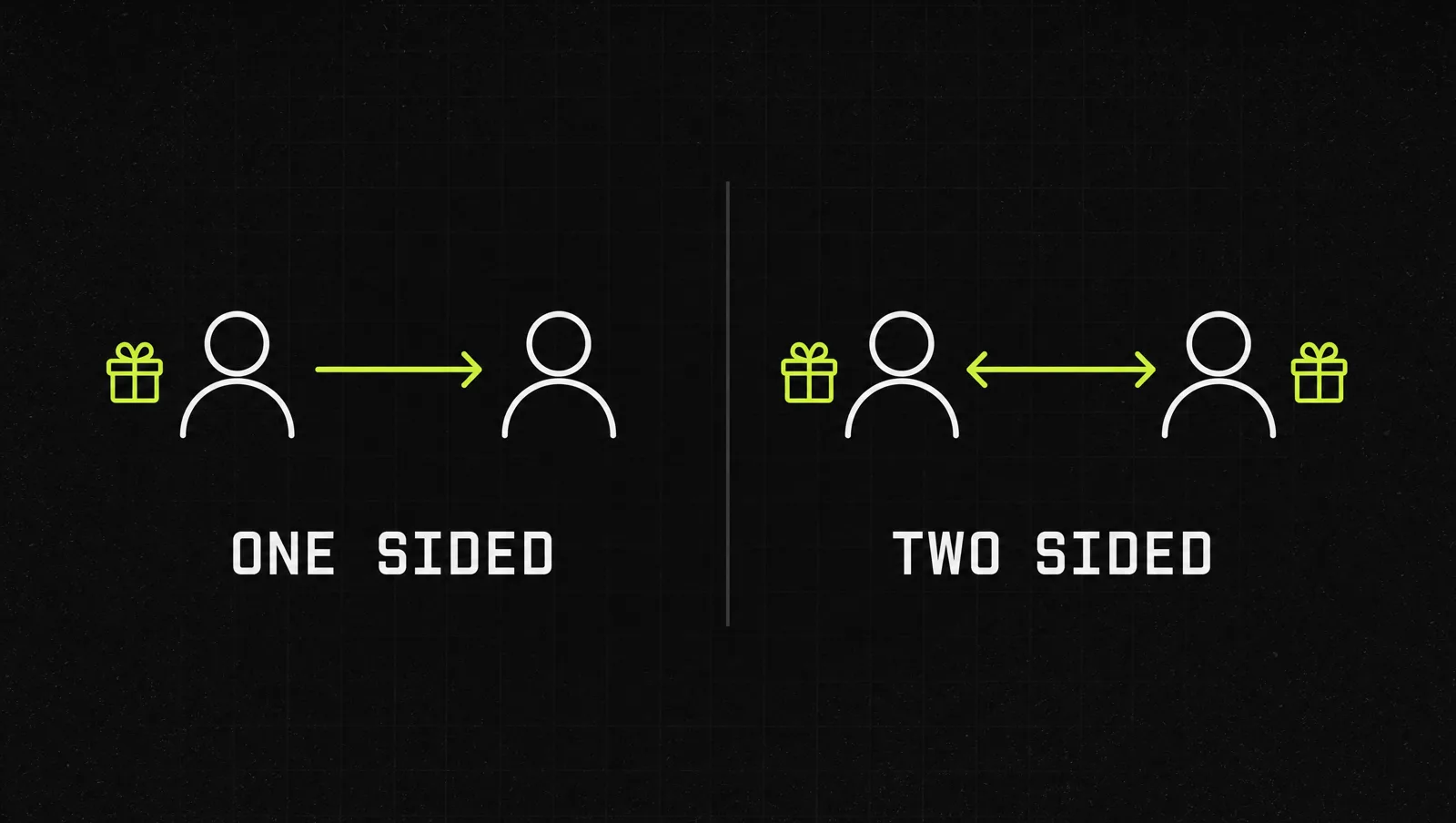
| One-sided | Two-sided | |
|---|---|---|
| Who gets the reward | Only the referrer | The referrer and the new customer |
| How the ask feels | "I get something if you sign up" | "Here is a gift for you, and I get one too" |
| Best for | High-trust services, B2B, loyal fans who would refer anyway | Consumer products, apps, subscriptions, first-time buyers who need a push |
| Cost per new customer | Lower, one reward | Higher, two rewards |
| Main risk | Referrer feels like a salesperson | Rewards attract deal hunters who never come back |
Neither is always better. One-sided works when the referrer would recommend you anyway and the reward is a thank you. Two-sided works when the new customer needs a nudge, because the gift gives the referrer something to offer instead of something to ask for. If unsure, start two-sided: it is easier to share.
How to build a referral program in 5 steps
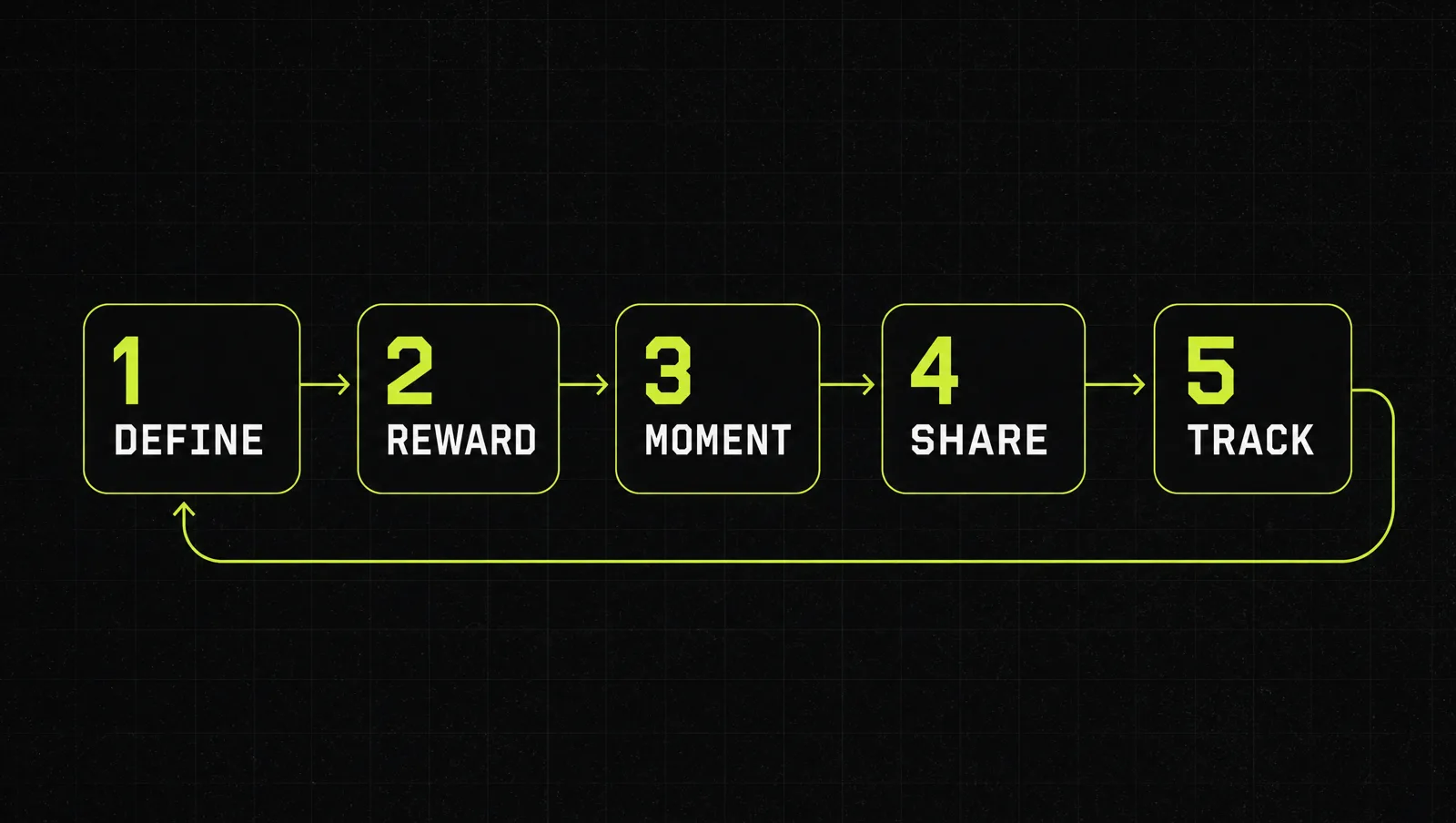
Step 1: Define what success looks like
Before you pick a reward, write down the numbers that tell you whether the program works: how many customers send an invite, how many people each invites, how many invitees become customers, and what those customers are worth. Set a target for each, or you will never know which part to fix.
Step 2: Design the reward
Choose one-sided or two-sided, then size the reward against what a new customer is worth to you. A simple rule: the total reward should be a fraction of the gross profit from a new customer, not of the revenue. Then decide the trigger. Pay when the referred customer completes a first purchase, first project or first paid month, not at sign-up, or you will pay for accounts that never buy.
Reward ideas that work for small businesses:
- Account credit for both sides, usable on the next order or invoice.
- A free month of a subscription or retainer.
- An upgrade: a bigger package, priority delivery, an extra session.
- A product the referrer actually wants, like your best-seller or a limited item.
- Cash or a gift voucher for B2B referrals, where the referrer is not your customer's end user.
- A donation in the referrer's name, for audiences who would feel odd taking money.
- Status: early access, a founder call, a spot on a "top referrers" wall.
Credit and upgrades cost you your margin, not the full price, and they bring the referrer back.
Step 3: Pick the moment to ask
Timing matters more than the size of the reward. Ask when the customer has just felt the value: right after delivery, after a result, after a five-star review, after they renewed. Build the ask into those moments: the thank-you page, the delivery email, the review confirmation, the end of a successful project call. Never make the first ask in a cold newsletter to people who have not bought yet.
Step 4: Make sharing effortless
Give every customer a personal link or code, so the referral is theirs and tracking happens on its own. Write the share message for them: a short text they can paste into a chat or email. Make the landing page say who sent the visitor and what gift is waiting. Remove every extra step. If you sell in person, a printed card with a code does the same job.
Step 5: Track, pay fast and refine
Log every step: invite sent, link clicked, sign-up, first purchase, reward paid. Pay rewards quickly and tell the referrer when it happens, because that notification is itself a reminder to refer again. Then review the chain from Step 1 every month and fix the weakest link. Low invite rate means the ask is hidden. Low conversion means the offer or landing page is weak. Referrals are one lead source among several, and they work best next to a steady lead system, where you can also read how Dropbox grew with a two-sided storage reward.
A real case: how Airbnb relaunched its referral program

Airbnb documented its referral relaunch in detail on its own engineering blog in March 2014, written by engineer Jason Bosinoff (Airbnb Tech Blog). Here is what the post describes:
- The starting point: the old referral system was underused and hard to find on the website, and it did not exist at all in the mobile apps.
- The reward: two-sided. Both the sender and the new user got $25 of travel credit, paid when the invited user completed their first trip.
- Metrics before code: the team defined a funnel of success metrics first: active users sending invites, invitees per inviter, and conversion to new user, new guest and new host. They set good, better and best forecasts for each and benchmarked against other referral programs, including Dropbox.
- Tracking: they defined more than 20 user events across the invite and sign-up journey and logged them the same way on web, iOS and Android, with dashboards live from launch day.
- Mechanics: personalized referral codes and links, and people who installed the app through an invitation link saw a special referral screen on first open.
- Result: the post reports that the program's sign-ups and bookings rose by over 300% per day, and that referrals increased bookings by over 25% in some markets.
- Timing: after launch, the team started promoting referrals at moments when users were most likely to refer, such as just after booking or after leaving a positive review.
- Message test: in an email A/B test, one version stressed that you earn $25 by inviting a friend, the other that you share $25 with a friend. In the post's words: "The altruistic email performed better globally."
Look at it through the system:
- Define the game: the metrics and forecasts came before a single line of product code.
- Two-sided reward, paid on value: the credit only unlocked after a completed trip, the action Airbnb earns money on.
- The right moment: the ask moved to the minutes after a booking or a good review.
- Effortless sharing: personal codes, and a first screen that recognized the invited user.
- Track and refine: 20 plus events, dashboards from day one, and ongoing A/B tests instead of launch and forget.
The lesson: Airbnb did not invent a new incentive. The $25 credit was already there. What changed was the system around it: visible everywhere, triggered at the right moment, framed as a gift and measured at every step.
Three use cases
The examples below are illustrative, not real clients. They show how the same five steps look in different businesses.
Use case 1: Local service business (a cleaning company)
Before: happy clients recommend the company now and then, and nobody tracks it or says thank you.
After:
- Two-sided reward: the new client gets their first cleaning 20% off, the referrer gets one free cleaning after the new client's second visit.
- The ask comes in the follow-up text after every cleaning that got a top rating.
- Each client has a short personal code that the team enters when booking.
Use case 2: B2B agency or consultant
Before: referrals come from a few loyal clients, mostly by accident.
After:
- One-sided reward: a thank-you fee or a free month of the retainer for every referred client who signs a contract.
- The ask happens at the end of the call where a client sees a strong result, with a ready-to-forward intro email.
- Every referred deal is tagged in the CRM with the referrer's name.
Use case 3: SaaS or subscription app
Before: a "refer a friend" link hidden in the settings menu.
After:
- Two-sided reward: one free month for both people once the new user starts paying.
- The invite prompt appears after the user completes their first successful project in the app.
- Personal links with a landing page that names the inviter.
- The team tests a "get" message against a "give" message and keeps the winner, then tracks whether referred users raise revenue per customer.
How we run this system with Claude
Inside CopyPasteCEO we run this as a set of Claude prompts, in one chat so Claude keeps the context. Here are the first two, copy-paste ready. Fill in the brackets.
Prompt 1: design the referral offer
Make it yours · 0/5 filled
You are a growth advisor who designs referral programs for small businesses. My business: [WHAT YOU SELL], to [WHO], at [PRICE]. Gross profit from a new customer in the first year: [AMOUNT]. Customers usually recommend us when [SITUATION]. Propose one one-sided and one two-sided referral program. For each, give the reward for the referrer, the reward for the new customer (if any), the exact trigger that unlocks the reward, the total cost per new customer, and the main risk. Then recommend one and explain why in three sentences.Prompt 2: build the moments, messages and tracking
Make it yours · 0/2 filled
Here is my referral program: [REWARD AND TRIGGER]. My customer journey has these steps: [LIST OF STEPS, E.G. PURCHASE, DELIVERY, REVIEW, RENEWAL]. Pick the 2 or 3 moments where a customer is most likely to refer and tell me why. For each moment, write the ask in the channel I use there: [CHANNELS]. Write a short share message the customer can paste to a friend. Then list the events I need to track from invite sent to reward paid, and the one number I should review every month.These two prompts get you a first version of your referral program and the words to launch it. Choosing a reward your margin can carry, and fixing the weak link month after month instead of launching and forgetting, are where most people get stuck, because that is where judgment matters more than templates.
Where most people get stuck
Setting up a referral link takes an afternoon. Getting people to use it every month is the hard part. The usual reasons programs die:
- They hide the ask. A link in the account settings gets no clicks. The ask has to show up at the moment of success.
- They pay on sign-up. Rewards go to accounts that never buy, and the program gets shut down as too expensive.
- They launch and forget. Nobody tracks the funnel, so nobody knows whether the problem is the reward, the timing or the landing page.
That is exactly the gap the Inner Circle is built for: the playbooks to design, launch and improve your referral program, a new playbook every week, and founders building their own growth systems next to you.