The Flywheel Effect: How to Build a Business Flywheel (Step by Step)
Most founders don't have a strategy problem. They have a momentum problem. Every quarter starts with a new plan: a new channel, a new offer, a new hire who will fix everything. Each push moves the business a little, then it stops, and the next push starts from zero again.
Jim Collins named the fix in Good to Great and later expanded it in his monograph Turning the Flywheel. This guide shows you how to build a business flywheel yourself. It isn't a chapter-by-chapter summary. It turns the core ideas into a system you can run: what the flywheel is, how to map and build yours in five steps, how Amazon turned it into the engine of its business, three worked use cases and the Claude prompts we use. For the full research and stories, read Collins directly. It's worth it.
The short version:
- Growth doesn't come from one big move. It comes from many small pushes in the same direction that add up.
- A flywheel is a loop: each part feeds the next, and the last part feeds the first again.
- Build it from your own evidence: what already worked, in what order, and why.
- Keep it to a handful of parts, and make sure the loop really closes.
- Then push the same wheel for years. Changing direction every quarter is how companies fall into the doom loop.
The problem the system solves
From the outside, successful companies look like they had one breakthrough moment. A viral launch, a big deal, a genius product. Collins found the opposite when he studied companies that went from good to great. On his concept page for the flywheel effect, he explains that there was no single defining action, no killer innovation and no lucky break. The results came from pushing a heavy wheel over and over in one direction until it built momentum and reached a breakthrough.
He also points out a trap. From the outside, these transformations looked dramatic. From the inside, the people involved described them as slow and organic. So founders copy the "big move" they see from outside, and miss the years of consistent pushing that made it work.
The comparison companies in his research did the opposite. They pushed in one direction, stopped, changed course and pushed somewhere else. Collins calls this pattern the doom loop (jimcollins.com). Every new direction throws away the momentum of the last one. That is what this system is built to prevent.
The core: the flywheel versus the doom loop
A flywheel is not a funnel. A funnel ends when someone buys. A flywheel is a closed loop: every component makes the next one stronger, and the last one feeds back into the first. Collins stresses that each turn builds on the work done before, so your effort compounds instead of starting over (Collins, "How does your flywheel turn?").
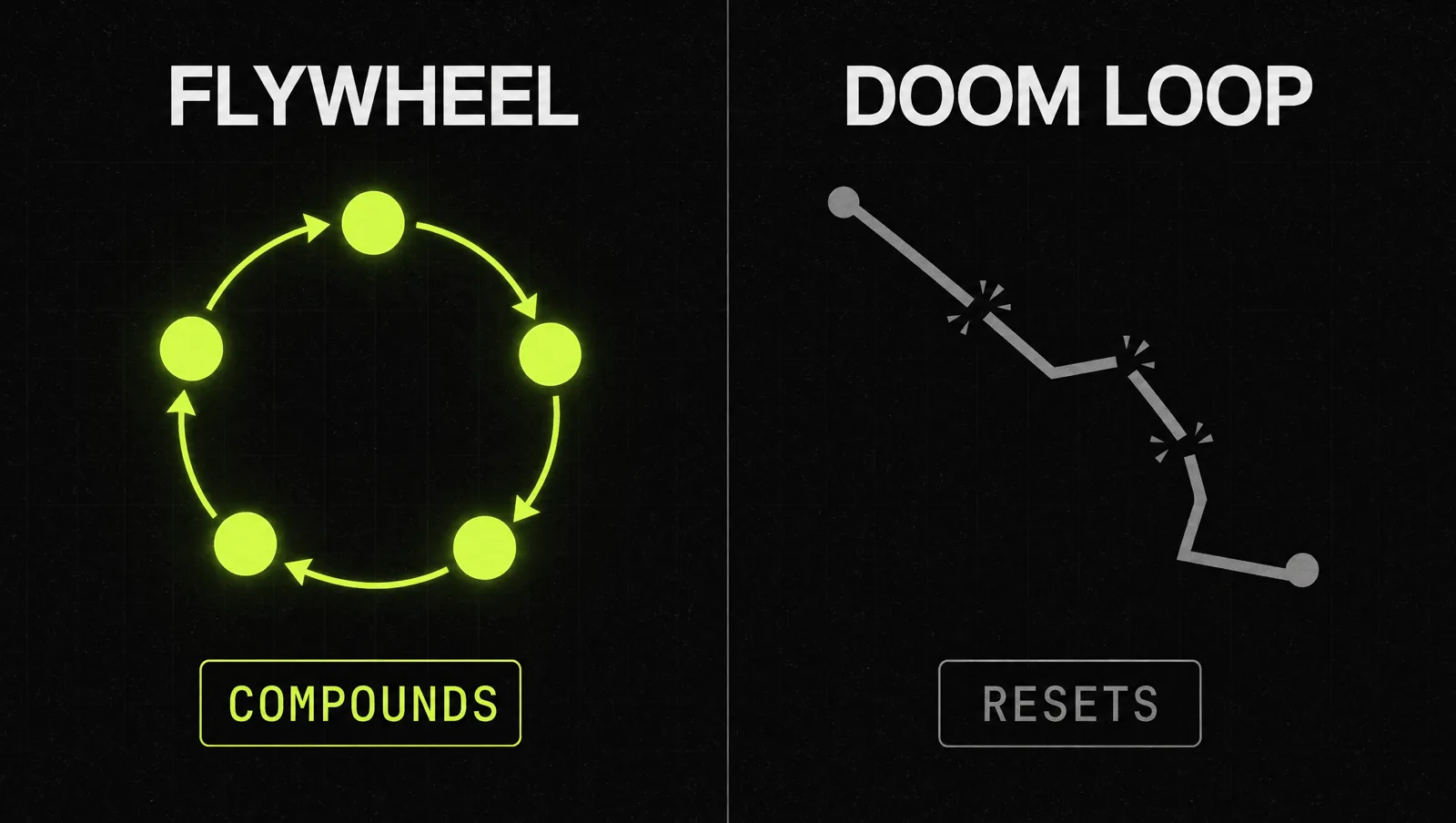
| Flywheel | Doom loop | |
|---|---|---|
| Direction | One direction, pushed for years | A new direction every time results disappoint |
| Where results come from | Many small pushes that add up | Hoping for one big program or miracle move |
| How effort behaves | Compounds, each turn builds on the last | Resets, each change throws momentum away |
| Decisions based on | Evidence of what already worked | Fashion, panic and the latest idea |
| How it feels inside | Slow, then suddenly unstoppable | Busy, dramatic and always starting over |
The practical difference: a flywheel tells you what to do next. If you know which component drives the next one, you know where your hours and budget go. Everything that doesn't feed the loop is a distraction.
How to build your flywheel in 5 steps
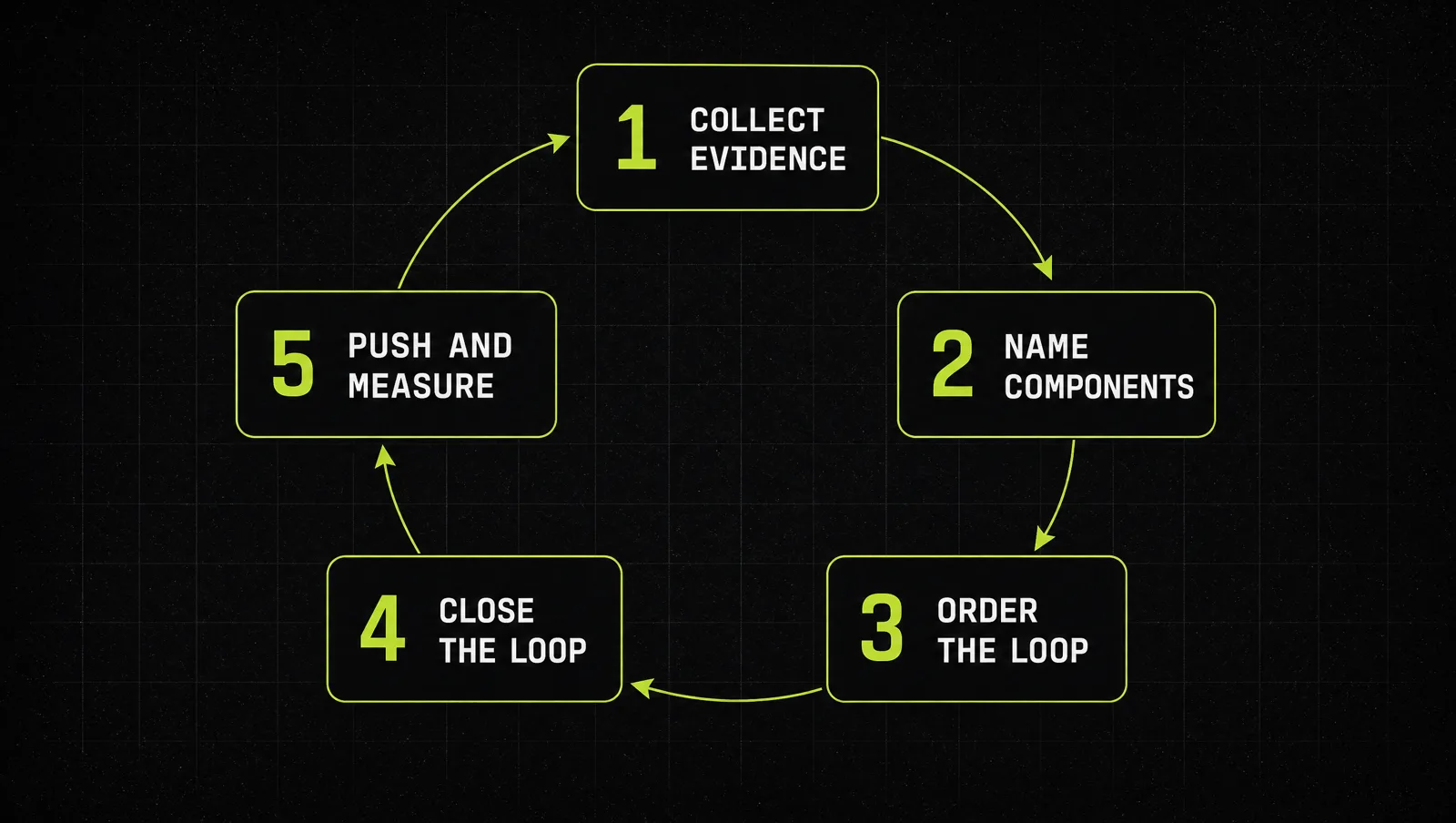
Step 1: Collect your evidence
Don't invent a flywheel on a whiteboard. Start from what already happened. Write down your clearest wins so far: the offers, channels and customers that worked and could work again. Then write down what failed. Your flywheel is hidden in the difference between the two lists.
Step 2: Name the components
Pull the recurring drivers out of your wins. Keep it short: a handful of components, not twenty. Collins' own example diagrams in Turning the Flywheel each use only five or six (Collins, flywheel diagrams). Each component should be a concrete action or result, like "deliver results in 30 days" or "turn happy clients into case studies". Not a value like "quality".
Step 3: Put them in order
Now arrange the components so each one causes the next. Test every arrow with one question: if I push this harder, does the next one actually grow? If the answer is "maybe", the arrow is wrong or a component is missing.
Step 4: Close the loop
The last component has to feed the first. This is the part most founders skip, and it is what separates a flywheel from a to-do list. If your chain ends at "new client signs", it is a funnel. Ask what that new client produces that restarts the wheel: a referral, a case study, more cash for ads, better data for the product.
Step 5: Push the same wheel and measure each turn
Pick one number per component and review them every month. When the wheel slows down, find the weakest link and fix that one. Don't redesign the whole wheel. The flywheel only works if you keep pushing it in the same direction long enough for momentum to build. More leads feed the wheel, which is why a steady lead system is often the first component to strengthen.
A real case: how Amazon turned its flywheel
Amazon is the best-documented flywheel in business, because both Jeff Bezos and Jim Collins wrote about it.
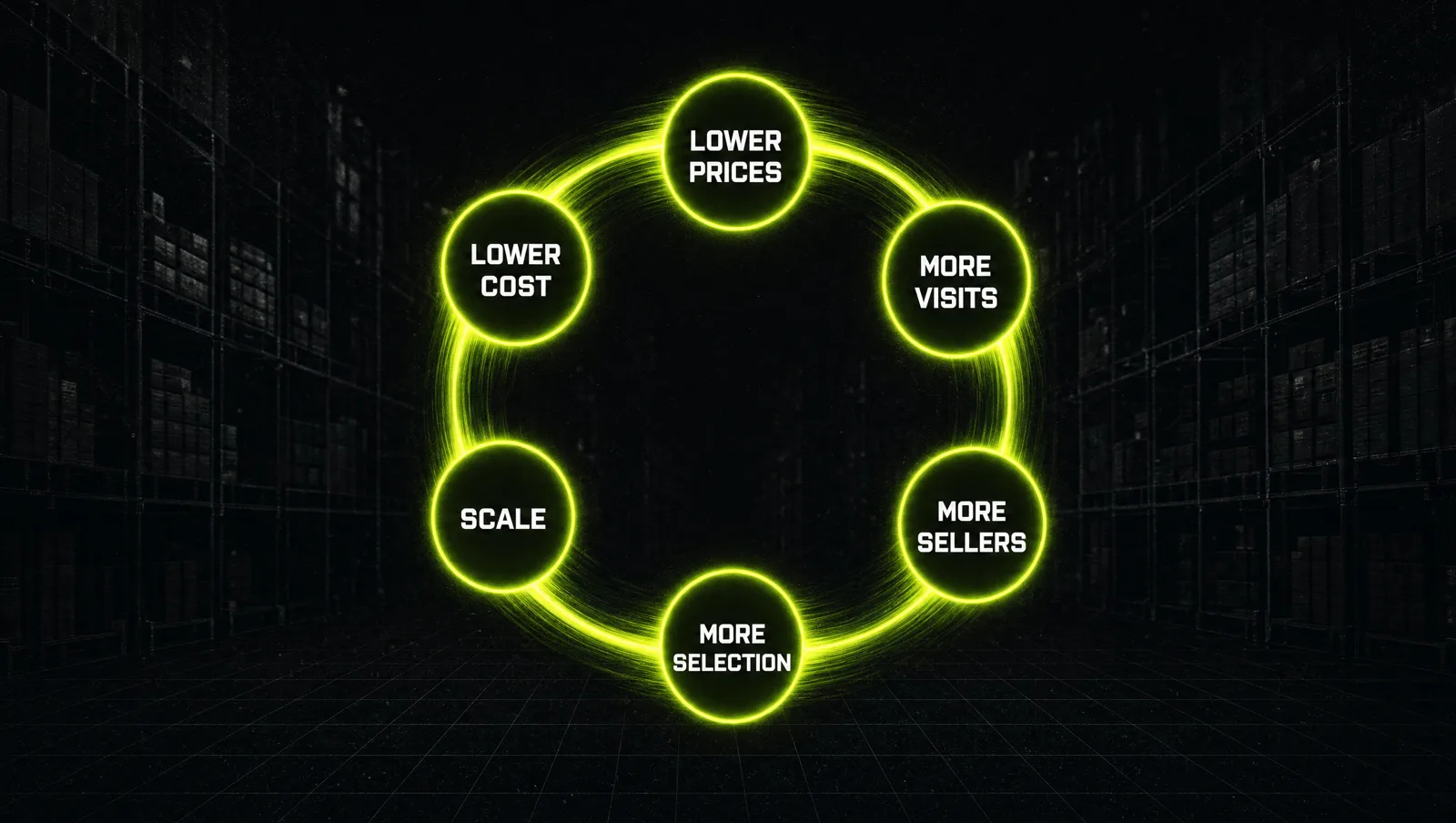
Collins' monograph Turning the Flywheel (2019) opens with Amazon. On his page for the book, he describes how Amazon, coming out of the dot-com bust in 2001, learned the flywheel idea and then went further by mapping the drivers of its own flywheel. The Amazon diagram in the monograph links these components (Collins, flywheel diagrams): lower prices on more offerings, more customer visits, attracting third-party sellers, expanding the store and distribution, growing revenue per fixed cost, and economies of scale that fund the next round of lower prices.
Bezos described the same loop in his 2001 letter to shareholders:
- In July 2001, Amazon cut book prices, discounting books over $20 by 30% off list. In January 2002 it added free shipping on orders over $99.
- He added lower prices as a third customer experience pillar, next to selection and convenience.
- He laid out the logic: cost improvements pay for lower prices, lower prices drive growth, growth spreads fixed costs over more sales, and lower cost per unit makes the next price cut possible. His words to shareholders: "Please expect us to repeat this loop."
- In 2001, sales grew 13% to $3.12 billion, and Amazon served 25 million customer accounts.
Then Amazon kept pushing the same wheel. In his 2014 letter to shareholders, Bezos wrote that the success of letting third-party sellers sell next to Amazon's own products accelerated the Amazon flywheel. More sellers made the store more attractive to customers, which drew even more sellers, and the added scale was passed on through lower prices and free shipping on qualifying orders. By then, more than 40% of units were sold by over two million third-party sellers. Today, Amazon states that more than 60% of sales in its store come from independent sellers (Amazon).
Look at it through the system:
- Evidence first: the price cut of 2001 worked, so it became a permanent component instead of a one-off campaign.
- Few components: price, visits, sellers, selection, scale. Nothing else made the diagram.
- A closed loop: the lower cost per unit at the end paid for lower prices at the start.
- Same direction for years: the wheel described in 2001 was still the wheel being accelerated in 2014.
The lesson: Amazon's advantage was never one move. It was one loop, pushed in the same direction for over a decade, where every new program (the marketplace, free shipping) was added to the wheel instead of replacing it.
Three more use cases
The examples below are illustrative, not real clients. They show how the same system looks in very different businesses.
Use case 1: Marketing agency
Before: a new service every quarter (SEO, then TikTok, then AI automation), a new niche every few months. Nothing compounds.
After: one niche, one loop.
- Deliver fast, visible results for dental practices.
- Turn every result into a named case study.
- Case studies make cold outreach and ads convert better.
- More clients in one niche mean sharper templates and lower delivery cost per client.
- Lower delivery cost pays for faster results, and the wheel turns again.
Use case 2: Coach or creator
Before: posts content, runs a launch, burns out, disappears for two months, starts over.
After:
- Free content answers one audience's questions every week.
- The best questions become a paid program.
- Program results become stories and testimonials.
- Stories become the next round of content, and members refer members.
- The growing library of answers makes every new piece of content easier to make.
Use case 3: SaaS or digital product
Before: chases feature requests from whoever shouts loudest, runs a new growth experiment every sprint.
After:
- A narrow product that gets one job done fast.
- Happy users invite teammates, because the product works better together.
- More users produce more templates and integrations.
- A bigger template library makes onboarding faster for the next user.
- Higher revenue per customer (see how to make more money per customer) funds the next improvement to the core job.
How we run this system with Claude
Inside CopyPasteCEO we run this as a set of Claude prompts, in one chat so Claude keeps the context. Here are the first two, copy-paste ready. Fill in the brackets.
Prompt 1: find your flywheel in your own evidence
Make it yours · 0/5 filled
You are a strategy advisor trained on Jim Collins' flywheel concept. My business: [WHAT YOU SELL], to [WHO], at [PRICE]. Here are my biggest wins so far: [LIST OF WINS]. Here are my biggest failures or abandoned projects: [LIST OF FAILURES]. Compare the two lists and tell me what the wins have in common that the failures lack. Then propose a flywheel of 4 to 6 components, each a concrete action or result, in the order where each one drives the next. Mark every arrow you are unsure about and explain why.Prompt 2: stress-test the loop and find the weakest link
Make it yours · 0/5 filled
Here is my flywheel: [COMPONENT 1] leads to [COMPONENT 2] leads to [COMPONENT 3] leads to [COMPONENT 4] leads back to [COMPONENT 1]. My current numbers for each component: [NUMBERS PER COMPONENT]. For each arrow, tell me whether it really causes the next step or only happens next to it. Check whether the loop actually closes. Then name the ONE weakest link, and give me three concrete actions for the next 30 days to strengthen only that link.These two prompts get you a first version of your flywheel and the place to push next. Choosing which components to cut, and staying on the same wheel when a shiny new idea shows up, are where most people get stuck, because that is where judgment matters more than templates.
Where most people get stuck
Understanding the flywheel takes an afternoon. Pushing the same one for years is the hard part. The usual reasons people stop:
- They draw a funnel and call it a flywheel. The chain ends at the sale, nothing feeds back, so nothing compounds.
- They add too many components. Twelve boxes on a slide means nobody knows which one to push today.
- They change direction when it feels slow. The first flat month makes them redesign the wheel, and they slide straight into the doom loop.
That is exactly the gap the Inner Circle is built for: the playbooks to map and run your flywheel, a new playbook every week, and founders who are pushing their own wheels next to you.