First Principles Thinking for Founders: How to Use It on Real Business Decisions

Most business decisions are copied, not made. You price like your competitors, budget like last year and launch the way everyone in your niche launches. It feels safe. It also means your business can never be much better, or much cheaper, than the people you copy.
This guide shows you how to use first principles thinking on the decisions that actually move a small business: pricing, costs, product and go to market. You get a plain definition, a five step system, the common mistakes, a real example in Elon Musk's own recorded words, and two Claude prompts we use to run it.
The short version:
- First principles thinking means breaking a problem down to the facts you are sure are true, then building a solution up from those facts instead of copying what others do.
- Its opposite is reasoning by analogy: "we do it this way because that is how it is done."
- Most of the time analogy is fine. Use first principles on the few big decisions where the accepted answer is expensive or limiting.
- The method has five steps: state the assumption, list the fundamentals, check each one, rebuild from scratch, test small.
- The payoff is usually one number everyone accepts and nobody has checked.
What is first principles thinking?
First principles thinking is a way of solving problems by reducing them to the most basic facts you can verify, and then reasoning upward from those facts to a new answer. Instead of asking "how do others do this?", you ask "what is actually true here, and what could be built from it?" It is slower than copying, but it finds answers the market has not already priced in.
The idea is old. Aristotle argued that every chain of proof has to stop somewhere, at first premises that cannot be derived from anything else and serve as the starting points for everything that follows (Stanford Encyclopedia of Philosophy).
Elon Musk gave the version most founders know in a 2012 interview with Kevin Rose. He contrasted it with reasoning by analogy, copying what was done before or what others do, and called first principles "a physics way of looking at the world" (Kevin Rose, Foundation interview with Elon Musk). He also admitted the catch: it takes a lot more mental energy. That is why most people default to analogy.
The core: analogy versus first principles
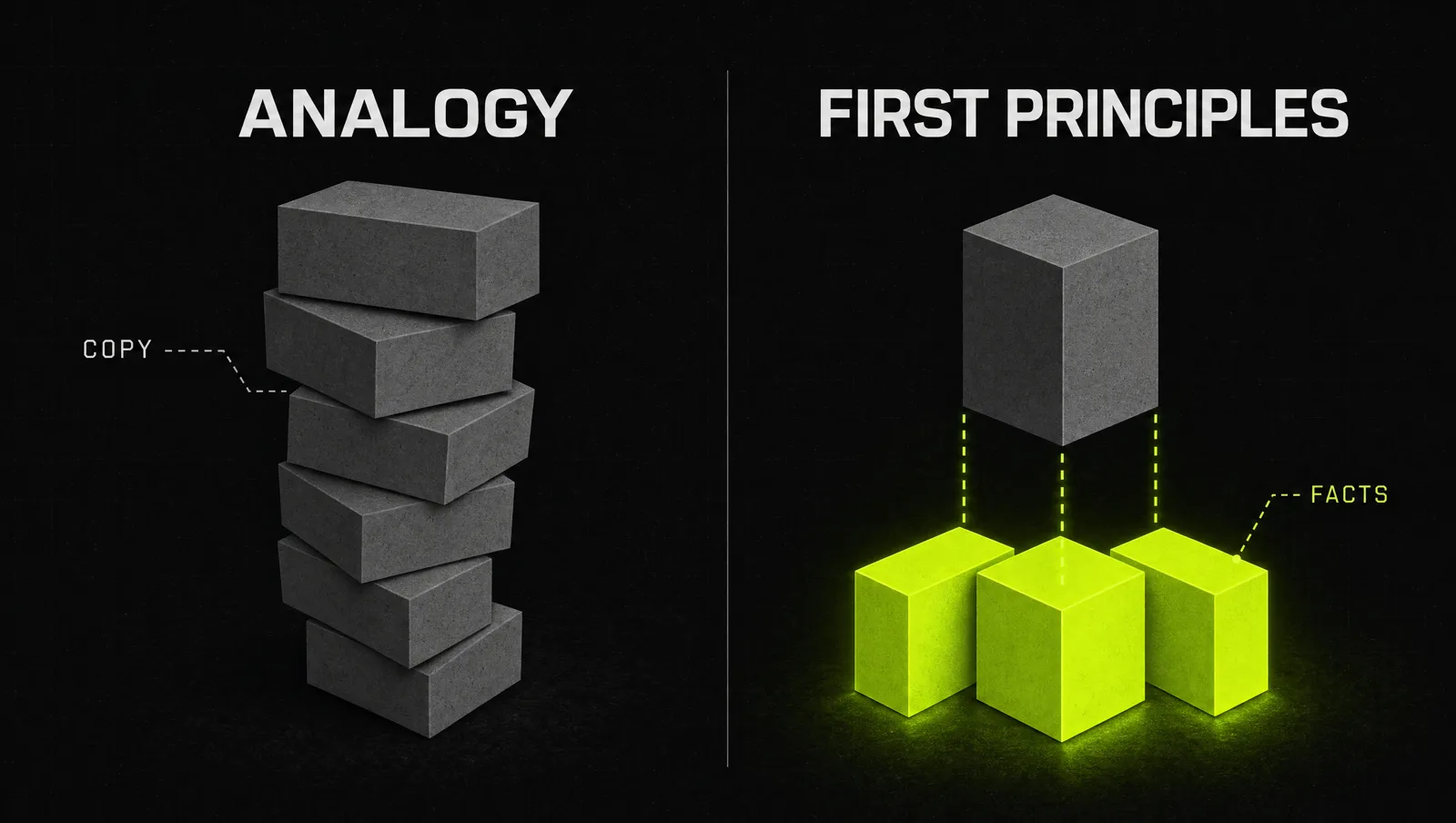
Reasoning by analogy is fast and usually good enough. But it inherits every hidden assumption of the thing you copy. First principles thinking keeps only what is true.
| Decision | Reasoning by analogy | First principles thinking |
|---|---|---|
| Pricing | "Competitors charge 99 a month, so we charge 89." | "What is the result worth to the buyer, and what does it cost us to deliver?" |
| Costs | "Agencies like ours are staff heavy, so that is normal." | "Which tasks create the result, and what is the cheapest reliable way to get each one done?" |
| Product | "The market leader has these 30 features, so we need them too." | "What job is the customer hiring this for, and what is the minimum that gets that job done?" |
| Go to market | "Everyone in our niche runs webinars, so we run webinars." | "Where do our buyers already look for a solution, and what makes them trust someone enough to pay?" |
Analogy starts from other people's answers. First principles starts from facts about your buyer, costs and constraints. The product row is basically the jobs to be done framework.
How to use first principles thinking in 5 steps
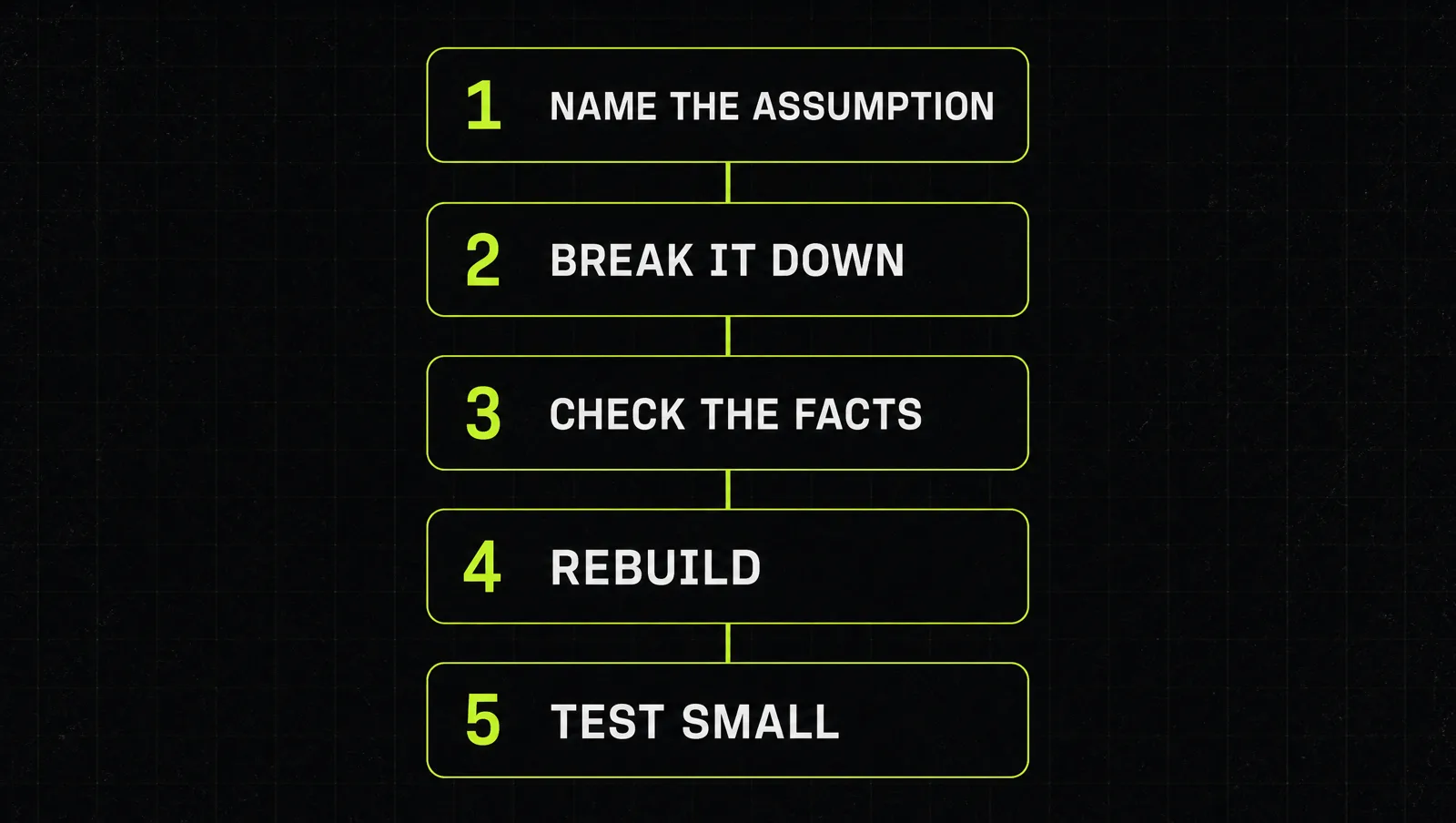
Use this on one decision at a time: one that is expensive, recurring or blocking growth.
Step 1: Write down the accepted answer and why you believe it
Start with the sentence everyone in your business repeats, such as "we can't charge more than our competitors". Next to it, write where the belief comes from. If the honest answer is "that is how it has always been" or "that is what others do", you have found an analogy, not a fact.
Step 2: Break it down into its components
Split the problem into parts you can price, count or test. A price breaks down into the value of the result, your delivery cost and the buyer's alternatives. A cost line breaks down into tasks, hours, tools and rates. Keep going until each piece is concrete.
Step 3: Separate facts from assumptions
Mark every component as fact or assumption. A fact is something you can verify: a supplier quote, a public price, your own sales data, what a customer pays today for a workaround. Everything else is an assumption. Only the verified pieces go into the next step.
Step 4: Rebuild the answer from the facts only
Ask: if I designed this from scratch, with only these facts, what would I do? Your price might go up because the verified value to the buyer is far higher than competitor prices suggest. That is often the start of a better offer. Your delivery might get cheaper because half the tasks were never needed.
Step 5: Test the new answer small, then commit
A first principles answer is a hypothesis until the market confirms it. Test it small: raise prices on the next five proposals, or run the new process with one client. Define in advance what result would prove you wrong. If it holds, make it the default. If not, find the "fact" that was an assumption and go back to Step 3.
Common mistakes with first principles thinking
- Using it on everything. It takes a lot of mental energy. Save it for decisions where the accepted answer costs real money or growth.
- Stopping at "question everything". Doubt is only half the method. The value comes from rebuilding and testing.
- Treating opinions as fundamentals. "Customers want cheap" is not a fundamental truth. It is an assumption until you have data from your own customers.
- Ignoring real constraints. Laws, physics, cash and the hours in your week are facts. The method removes false limits, not real ones.
- Throwing out proven practice out of pride. If the standard answer survives the breakdown, keep it. Now you know why it works.
A real case: Musk and the price of battery packs
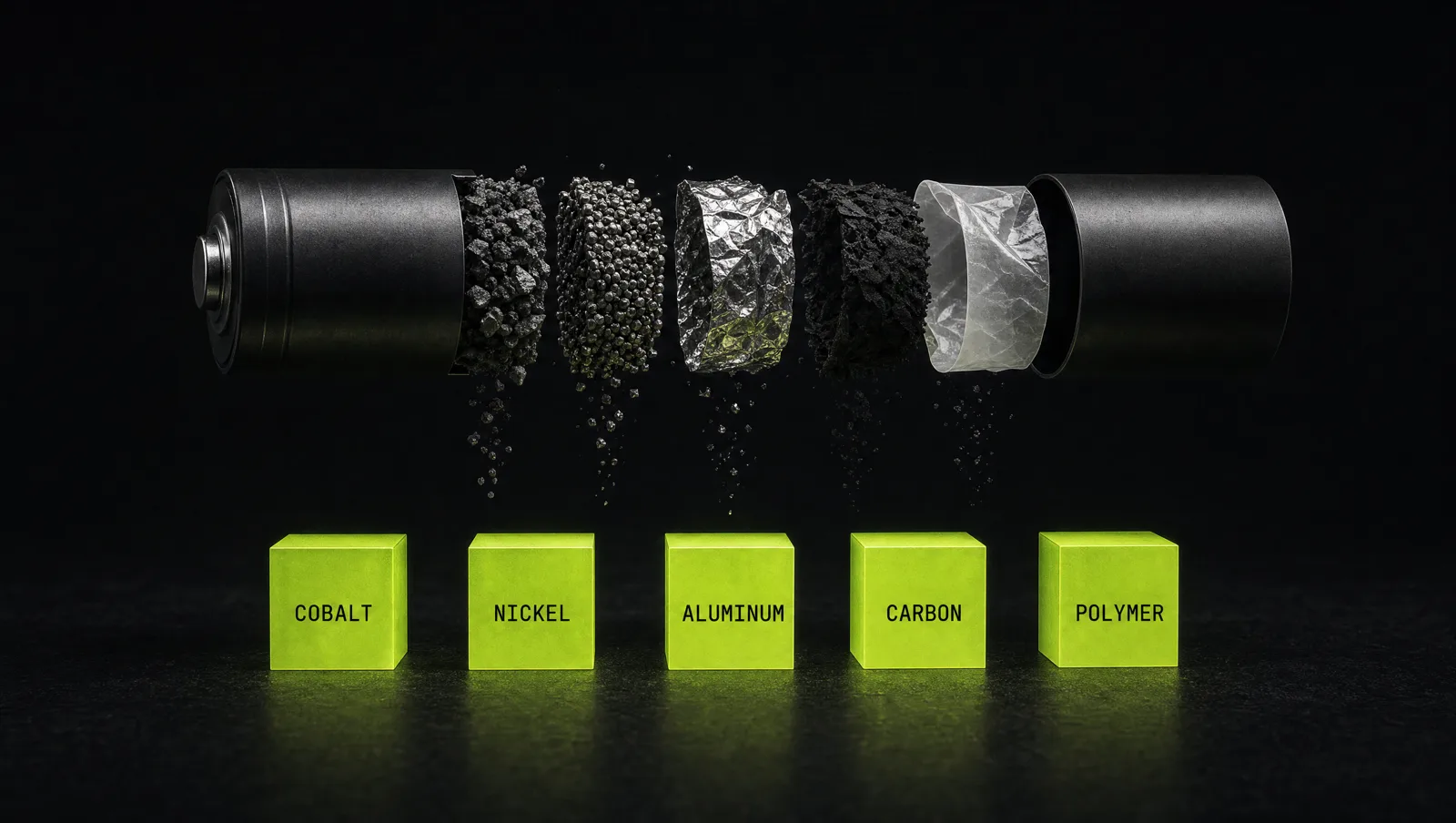
The best known example comes from Elon Musk, recorded in the 2012 Foundation interview that Kevin Rose published on his own YouTube channel (Kevin Rose, "Elon Musk and Kevin Rose", uploaded September 2012). Here is what he says in it, based on the recording:
- Asked for advice to new entrepreneurs, he recommends reasoning from first principles rather than by analogy.
- As an example, he says people claim battery packs are really expensive and will always be, because historically they have cost around $600 per kilowatt hour.
- His first principles move is to ask what batteries are made of: cobalt, nickel, aluminum, carbon, some polymers for separation and a seal can.
- Then he asks what those materials would cost if you bought them on the London Metal Exchange. His estimate in the interview: roughly $80 per kilowatt hour.
- His conclusion: the job is to find clever ways to combine those materials into a battery cell, and batteries can become much cheaper than anyone realizes.
Both numbers are Musk's own rough figures from a conversation, not audited data. What we can check is the direction. BloombergNEF's annual survey, published in December 2024, put the global average price of a lithium ion battery pack at $115 per kilowatt hour, after a 20% drop from 2023 (BloombergNEF). That is far below the $600 figure Musk says people treated as normal in 2012. Many companies and factors drove that decline, so it proves nothing about one person. It does show the accepted price was not a law of nature.
Look at it through the system:
- Step 1, the accepted answer: "batteries are expensive because they always have been."
- Step 2, the components: the raw materials inside a cell.
- Step 3, the facts: public commodity prices for each material, which anyone can look up.
- Step 4, the rebuild: a cost floor far below the market price, which turns the problem into a manufacturing and design problem.
- Step 5, the test: building cheaper cells is where the real work starts.
The lesson: the most valuable number in your business is often one that everyone quotes and nobody has broken down. Compare the market price of what you sell or buy with the cost of its basic parts. The gap tells you where the opportunity is.
Three use cases
The examples below are illustrative, not real clients. They show how the same five steps look in different small businesses.
Use case 1: Pricing a service business
Accepted answer: a bookkeeping firm charges 250 a month because local competitors do.
First principles: the owner breaks the price down into her delivery cost from time tracking and the value to the client: hours saved plus penalties avoided. She rebuilds the offer around a guaranteed monthly close, prices it by value, and tests it on the next five leads before touching existing clients.
Use case 2: Cutting costs in an agency
Accepted answer: "a content agency needs one writer per four clients."
First principles: the founder lists every task behind a finished article and times each one. Research and first drafts are the slowest steps, exactly where AI assistance and templates help most. He redesigns the workflow, runs it with one client for a month and compares hours and quality before rolling it out.
Use case 3: Go to market for a new product
Accepted answer: "B2B software launches with paid ads and a free trial."
First principles: the founder asks where her buyers, operations managers in logistics firms, already look for solutions and whom they trust. Interviews point to industry newsletters and peer recommendations. She skips paid ads, sponsors one newsletter issue and turns her first ten clients into case studies. For more on building steady demand, see how to get more leads.
How we run this with Claude
Inside CopyPasteCEO we run this as two Claude prompts in one chat, so Claude keeps the context. Fill in the brackets.
Prompt 1: break an accepted answer down to its fundamentals
Make it yours · 0/2 filled
Act as a first principles thinking coach for a small business. The decision: [DECISION, e.g. our monthly price]. The accepted answer we use today: [CURRENT ANSWER]. Why we believe it: [REASONS]. Break this decision down into its basic components. For each component, tell me whether it is a verifiable fact or an assumption, and tell me exactly how I could verify it this week (data source, question to ask, number to look up). List the three assumptions that, if wrong, would change the decision the most.Prompt 2: rebuild the answer and design a small test
Make it yours · 0/2 filled
Here are the facts I verified: [VERIFIED FACTS WITH NUMBERS]. Here are the constraints that are truly fixed: [REAL CONSTRAINTS, e.g. budget, legal limits, team hours]. Ignore how competitors do it. Using only these facts and constraints, propose three different answers to the decision [DECISION], from conservative to radical. For each one, design the smallest test I can run in 14 days, the result that would prove it wrong, and the risk if it fails.These two prompts take you from "that is how it is done" to a tested alternative. Choosing which decision to attack first is where judgment matters more than a template.
Where most people get stuck
Understanding first principles thinking takes ten minutes. Using it on your own business is harder, because your own assumptions are the hardest to see:
- They cannot see their own analogies. "That is just how our industry works" feels like a fact when you have heard it for years.
- They break things down and never rebuild. They end up with a long list of doubts and no new decision.
- They skip the test. They either bet the business on a clever theory or drop it at the first objection, instead of testing it small.
That is exactly the gap the Inner Circle is built for: playbooks that walk you through these decisions, a new playbook every week, and founders building their businesses next to you who will call out your blind spots.