Claude Models Explained: Opus, Sonnet, Haiku and Fable, and How Founders Pick the Right One

Most founders pick a Claude model once and never think about it again. They either run everything on the biggest model and burn through their limits by Wednesday, or they stay on the default and wonder why the hard jobs come back half done. The model is not a detail. It decides how good, how fast and how expensive every single task is.
This guide shows you how to choose between the Claude models for real business work: what the four current models are, what each one is best at, how they differ in capability, speed, cost and availability, and a five step method to match the right model to each task. Everything here comes from official Anthropic pages, as of September 2026. Models change fast, so check the linked pages before you rely on a detail.
The short version:
- As of September 2026, the current Claude models are Claude Fable 5.1, Claude Opus 5.5, Claude Sonnet 5.5 and Claude Haiku 4.5.
- Anthropic recommends starting with Claude Opus 5.5 for most workloads and moving to Claude Fable 5.1 only for demanding reasoning and long-horizon agentic work.
- Claude Sonnet 5.5 is the fast, lower cost everyday model, and Claude Haiku 4.5 is the fastest and cheapest, built for high volume and real-time tasks.
- In the Claude apps, the Free plan includes Sonnet and Haiku, paid plans add Opus, and Fable is included on Max plans and premium Team and Enterprise seats.
- The best setup is rarely one model: route bulk work to a cheaper model and send only the hard decisions to a stronger one.
What are the Claude models?
The Claude models are the family of large language models Anthropic builds and offers in the Claude apps, in Claude Code and through the Claude API. As of September 2026, the current lineup on Anthropic's models overview has four models: Claude Fable 5.1 for demanding reasoning and long-horizon agentic work, Claude Opus 5.5 for long-running agentic coding and knowledge work, Claude Sonnet 5.5 as the best combination of speed and intelligence, and Claude Haiku 4.5 as the fastest model with near-frontier intelligence.
The name tells you the tier, the number the generation. Opus 5.5 launched on September 22, 2026 and Sonnet 5.5 on September 28, 2026, as the first two models in the new 5.5 family. Anthropic has said a model for high volume, cost sensitive applications will join the 5.5 family in the coming weeks, so the lineup below may change soon.
The core: four models, four jobs
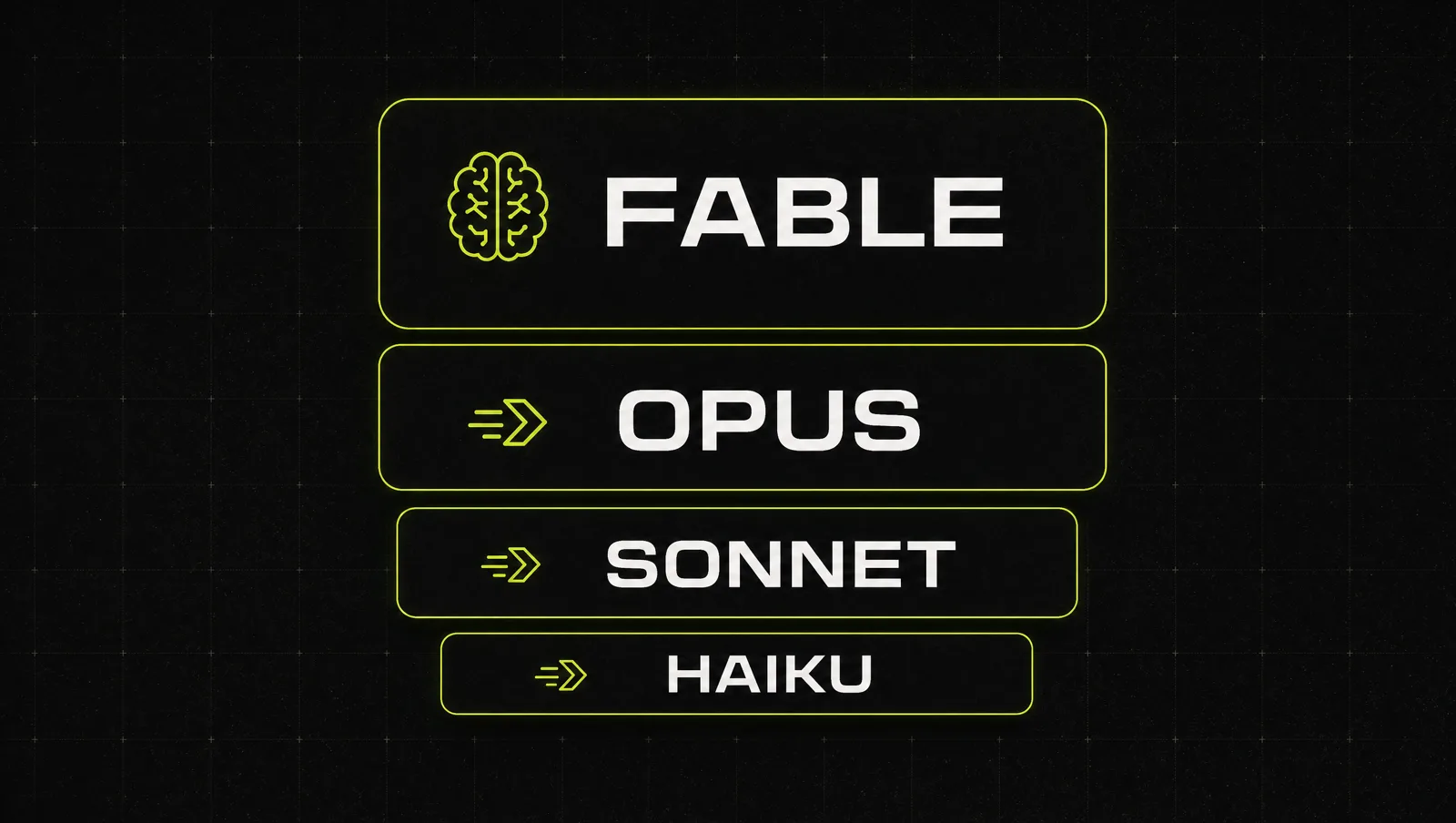
Here is the lineup side by side. API prices are the base rates per million tokens (MTok) from Anthropic's models overview and pricing page, as of September 2026. Prices change, so always check the official page before you budget.
| Model | Best for | Speed | API price (input / output per MTok) | Context window | In the Claude apps |
|---|---|---|---|---|---|
| Claude Fable 5.1 | Hours long agent sessions, deep research, analysis carried through to a finished document | Slower | $10 / $50 | 1M tokens | Included on Max and premium Team and Enterprise seats; on Pro via usage credits |
| Claude Opus 5.5 | Long-running agentic coding, large refactors, complex knowledge work | Moderate | $4 / $20 | 1M tokens | Pro, Max, Team, Enterprise |
| Claude Sonnet 5.5 | Everyday coding, data analysis, content, documents and slides | Fast | $2 / $10 | 1M tokens | All plans, including Free |
| Claude Haiku 4.5 | Real-time replies, high volume processing, sub-agent tasks | Fastest | $1 / $5 | 200K tokens | All plans, including Free |
A few details matter for founders:
- Fable 5.1 is the top of the range. Anthropic calls it its most capable model open to all customers (Anthropic). In the apps it draws down your limits faster than other models, and you can use up to 50% of your weekly limit on Fable models where it is included (Claude Help Center).
- Opus 5.5 is the new default starting point. Anthropic says it performs at the level of Fable 5.1 on most work and costs 40% less to run than the previous Opus model (Anthropic). In Claude Code, the default model on Pro, Max, Team, Enterprise and the API is Opus 5.5 (Claude Code Docs).
- Sonnet 5.5 is the workhorse. Anthropic calls it the faster, lower cost complement to Opus 5.5 (Anthropic).
- Haiku 4.5 is the speed tier. Smallest context window and an older knowledge cutoff, but the cheapest and fastest option.
On the API, batch requests are 50% off and cached prompt reads cost a fraction of the base input price (Anthropic). For the full breakdown, see our guides to Claude API pricing and Claude plans and pricing.
Claude Opus vs Sonnet: which one for which job?
Anthropic's model selection guide puts it simply: Opus 5.5 is for complex agentic coding and enterprise work, such as multi-hour coding agents, large refactors and computer use. Sonnet 5.5 is for everyday coding, data analysis, content creation and agentic tool use, where speed matters.
In practice, use Opus 5.5 when a task has many steps, a lot of context, or a costly mistake at the end. Use Sonnet 5.5 when the task is well defined and you run it often, because it answers faster and costs half as much per token at the API rates above. In the apps, the trade is about usage limits instead of dollars, and Fable models use up your limit fastest.
How to choose the right Claude model in 5 steps
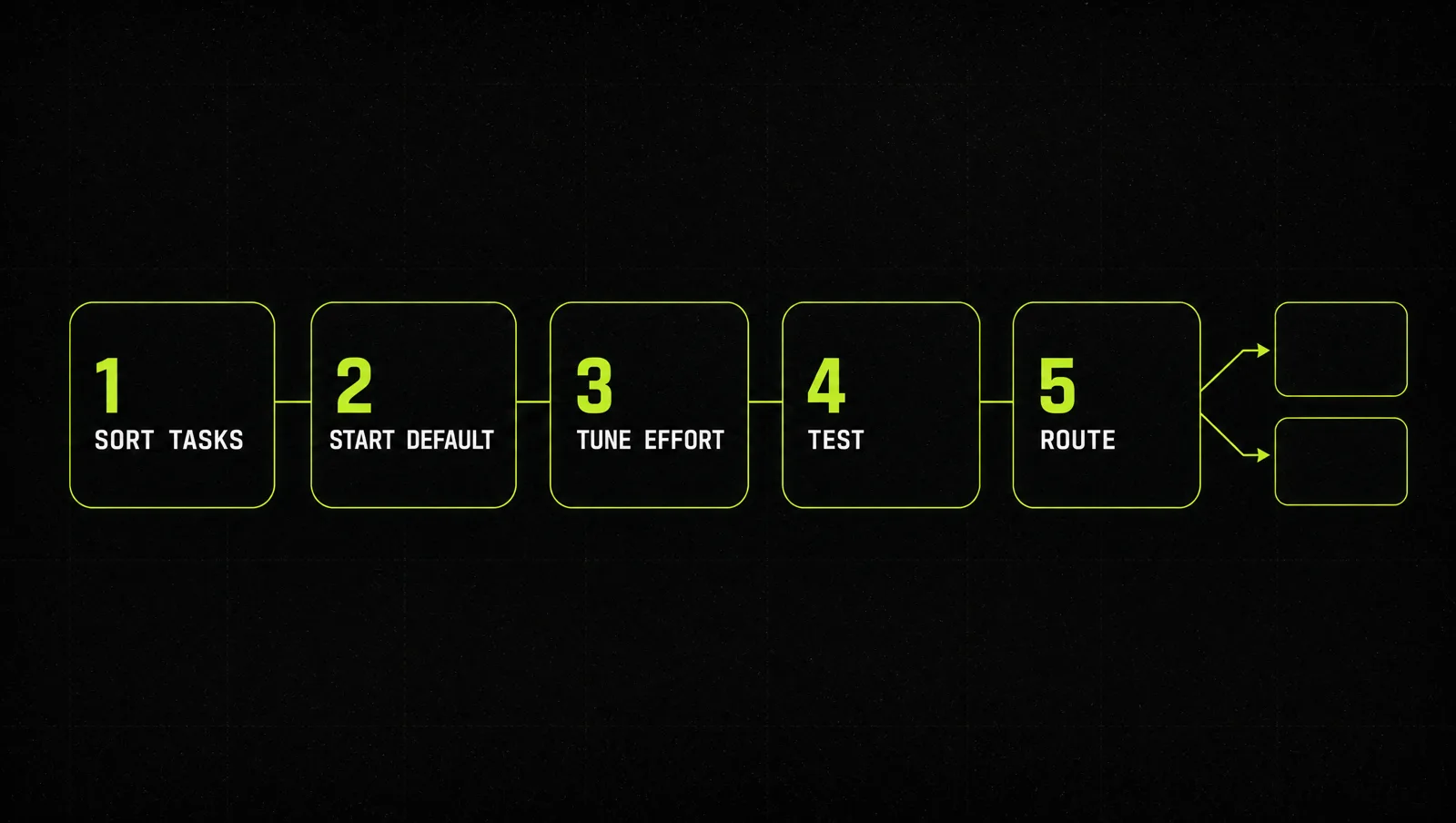
Step 1: Sort your tasks by stakes and volume
List the ten things your team uses Claude for most. Mark each on two axes: how bad is a wrong answer, and how often does it run. A board memo is high stakes, low volume. Tagging 500 support emails a day is low stakes, high volume. Model choice is really a choice about which tasks deserve the expensive thinking.
Step 2: Start from Anthropic's documented default
Anthropic describes two starting points (Anthropic). Capability first: begin with Opus 5.5 for complex reasoning, nuanced work and advanced coding, then optimize down. Efficiency first: begin with Haiku 4.5 for prototypes, tight latency needs, cost sensitive work and high volume, simple tasks, then upgrade only where you hit a gap. Put your high stakes tasks on the first path and your high volume tasks on the second.
Step 3: Tune effort before you switch models
Several models have an effort setting that trades intelligence for speed and cost. Anthropic says tuning effort is often a better lever than switching models (Anthropic). Opus 5.5 defaults to medium effort on the API, and Fable 5.1 and Sonnet 5.5 default to high (Anthropic). Only move up to Fable 5.1 if Opus 5.5 at its highest effort levels still falls short on your task.
Step 4: Test on your real work, not on benchmarks
Anthropic calls a good evaluation set the most important step when deciding to change models (Anthropic). You don't need a lab. Take ten real examples of one task, run them through two models, and compare accuracy, quality and how each handles the awkward cases. Then weigh the difference against the cost. If the cheaper model gets nine out of ten right and the misses are easy to catch, it wins.
Step 5: Combine models instead of crowning one
The strongest setups pair a lower cost model with a frontier model, so most of the work is billed at the lower rate. Anthropic documents two patterns: an executor that hands hard decisions to an advisor, and an orchestrator that delegates bulk work to cheaper workers (Anthropic). In Claude Code you can switch with the /model command, and the opusplan setting plans with Opus and executes with Sonnet (Claude Code Docs). Review your routing once a month, because the lineup keeps moving.
A real case: Quantium and Optiver on Claude Opus 5.5

At the Opus 5.5 launch on September 22, 2026, Anthropic published results from early testers (Anthropic). Two show why model choice is a business decision.
- Quantium: Harley Barnes, Executive Manager for AI Technology, reported that a complex coding task that previously took 38 prompts over four days came in at 11 prompts over three hours, with more production ready outputs and less rework.
- Optiver, which tests models on real engineering and trading desk work: Noyan Tokgozoglu, Global Head of AI Engineering, reported that on its agentic coding tasks, Opus 5.5 matched the previous Opus model's quality in about half the turns, time and output tokens, cutting the cost of that workload by 40 to 50%.
- Anthropic's own positioning backs this up: Opus 5.5 performs at the level of Fable 5.1 on most work and costs 40% less to run than its predecessor (Anthropic).
Look at it through the system:
- Real work: both tested on high stakes production tasks, not toy prompts (Steps 1 and 4).
- Cost per result, not cost per token: Optiver's saving came from fewer turns and fewer output tokens, not a cheaper price tag. A model that finishes in fewer steps can cost less even at a higher rate.
- Time is the hidden cost: for Quantium, going from four days to three hours matters more than any token bill.
The lesson: the right model is the one that gets the job done in the fewest rounds, and you only find that out by testing it on your own work.
Three use cases
The examples below are illustrative, not real clients. They show how the same five steps play out in different businesses.
Use case 1: Marketing agency
Strategy decks and quarterly reviews go to Opus 5.5, because a weak argument in front of a client costs the account. Ad copy variations and social posts run on Sonnet 5.5, because the team writes dozens a day and reviews them anyway. The expensive model only touches the work that decides renewals.
Use case 2: E-commerce brand with a busy inbox
Haiku 4.5 sorts hundreds of emails a day and flags urgent ones in real time. Sonnet 5.5 drafts replies for shipping, returns and sizing. Only complaints and refund disputes go to Opus 5.5 with the full order history. Cheap workers for the bulk, a strong model for the judgment calls.
Use case 3: Solo SaaS founder
Daily bug fixes in Claude Code run on the default Opus 5.5. A large database migration over several sessions gets Fable 5.1, where the plan includes it. Quick scripts go to Sonnet 5.5. For features inside the product, the founder calls the Claude API and tests Haiku 4.5 first, upgrading only where the evals demand it.
How we run this with Claude
We run model choice as a short routine, not a gut feeling. Here are the two prompts we start with. Fill in the brackets.
Prompt 1: map your tasks to models
You are an AI operations advisor. The current Claude models are Claude Fable 5.1 (demanding reasoning, long-horizon agentic work), Claude Opus 5.5 (long-running agentic coding and knowledge work), Claude Sonnet 5.5 (fast everyday work) and Claude Haiku 4.5 (fastest, high volume). Here are the tasks my team uses Claude for: [LIST OF TASKS, ONE PER LINE, WITH HOW OFTEN EACH RUNS]. For each task, rate the cost of a wrong answer (low, medium, high) and the volume (low, medium, high), then recommend one model and one fallback model. Finish with the three tasks where I am most likely overpaying.Prompt 2: run a mini model test
Make it yours · 0/5 filled
I want to test whether [CHEAPER MODEL] is good enough for [TASK] compared with [STRONGER MODEL]. Here are 10 real examples of the input: [PASTE EXAMPLES]. Here is what a great output looks like: [DESCRIBE OR PASTE ONE GREAT OUTPUT]. Build me a simple scoring sheet with 4 criteria and a 1 to 5 scale, tell me which edge cases to watch for, and give me a clear rule for when the cheaper model is good enough.Run the second prompt, score both models side by side, and you have a decision in under an hour. The judgment call is which tasks deserve the stronger model at all.
Where most people get stuck
Knowing the four models takes five minutes. Running on the right mix takes a few rounds of testing, and most founders stop after one. The usual reasons:
- They crown one model. Everything runs on the biggest model, the limits run out, and they blame Claude instead of the routing.
- They trust benchmarks over their own work. A leaderboard score says nothing about your client reports, your inbox or your codebase.
- They never revisit the choice. The lineup changed twice in September 2026 alone, and a routing plan from three months ago is already out of date.
That is exactly the gap the Inner Circle is built for: the playbooks to run it, a new playbook every week, and founders building their own Claude systems next to you.